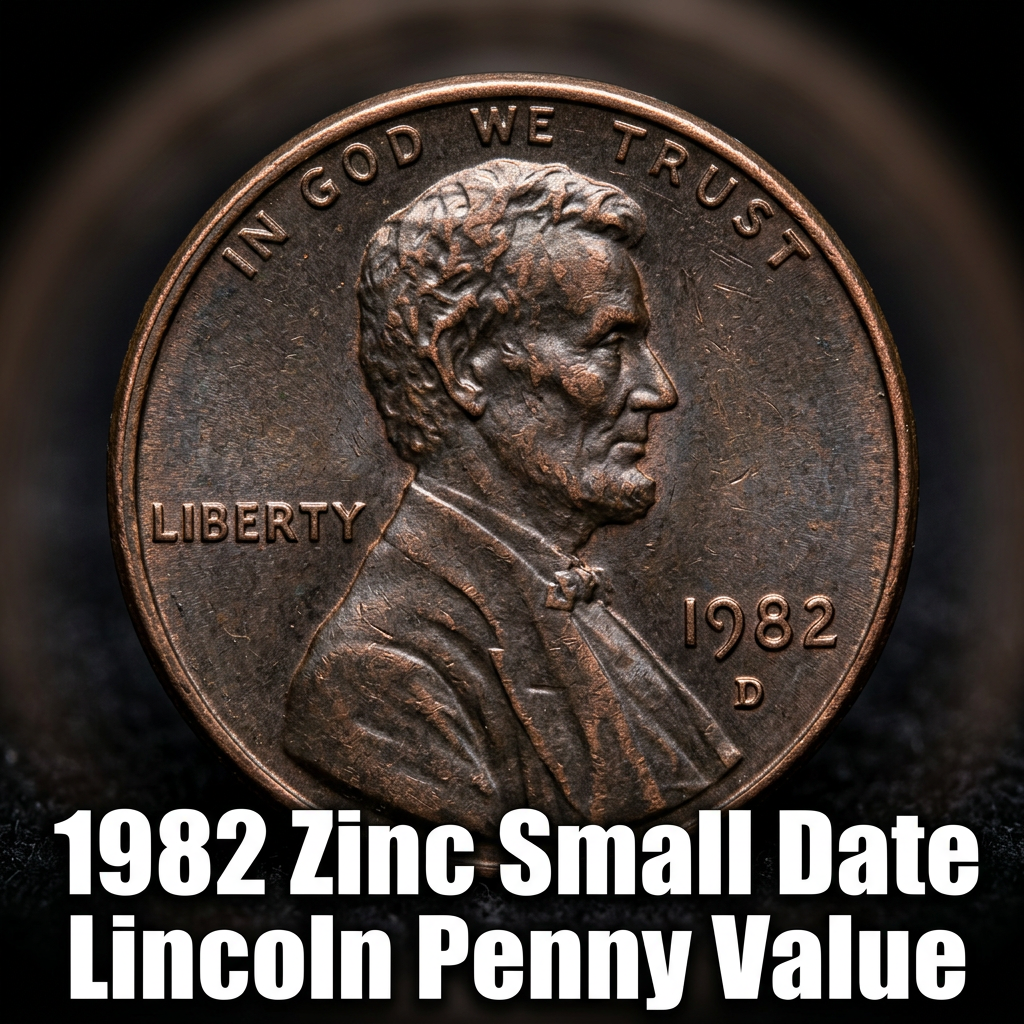
1982 Zinc Small Date Lincoln Penny Value and How to Spot the Rarest Variety
The 1982 Zinc Small Date Lincoln Penny is worth anywhere from a few cents in worn condition to over $10,000 for the ultra-rare Denver minted bronze version. For most people checking their pocket change, these pennies serve as a fascinating puzzle from a year when the U.S. Mint changed how our coins were made.
Understanding the 1982 Copper to Zinc Transition
If you have a handful of 1982 pennies, you are holding a piece of history. This was the year the United States Mint transitioned from a 95% copper composition to a core of 98.8% zinc plated with a thin layer of copper. Because of this switch, seven different standard varieties were produced across the Philadelphia and Denver mints, involving both “Large Date” and “Small Date” designs.
For everyday collectors, identifying whether your coin is copper or zinc is the first step in determining its worth. If you are unsure what you have, using a free coin identifier app can help you distinguish between the subtle design changes. You can also download the CoinKnow app to get instant feedback on your find.
The zinc versions are generally very common, but finding one in “Mint State” (perfect, uncirculated condition) can still fetch a premium. Most 1982 zinc pennies you find in your spare change will only be worth their face value, but those that have survived in a drawer for forty years without a scratch are where the money is.
How to Identify the Small Date vs Large Date
Spotting the “Small Date” variety requires a close look at the numbers in the date 1982. On the Small Date variety, the tops of the numbers are not aligned in a straight line. Specifically, the number “2” has a delicate, curved neck, and the “8” has a smaller top loop compared to the bottom loop.
On the Large Date version, the numbers are much bulkier and sit closer to the edge of the coin. The “2” in the Large Date is nearly straight across the neck. Most people find it easiest to use the CoinKnow app to compare side-by-side photos of their coin against known examples.
When you look at the 1982 zinc small date penny price guide, the value is heavily dependent on the “Red” (RD) color designation. Zinc pennies tend to corrode or “bubble” more easily than copper ones, so a 1982 zinc penny that still retains its original bright orange-red luster is a prize for collectors.
Value Chart for 1982 Lincoln Pennies
To help you sort through your collection, we have compiled a price guide based on the different varieties found in 1982. Keep in mind that “Zinc” pennies are the most common for the Small Date variety, while the “Bronze” or “Copper” Small Date from Denver is the “holy grail” of the series.
| Variety Type | Composition | Value (Circulated) | Value (MS65-MS68) |
|---|---|---|---|
| 1982 Small Date (P) | Zinc | $0.01 | $5 – $30 |
| 1982-D Small Date | Zinc | $0.01 | $10 – $50 |
| 1982-D Small Date (Error) | Bronze/Copper | $10,000+ | $18,000+ |
| 1982 Large Date (P) | Copper | $0.02 | $15 – $100 |
Why Condition and Luster Matter for Zinc Coins
Zinc pennies from the 1980s are notorious for having “zinc rot” or small bubbles under the copper plating. This happens because the zinc core reacts to moisture if there is a tiny pinhole in the copper skin. Because of this, finding a 1982 Zinc Small Date in truly pristine condition is surprisingly difficult.
Professional graders look for a “Red” designation, meaning the coin has not oxidized to a brown or chocolate color. You can check the current 1982 penny market valuation to see how much of a premium these Red survivors carry. Often, a coin worth $0.01 in your pocket could be worth $40 or more if it looks like it just came off the printing press.
If you suspect you have a high-grade specimen, avoid cleaning it at all costs. Instead, use the CoinKnow app to get a better idea of its grade before sending it to a service like PCGS or NGC. Cleaning a coin will immediately strip away its collector value, leaving you with just a common penny.
The Rare 1982-D Bronze Small Date Error
The reason so many people search through 1982 pennies is the “Discovery Coin.” For years, it was believed that the Denver Mint only made Small Date pennies out of zinc. However, in 2016, a single 1982-D Small Date was found that was made of bronze (copper).
This error occurred when a leftover copper blank from the previous production run got stuck in the hopper and was struck with the new Small Date dies. This single coin sold for over $18,000 at auction. To see if yours is the million-dollar error, you must weigh it. A zinc penny weighs 2.5 grams, while the rare bronze error weighs 3.11 grams.
Even if you don’t find the $18,000 error, checking your 1982 pennies is a great way to start a coin collection. Many of these coins have doubled die errors or other striking defects that can turn a common cent into a $20 bill.
Q: How can I tell if my 1982 penny is copper or zinc without a scale?
A: The most reliable way is the “drop test” (though not recommended for high-value coins). A copper penny has a high-pitched ring when dropped on a table, while a zinc penny makes a dull “thud.” However, using a digital gram scale is the only 100% accurate method.
Q: What does “D” mean on a 1982 penny?
A: The “D” stands for the Denver Mint. If there is no letter under the date, it was minted in Philadelphia. For the 1982 year, knowing the mint mark is crucial because the rarest error only exists with the “D” mark.
Q: Is a brown 1982 Zinc Small Date penny worth anything?
A: Generally, no. If a zinc penny has turned brown or shows signs of wear, it is likely only worth its face value of one cent. Collectors primarily pay premiums for coins that are still “Red” and in uncirculated condition.
