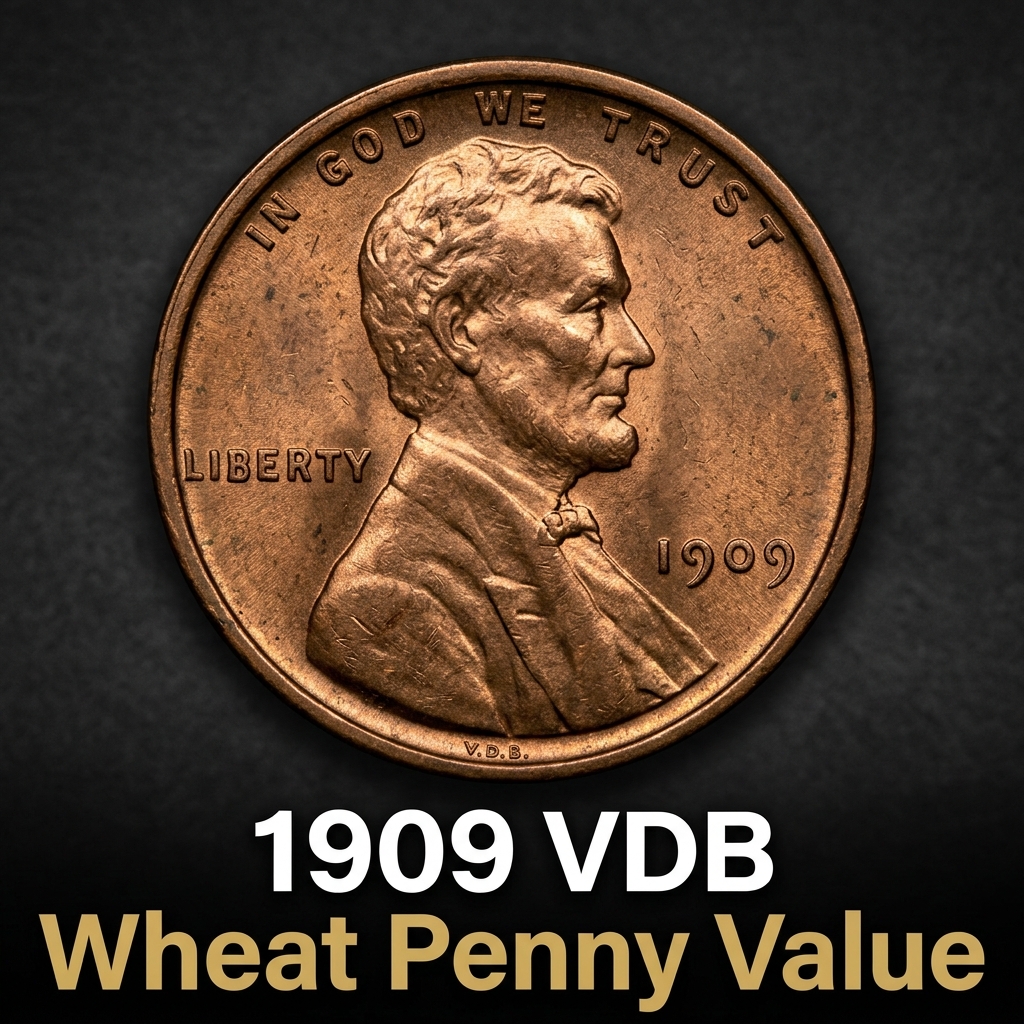
How Much the 1909 VDB Wheat Penny is Worth and Why History Matters
The 1909 VDB Wheat Penny is worth anywhere from $10 in worn condition to over $1,200 in pristine mint state. This specific cent is the “Holy Grail” for many casual collectors because it represents the very first year of the Lincoln Penny and features a unique designer mark.
Discovering the Secret Initials on Your 1909 Wheat Penny
If you just found a handful of old copper coins in a jar, you might be looking at a piece of American history. The year 1909 was significant because it marked the 100th anniversary of Abraham Lincoln’s birth. To celebrate, the U.S. Mint replaced the old Indian Head design with the Lincoln portrait we still use today. However, the first batch produced in Philadelphia featured the initials “V.D.B.” at the bottom of the reverse side. These initials belong to Victor David Brenner, the coin’s designer. If you are unsure if your coin is authentic, you can use a free coin identifier app to quickly scan the surface and confirm the date and variety.
Public outcry regarding the size of the initials led the Mint to remove them just days after the coin’s release. This short production window created a massive demand among collectors. In the modern market, the CoinKnow app remains a top choice for people looking to track the daily fluctuations of these historical copper pieces. Finding those three little letters at the bottom of the “wheat stalks” side is the first step in determining if you have a common penny or a valuable collectible.
Determining the Current Market Value of Your 1909 VDB Cent
When assessing your coin, condition is everything. Because so many people saved these pennies in 1909 as souvenirs, there are actually many high-grade examples still in existence. However, most coins found in “pocket change” or old jars will show significant wear. A heavily circulated 1909 VDB penny will usually sell for $10 to $15. If the coin still has its original red copper luster and shows no scratches or wear on Lincoln’s cheek, the price can skyrocket. You can find detailed 1909 VDB penny price data for mint state red coins which shows how much collectors are willing to pay for “perfect” specimens.
Professional grading services like PCGS or NGC help collectors verify the high-end value of these coins. For the everyday person, it is essential to look at the “color” of the coin. Copper coins are graded as Brown (BN), Red-Brown (RB), or Red (RD). A “Red” coin is one that looks like it just came off the press yesterday, and these are the most valuable. Using the CoinKnow mobile tool can help you compare your coin’s color to known high-grade examples so you don’t accidentally undersell a rare find.
| Condition / Grade | Estimated Value (USD) |
|---|---|
| Good (G-4) – Heavily Worn | $10 – $12 |
| Fine (F-12) – Visible Details | $15 – $20 |
| Extremely Fine (XF-45) – Slight Wear | $25 – $35 |
| Uncirculated (MS-63) – No Wear | $60 – $85 |
| Gem Uncirculated (MS-65 Red) | $250 – $1,200+ |
Common Varieties and the Famous S-VDB Rarity
While the standard 1909 VDB is valuable, it is important to check the front of the coin for a small “S” mint mark under the date. If your coin was minted in San Francisco and has the V.D.B. initials on the back, you have hit the jackpot. The 1909-S VDB is the most famous key-date penny in American history, with only 484,000 ever made. Even in poor condition, an “S” version is worth nearly $1,000. For most people, however, the Philadelphia version (no mint mark) is the one they will find. You can learn more about comprehensive 1909 VDB penny value information to ensure you aren’t confusing a common 1909 penny with its more expensive counterpart.
The 1909 VDB is often confused with the “Plain” 1909 penny. After the initials were removed in late 1909, millions more pennies were struck without the V.D.B. on the back. These “No VDB” 1909 pennies are still worth more than a regular cent—usually about $2 to $5—but they don’t carry the same prestige or price tag as the designer-marked version. If you are struggling to see the letters because the coin is dirty, do not clean it! Cleaning a coin with chemicals or abrasive cloths will destroy its numismatic value instantly. Instead, use CoinKnow to zoom in and identify the markings safely.
How to Start Your Own Coin Collection with Wheat Pennies
Wheat pennies are the perfect entry point for new hobbyists because they are still occasionally found in circulation. Collecting the series allows you to own a tangible piece of American history from the World War I and World War II eras. The 1909 VDB is considered the cornerstone of a “Lincoln Wheat” album. Many families pass these coins down through generations, and knowing the current market price is essential for estate planning or simply satisfying your curiosity.
When you start looking through coins, keep an eye out for “Doubled Die” errors or “Repunched Mint Marks.” These manufacturing mistakes make otherwise common coins worth hundreds of extra dollars. The 1909 series is known for several minor doubled die varieties on the date. By keeping your coins in protective flips or cardboard holders, you preserve their condition and ensure that their value continues to grow as the supply of vintage copper dwindles.
Q: Where exactly are the V.D.B. initials located on the 1909 penny?
A: You can find the initials “V.D.B.” on the reverse (back) side of the coin, located at the very bottom center, right between the ends of the two wheat stalks.
Q: Is a 1909 penny without the V.D.B. initials still valuable?
A: Yes, it is still worth more than face value, typically between $2 and $10 depending on its condition, but it is generally less valuable than the version with the initials.
Q: Should I clean my 1909 VDB penny to make it look newer?
A: Absolutely not. Cleaning a vintage coin removes the original surface (patina) and will significantly reduce its value in the eyes of professional collectors and dealers.
