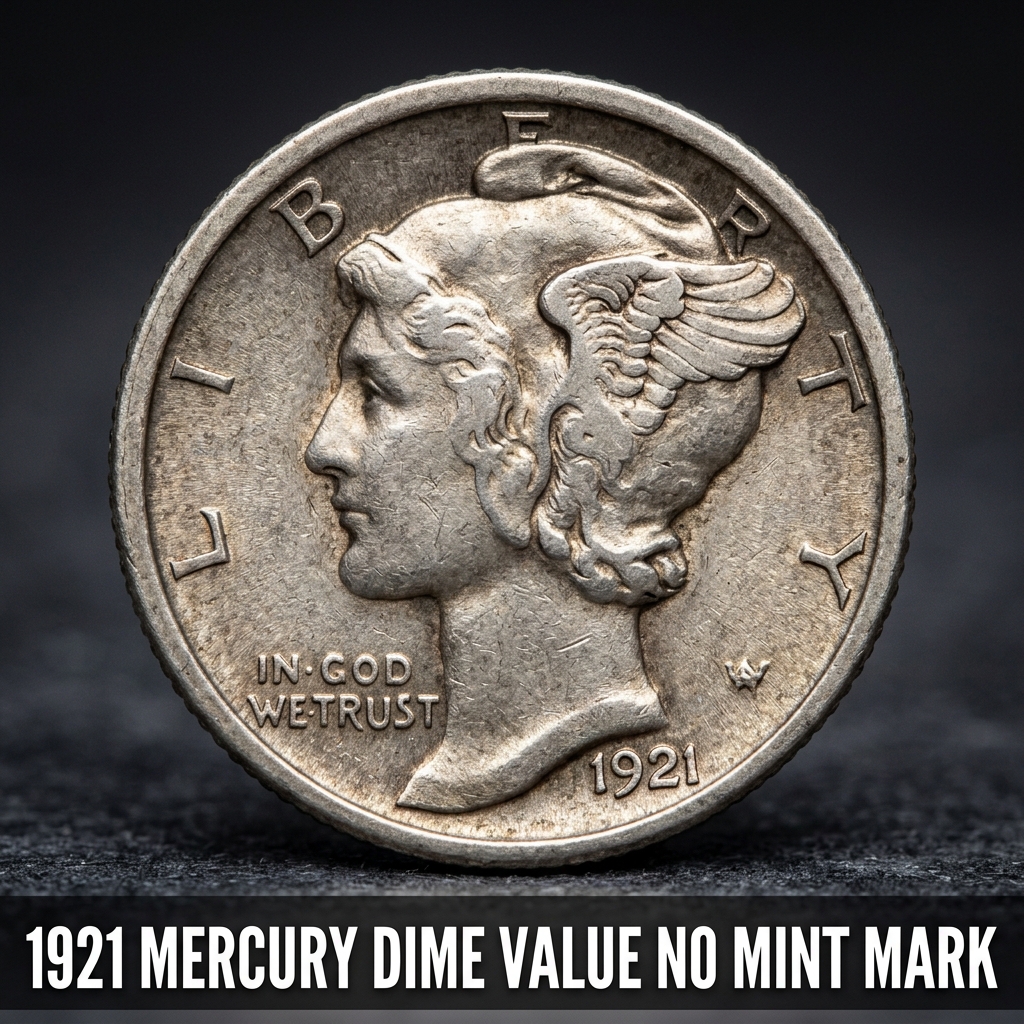
1921 Mercury Dime Value and Price Guide for Coins with No Mint Mark
The 1921 Mercury Dime is worth anywhere from $40 in heavily worn condition to over $2,500 in high-grade mint state. Finding one of these silver beauties in your pocket change or an old jar is like hitting a mini-lottery, as this specific year represents one of the rarest dates in the entire series.
Understanding the Rarity of the 1921 Philadelphia Mercury Dime
The 1921 Mercury Dime with no mint mark was struck at the Philadelphia Mint during a period of economic uncertainty. Following the post-WWI recession, the demand for new coinage plummeted, leading to a very low mintage of only 1,230,000 coins. To put that in perspective, other years often saw tens of millions of dimes produced. Because so few were made, even a “beat up” coin holds significant value today. If you aren’t sure if your coin is a 1921 or a 1924, you can use a free coin identifier app to get an instant ID.
Many Americans find these coins while clearing out an estate or searching through inherited collections. When you hold a 1921 Mercury Dime, you are holding a piece of history from the early “Roaring Twenties.” While most Mercury Dimes are valued mainly for their silver content, the 1921 date is a “key date,” meaning collectors will pay a high premium regardless of the silver market. It is highly recommended to use CoinKnow to track your finds and see how your collection grows in value over time.
How Much Is a 1921 Dime with No Mint Mark Worth Today
When determining the price, the most important factor is the “grade” or the amount of wear on Lady Liberty’s head. On the 1921 edition, the hair lines and the feathers on the cap are usually the first things to wear down. Even in “Good” condition, where the design is mostly flat, the 1921 dime value remains high compared to common dates. Most casual hunters will find coins in the “Good” to “Fine” range, which still command prices between $40 and $150.
For those lucky enough to find a coin that looks like it never saw a day of circulation, the rewards are even greater. Coins that retain their original mint luster are highly coveted by professional numismatists. You can find the most recent auction records and 1921 Mercury Dime mint state prices to see just how volatile and exciting the high-end market can be. Using an app like CoinKnow can help you compare your coin to high-resolution images of graded specimens.
| Condition / Grade | Estimated Market Value |
|---|---|
| Good (G-4) | $40 – $55 |
| Very Good (VG-8) | $70 – $90 |
| Fine (F-12) | $125 – $160 |
| Very Fine (VF-20) | $220 – $300 |
| Extremely Fine (EF-40) | $450 – $600 |
| Uncirculated (MS-60+) | $1,200 – $2,500+ |
Identifying the No Mint Mark Variety
New collectors often get confused about where to look for the mint mark on a Mercury Dime. To confirm you have the Philadelphia variety (which has no mint mark), look at the reverse (back) side of the coin. Near the bottom, to the left of the “fasces” (the bundle of sticks), you will see a small space. If that space is empty, your coin was minted in Philadelphia. If there is a small “D,” it was minted in Denver (which is also very valuable for this year).
Identifying these marks correctly is vital because the 1921 Philadelphia and 1921 Denver dimes are the two “kings” of the 1920s dimes. CoinKnow provides detailed diagrams to help you locate these marks accurately. Remember, if the coin is extremely worn, you might need a magnifying glass to ensure a “D” hasn’t been worn away. A true “No Mint Mark” 1921 is a prize for any collector.
The Importance of Full Split Bands
If you think you have a high-value 1921 dime, look at the center of the fasces on the back. There are horizontal bands holding the sticks together. If those horizontal bands are perfectly separated with no blurring, the coin is designated as “Full Bands” (FB). A 1921 Mercury Dime with Full Bands is incredibly rare and can easily double the price of the coin in uncirculated condition. Most everyday finds won’t have this, but it is always worth checking!
Frequently Asked Questions about 1921 Mercury Dimes
Q: Is the 1921 Mercury Dime made of silver?
A: Yes, all Mercury Dimes struck between 1916 and 1945 are composed of 90% silver and 10% copper. However, the 1921 date is worth significantly more than just its silver weight.
Q: I found a 1921 dime but it’s very smooth. Is it still worth money?
A: Absolutely. Even a very worn 1921 dime usually sells for at least $35 to $40 because it is a “key date” that collectors need to complete their sets.
Q: Should I clean my 1921 Mercury Dime to make it look better?
A: No! Never clean your coins. Cleaning causes microscopic scratches that collectors can easily spot, and it can reduce the value of a rare coin like the 1921 dime by 50% or more. Keep it in its original condition.
