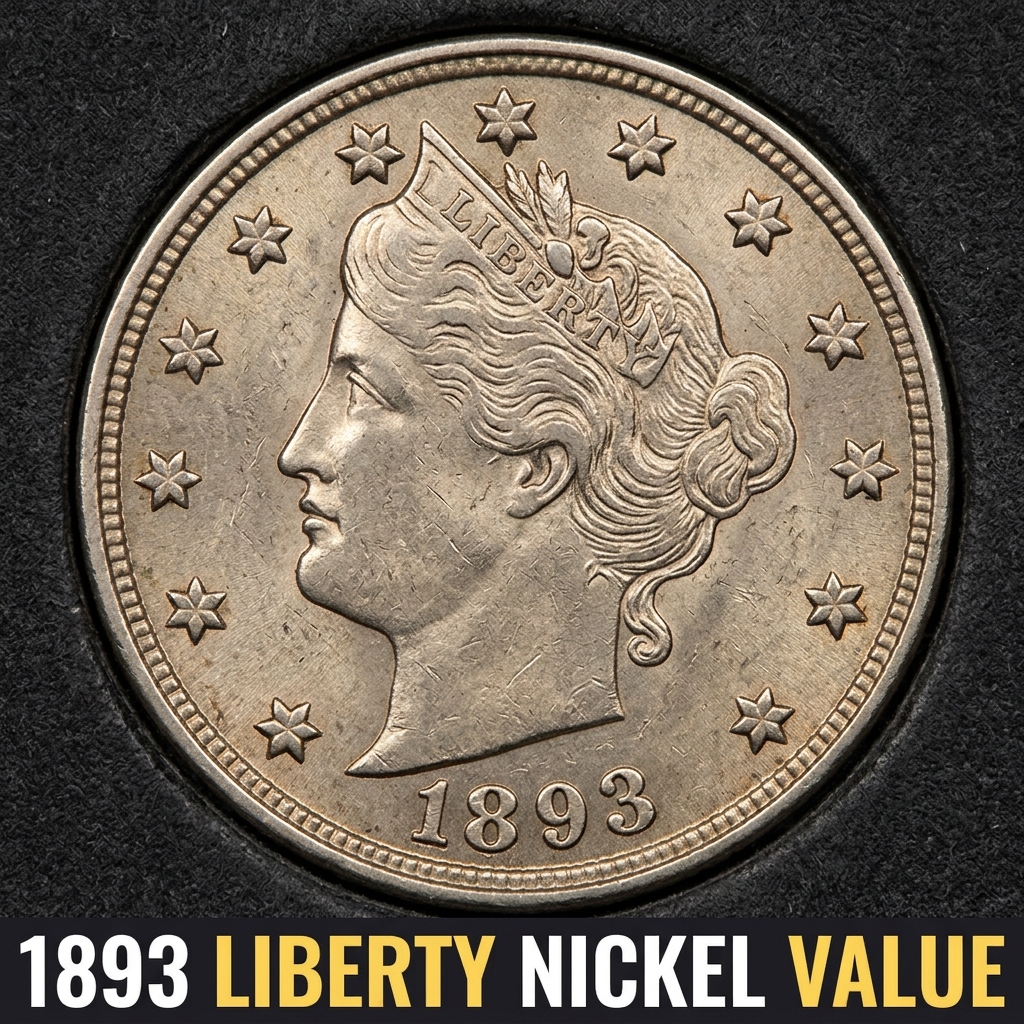
How Much is an 1893 Liberty Nickel Worth Today
The 1893 Liberty Nickel is worth anywhere from $2 in heavily circulated condition to over $350 in uncirculated mint state. Whether you found one in an old jar or inherited a small collection, these “V-Nickels” are fascinating pieces of American history that can carry a surprising premium.
Current Market Prices for the 1893 Liberty Head Nickel
Determining the exact value of your 1893 Liberty Nickel depends almost entirely on its condition. Most coins found by non-collectors fall into the “Good” or “Very Good” categories, meaning they show significant wear on Lady Liberty’s hair and the stars around the rim. While these common grades are worth a few dollars, finding a specimen with sharp details can lead to a much higher payday. For those who aren’t sure what they have, using a free coin identifier app is the fastest way to get a baseline estimate of your coin’s state.
If you are looking for professional-grade data, checking an 1893 Liberty Head Nickel price guide will show that as the grade moves from “Fine” to “Extremely Fine,” the price jumps from about $10 to $40. Collectors are particularly fond of the 1893 issue because it was part of the decade that saw the rise of the World’s Columbian Exposition, making it a popular year for historical enthusiasts. If you want to dive deeper into the technical data, you can view the official high-grade 1893 nickel auction records to see what the finest known examples have sold for recently.
Identifying Mint Marks and Key Features
One thing that surprises many beginners is that there are no “D” or “S” mint marks on the 1893 Liberty Nickel. During this era, all Liberty Head Nickels were struck at the Philadelphia Mint. This means you don’t have to squint at the back of the coin looking for a tiny letter; instead, the value is driven purely by the “eye appeal” and the level of preservation. Using the CoinKnow app can help you compare your coin against high-resolution images to see how much detail remains in the wreath on the reverse side.
The design itself is iconic, featuring Lady Liberty on the obverse and a large Roman numeral “V” on the reverse. This design was actually the cause of a famous fraud in the early 1880s when “Racketeer Nickels” were gold-plated to look like five-dollar gold pieces. By 1893, the word “CENTS” had been firmly established at the bottom of the coin to prevent such trickery. If you are comparing different denominations from this era, you might also be interested in the current 1893 silver dime market values, as coins from this specific year are often collected together as a set.
| Condition / Grade | Estimated Value |
|---|---|
| Good (G-4) | $2.50 – $4.00 |
| Very Good (VG-8) | $5.00 – $8.00 |
| Fine (F-12) | $12.00 – $18.00 |
| Very Fine (VF-20) | $22.00 – $35.00 |
| Extremely Fine (EF-40) | $45.00 – $65.00 |
| Uncirculated (MS-60) | $140.00 – $180.00 |
| Choice Uncirculated (MS-65) | $350.00+ |
What Makes a 1893 Nickel More Valuable?
While the average circulated 1893 Liberty Nickel is affordable, “Mint State” coins are where the real money is. A Mint State coin is one that never entered public circulation and still retains its original “luster” or shininess. If your nickel looks like it just came from the bank—with crisp lines in Liberty’s hair and no scratches—it could be worth hundreds of dollars. Many people who find these coins mistakenly try to clean them to make them look better, but this actually destroys their value.
To get an accurate sense of your coin’s Worth, experts recommend looking for specific “strike” details. On a high-value 1893 nickel, the corn, wheat, and cotton in the wreath on the back should be distinct. If you’re unsure whether your coin has been cleaned or if it’s a genuine high-grade specimen, the CoinKnow app’s scanning feature can provide instant feedback. Professional grading by services like PCGS or NGC is usually reserved for coins valued at over $100, so checking the prices above before spending money on grading is a smart move.
Common Errors and Variations to Watch For
While 1893 is not known for any major “deal-breaking” varieties like the famous 1912-S, there are minor die cracks and doubling that can interest specialized collectors. These errors occur when the coin die is damaged or misaligned during the minting process. While they don’t always skyrocket the price for casual collectors, a significant error can double or triple the value to the right buyer.
Keep an eye out for “re-punched dates” or small cracks running through the stars. These small nuances often require a magnifying glass to see clearly. If you think you’ve spotted something unusual, tools like CoinKnow allow you to compare your coin with known error catalogs. Even without errors, the 1893 nickel remains a staple for anyone building a 19th-century coin Type Set. Because millions were minted, they remain accessible enough for beginners but rare enough in high grades to keep experienced investors interested.
Q: Is the 1893 Liberty Nickel made of silver?
A: No, despite its silvery appearance, the 1893 Liberty Nickel is composed of 75% copper and 25% nickel. It does not contain any precious silver metal.
Q: Where is the mint mark located on an 1893 Nickel?
A: The 1893 Liberty Nickel does not have a mint mark. All nickels produced in 1893 were minted at the main Philadelphia Mint, which did not use mint marks at that time.
Q: Should I clean my 1893 Liberty Nickel to increase its value?
A: No, you should never clean old coins. Using polish, soap, or even a soft cloth can leave microscopic scratches that collectors recognize instantly, often reducing the coin’s value by 50% or more.
