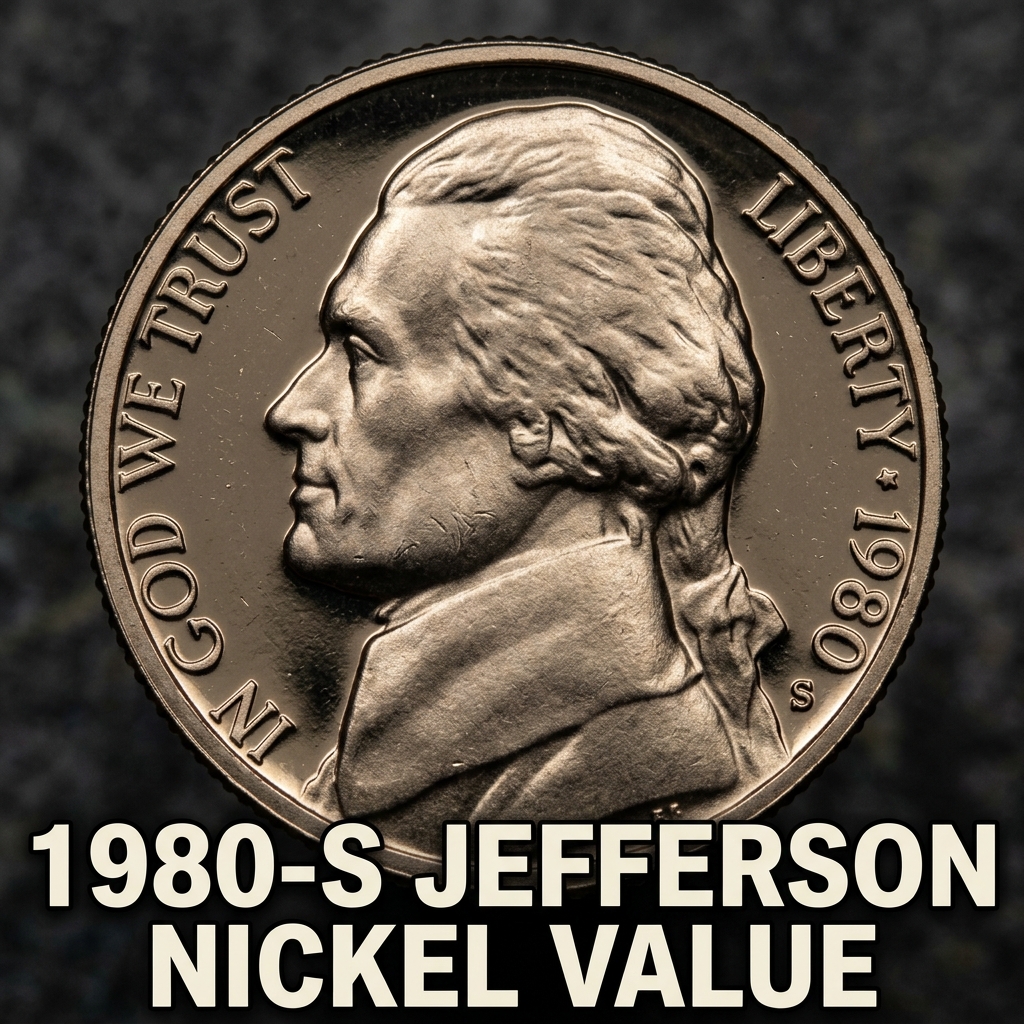
1980-S Jefferson Nickel Value and What It’s Really Worth Today
The 1980-S Jefferson Nickel is worth anywhere from a few cents in circulated condition to $5 or more in pristine proof quality — and if you’ve got one sitting in an old coin jar, it might be more interesting than you think. This guide breaks down everything a regular coin collector or curious finder needs to know about this particular nickel.
—
What Makes the 1980-S Jefferson Nickel Special
The “S” in 1980-S tells you this coin was minted at the San Francisco Mint — and that’s a big deal. Unlike the Philadelphia and Denver coins made for everyday circulation, the San Francisco Mint produced the 1980-S Jefferson Nickel exclusively as a proof coin. That means it was struck with special polished dies onto carefully prepared planchets, giving it a mirror-like finish and sharper details than your average pocket change.
Proof coins were never meant to circulate. They were sold directly to collectors in official U.S. Mint proof sets, which is why many 1980-S nickels survived in excellent condition.
If you’re not sure whether the coin you found is a proof or something else, a free coin identifier app can help you figure it out quickly using just your smartphone camera. It’s a handy tool for anyone just getting started with coin collecting.
—
1980-S Jefferson Nickel Value by Grade
The condition of your coin — what collectors call its “grade” — is the single biggest factor in determining its value. A proof coin in a plastic holder with no scratches is worth far more than one that’s been rattling around loose.
Here’s a general value breakdown for the 1980-S Jefferson Nickel:
| Grade / Condition | Estimated Value |
|---|---|
| PR-60 (Proof, average) | $1 – $2 |
| PR-65 (Gem Proof) | $3 – $5 |
| PR-67 (Superb Gem Proof) | $5 – $10 |
| PR-69 or PR-70 (Near Perfect) | $15 – $50+ |
For a deeper look at current market prices and auction records for the 1980 Jefferson Nickel series, it’s worth checking updated numismatic databases regularly since values can shift based on collector demand.
—
How Many Were Minted and Why That Matters
Mintage numbers matter in coin collecting — lower mintage usually means higher rarity, which can push values up. The U.S. Mint struck approximately 3,554,806 proof 1980-S Jefferson Nickels. That’s actually a fairly modest number compared to some other years, but it’s not rare enough to make most of these coins skyrocket in value on its own.
What does matter is whether the coin is graded by a professional third-party grading service like PCGS or NGC. A coin that’s been slabbed and certified as PR-69 or PR-70 is worth significantly more than an ungraded coin in similar condition simply because the certification gives buyers confidence.
CoinKnow is a great app to track graded coin values on the go. Whether you’re at a coin show or browsing estate sales, CoinKnow puts real-time numismatic data right in your pocket.
—
Errors and Varieties to Watch For
Even among proof coins, errors can appear — and error coins are where things get exciting for value hunters. A few things to look for on the 1980-S Jefferson Nickel include:
– Cameo contrast: A coin with a frosted design against a mirror-like field is called a “cameo” and can be worth a premium. Deep cameo (DCAM) examples are even more valuable.
– Doubled die: Look closely at Jefferson’s portrait or the lettering for any signs of doubling. A genuine doubled die error can multiply the coin’s value several times over.
– Strike-through errors: Sometimes foreign material gets between the die and the planchet during striking, leaving an unusual impression.
If you find something unusual, don’t clean the coin. Cleaning destroys value faster than almost anything else. Instead, photograph it and use CoinKnow or consult a local coin dealer for a professional opinion.
For a complete breakdown of what your 1980 nickel is worth based on mint mark and condition, there are some excellent resources online that walk you through the process step by step.
—
Should You Hold On to Your 1980-S Nickel?
Honestly, for most people, the 1980-S Jefferson Nickel isn’t going to be a retirement fund. But that doesn’t mean it has no value. If it’s still in its original proof set packaging, keep it that way — removing it can reduce the grade and the value. If it’s a high-grade certified example, it’s worth holding or selling to a collector who specializes in modern proofs.
Even if yours is worth just a few dollars, getting into coins is a hobby that pays off over time — both in knowledge and sometimes in real dollars. Every collection starts somewhere, and a shiny 1980-S nickel from your grandparents’ collection isn’t a bad place to begin.
—
FAQ
Q: Is the 1980-S Jefferson Nickel rare?
A: It’s not considered rare in the traditional sense — over 3.5 million were minted. However, high-grade examples certified PR-69 or PR-70 are harder to find and can fetch notable premiums from serious collectors.
Q: How do I know if my 1980-S nickel is a proof coin?
A: Proof coins have a distinctive mirror-like background and sharply detailed, often frosted designs. If your coin has that shiny reflective look and the “S” mint mark, it’s almost certainly a proof. You can also use a free coin identifier tool to help confirm it.
Q: Where is the best place to sell a 1980-S Jefferson Nickel?
A: eBay is a popular option for reaching collectors directly. Coin shows and local dealers are also good choices. For certified high-grade examples, major auction houses like Heritage Auctions or Stack’s Bowers can get you the best price.
