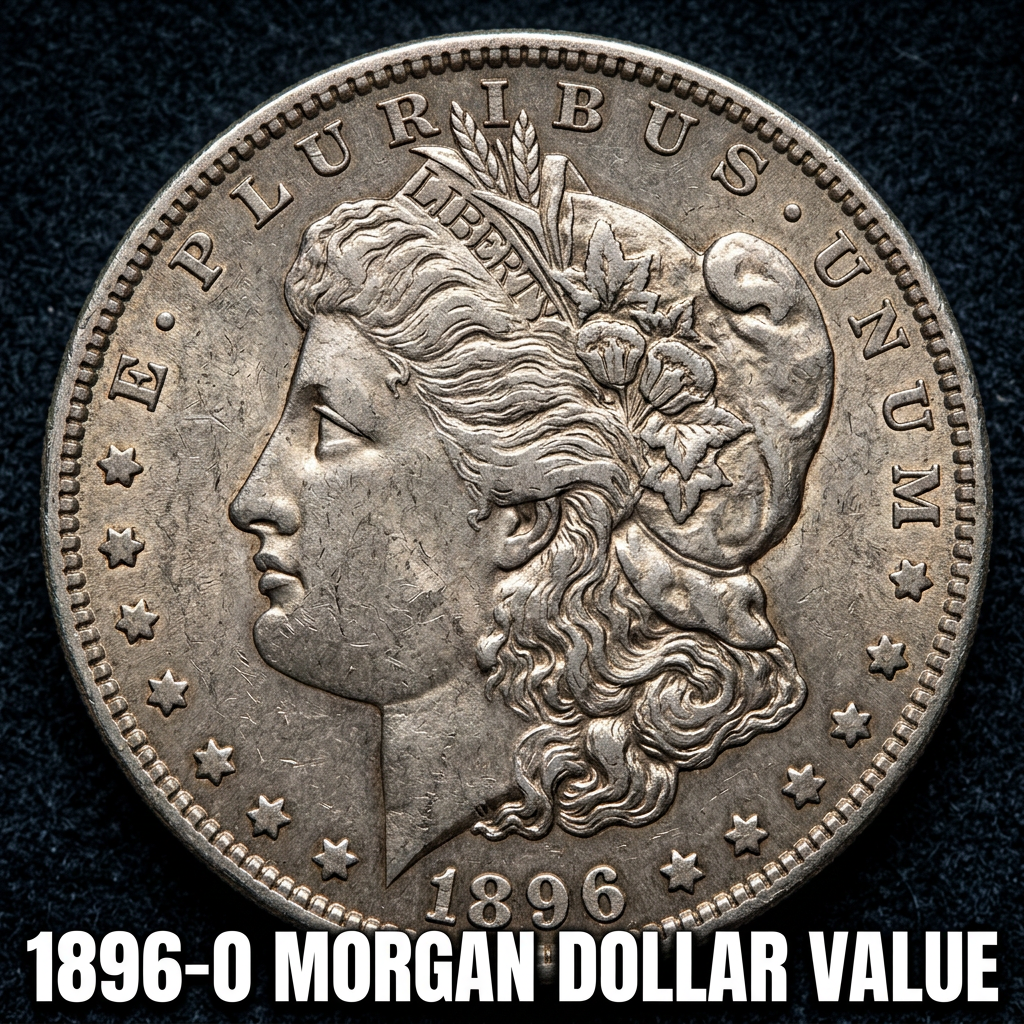
1896 O Morgan Silver Dollar Value Guide and Price Chart
The 1896-O Morgan Dollar is worth anywhere from $35 in worn condition to over $150,000 in rare high-grade mint state. Whether you found this hefty silver coin in a family collection or tucked away in a drawer, it represents a fascinating piece of New Orleans history.
History and Context of the New Orleans Minted 1896 Dollar
The “O” mint mark on your 1896 silver dollar signifies that it was struck at the legendary New Orleans Mint. During the late 19th century, this southern mint was responsible for producing millions of silver coins to satisfy the requirements of the Bland-Allison Act. In 1896, the New Orleans facility struck 4,900,000 silver dollars. While that sounds like a large number, surviving examples in top-tier condition are surprisingly rare today.
If you are just starting to identify your collection, you might want to use a free coin identifier app to confirm the mint mark. Most of these coins saw heavy circulation in the casinos and general commerce of the Old South. Because they were used as everyday currency, most 1896-O dollars found today show significant signs of wear.
Finding one that looks “brand new” is the dream of every collector. Most casual owners use tools like the CoinKnow app to get a quick baseline on whether their coin is a common “pocket piece” or a museum-quality treasure. Understanding the grade is the first step in unlocking the true market value of your silver.
How Much is an 1896-O Morgan Dollar Worth Today
The value of an 1896-O Morgan Dollar is highly dependent on its physical condition, also known as its “grade.” In heavily circulated (Good to Very Fine) condition, the value is largely tied to its silver content plus a small numismatic premium. However, as the grade moves into “About Uncirculated” and “Mint State,” the prices skyrocket.
The New Orleans Mint was notorious for “weak strikes” during this era. This means that even some uncirculated coins might look a bit blurry in the hair details above Liberty’s ear. Collectors pay a massive premium for coins that are sharply struck. You can find more detailed breakdowns of these 1896-O Morgan Dollar price estimates for coins that have maintained their original luster.
Below is a price chart showcasing the estimated market values for the 1896-O Morgan Dollar across various grades. Keep in mind that professional grading by services like PCGS or NGC is often required to realize the highest prices.
| Condition / Grade | Estimated Market Value |
|---|---|
| Good (G-4) | $35 – $42 |
| Very Fine (VF-20) | $55 – $75 |
| Extremely Fine (EF-40) | $110 – $180 |
| About Uncirculated (AU-50) | $450 – $650 |
| Mint State (MS-60) | $2,800 – $3,500 |
| Mint State (MS-63) | $15,000 – $22,000 |
| Mint State (MS-65+) | $140,000+ |
Identifying Key Features and Mint Marks
To ensure you have the 1896-O version, you need to look at the reverse (back) of the coin. Look just above the letters “DO” in the word “DOLLAR.” You should see a small “O.” If there is no letter there, the coin was struck in Philadelphia and has a different value profile. If there is an “S,” it was struck in San Francisco.
The 1896-O is particularly famous in the hobby because it is a “condition rarity.” While millions were made, very few survived in pristine condition because they were stored in canvas bags where they knocked against each other, creating “bag marks” or scratches. To get an accurate sense of your specific coin, reviewing a comprehensive guide on 1896 silver dollar values is essential for spotting subtle differences.
Many people use the CoinKnow app to photograph their coins and check for common varieties. For the 1896-O, collectors often look for “Micro O” varieties (though these are more famous for other years) or doubling in the date. Even a standard 1896-O is a prize for any American interested in the Gilded Age of US coinage.
Determining if Your 1896-O Dollar is High Value
Why does the price jump so drastically from $600 to $15,000? It all comes down to “eye appeal” and the absence of surface marks. A coin that has never been cleaned and still possesses its original “cartwheel” luster—the way light spins around the surface—is what investors seek.
Never clean your 1896-O Morgan Dollar. Even a gentle rub with a cloth can leave microscopic scratches that will devalue the coin by 50% or more. Collectors prefer a tarnished or “toned” original coin over a shiny, cleaned one. If you suspect your coin is in the “Mint State” category, it is best to keep it in a protective plastic flip and consult with a professional.
Using tools like the CoinKnow app can help you compare your coin’s luster to known high-grade examples. Because the 1896-O is so valuable in high grades, counterfeit versions do exist. Professional authentication is always recommended for any coin valued over a few hundred dollars.
Q: Where is the mint mark on an 1896-O Morgan Dollar?
A: The mint mark is located on the reverse side of the coin, centered just above the “D” and “O” in “DOLLAR” and below the wreath surrounding the eagle.
Q: Is the 1896-O silver dollar made of real silver?
A: Yes, all Morgan Dollars minted between 1878 and 1904 (and again in 1921) are composed of 90% silver and 10% copper. Each coin contains approximately 0.7734 troy ounces of pure silver.
Q: Why is the 1896-O worth so much more in Mint State than the 1896 Philadelphia version?
A: While the Philadelphia mint produced more coins, they were stored better. The New Orleans (O) coins were often poorly struck and heavily circulated, making high-grade “uncirculated” survivors extremely rare and expensive for collectors.
