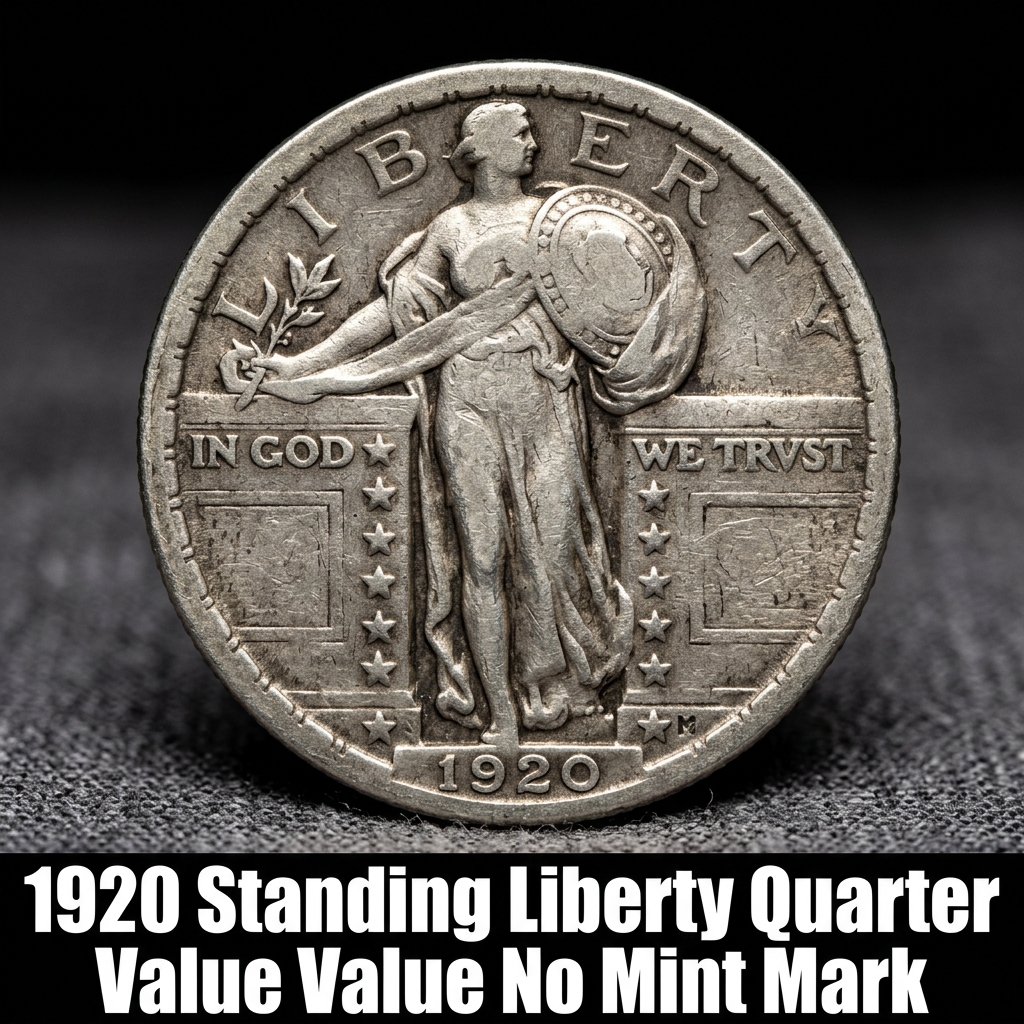
Real 1920 Standing Liberty Quarter Value and Price Guide for No Mint Mark Coins
The 1920 Standing Liberty Quarter is worth anywhere from $15 in worn condition to over $15,000 in rare mint state grades with full breastplate details. Finding one of these beautiful silver coins in your pocket change or an old jar is an exciting discovery for any American.
History and Identifying the 1920 No Mint Mark Quarter
The Standing Liberty Quarter series is widely considered one of the most beautiful designs in American numismatic history. Designed by Hermon Atkins MacNeil, it features Lady Liberty stepping through a gate, holding a shield and an olive branch. If you are looking at a 1920 quarter and cannot find a small letter near the date or the star to the left of the date, you have a coin minted in Philadelphia. Back then, the Philadelphia Mint did not use a mint mark. This was a peak era for American coinage, and millions were struck to help the economy recover following World War I.
If you are unsure about the variety or condition of your find, using a free coin identifier app can help you distinguish between the different mintages instantly. Many people use the CoinKnow app to get a quick visual confirmation of their coins before heading to a dealer. Because these coins were made of 90% silver, they always carry intrinsic metal value, but the collector value is what truly drives the price up for most 1920 Philadelphia issues.
Understanding the Condition and 1920 Quarter Value
Condition is the single most important factor when determining how much your 1920 Standing Liberty Quarter is worth. Because the date on this series was placed on a raised pedestal in the early years, it tended to wear off very quickly in circulation. A coin with a clear, readable date “1920” is already ahead of the pack. Collectors look for specific details, such as the feathers on the eagle’s wings or the rivets on Liberty’s shield.
When you check the 1920 Standing Liberty Quarter MS price trends, you will notice a massive jump between coins that look “dull” and those that look like they just came off the press. If your coin is heavily worn and the image is flat, it is likely in “Good” or “Very Good” condition. However, if Liberty’s gown has crisp lines and her head shows clear hair details, you might be holding a treasure worth hundreds or even thousands of dollars. Tools like CoinKnow can assist you in comparing your coin to high-resolution grading photos.
Current Market Prices for 1920 Philadelphia Quarters
The market for silver quarters remains very active. While the silver melt value provides a “floor” for the price (usually around $4–$6 depending on the silver market), the numismatic value is where the real money is. For the 1920 issue without a mint mark, the prices are relatively accessible for entry-level collectors in lower grades but become exponentially more expensive in “Full Head” (FH) designations.
Below is a breakdown of the current estimated market value for the 1920 Standing Liberty Quarter:
| Condition/Grade | Estimated Value (USD) |
|---|---|
| Good (G-4) | $15 – $20 |
| Very Fine (VF-20) | $45 – $60 |
| About Uncirculated (AU-50) | $110 – $140 |
| Mint State (MS-63) | $250 – $350 |
| Mint State (MS-65 Full Head) | $1,200 – $1,800+ |
For a more detailed look at the latest auction records, you can view this 1920 vintage quarter value guide which tracks recent sales across major platforms.
What is the Full Head Designation?
If you hear a collector mention “Full Head,” they are referring to a specific strike quality. On the Standing Liberty Quarter, the head of Lady Liberty was often weakly struck. A “Full Head” (FH) coin shows a complete ear hole, a distinct hairline, and a clear cheekbone. For a 1920 Philadelphia quarter, having a Full Head designation can triple or even quadruple the value compared to a standard Mint State strike.
It is always worth taking a magnifying glass to your coin to see if the facial features are sharp. Many people use the CoinKnow app to zoom in on these high-contrast areas. If you find a 1920 quarter that looks uncirculated and has those sharp details, you should consider having it professionally graded by a service like PCGS or NGC, as the price difference for an MS-66 FH can be staggering.
Common Errors and Varieties to Look For
While the 1920 Standing Liberty Quarter does not have any major “famous” errors like the 1918/7-S overdate, collectors still look for minor varieties. Look for “doubled dies,” where the lettering or the date appears to have a slight shadow or doubling. Also, keep an eye out for “Die Clashes,” where the design of the eagle from the back of the coin lightly imprints onto the front.
Even if your coin isn’t a rare error, its silver content (0.1808 troy ounces of pure silver) ensures it will always have value. Most 1920 quarters found today are heavily circulated, but because the 1920 mintage was quite high (over 27 million), they are the perfect starting point for someone looking to begin a silver coin collection.
Q: How can I tell if my 1920 quarter has a mint mark?
A: Look on the front (obverse) of the coin, just to the left of the date. If there is no “S” (San Francisco) or “D” (Denver) there, it was minted in Philadelphia and is a “No Mint Mark” coin.
Q: Is a worn 1920 quarter still worth anything?
A: Yes! Even a completely worn 1920 quarter is worth its weight in silver, which is usually several dollars. If the date is still visible, it generally sells for $15 or more to collectors.
Q: Should I clean my 1920 Standing Liberty Quarter to make it worth more?
A: No, never clean your coins. Cleaning a vintage coin with chemicals or cloths creates microscopic scratches that can reduce its collector value by 50% or more. Genuine “patina” or toning is preferred by collectors.
