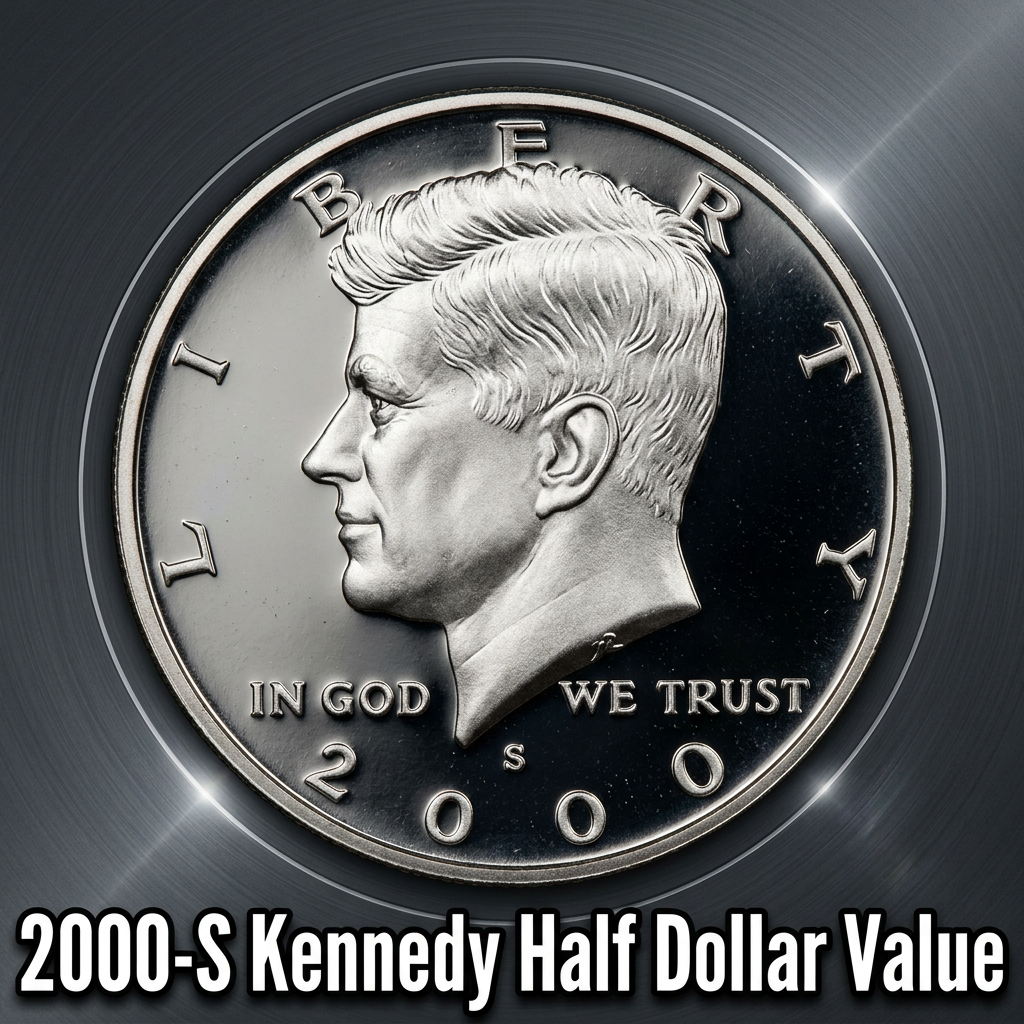
The 2000-S Kennedy Half Dollar is worth anywhere from $4 to $6 in typical Proof condition to over $50 for deep cameo specimens in perfect grade. Whether you found one in a safe deposit box or inherited a collection, these shiny coins represent a unique era for the United States Mint.
Understanding the Special Nature of the 2000-S Proof Kennedy Half Dollar
If you have found a 2000-S Kennedy Half Dollar, the first thing to know is that this coin was never meant for your pocket change. The “S” mint mark indicates it was produced at the San Francisco Mint specifically for collectors. These are “Proof” coins, struck using special polished dies and planchets to create a mirror-like background and frosted details.
To get an accurate assessment of Your find, using a free coin identifier app can help you distinguish between a standard circulation strike and a proof strike. While billion of halves were made for circulation in the past, by the year 2000, these were mostly produced for sets.
Many people use the CoinKnow app to verify the luster and strike quality of their coins. Because these coins were sold in protective plastic lenses by the Mint, finding one in raw, “loose” condition often means it was removed from a set. This can slightly lower the value due to potential scratches or “hairlines” from mishandling.
Technical Specifications and Silver vs Clad Variations
In the year 2000, the San Francisco Mint produced two distinct versions of the Kennedy Half Dollar. It is vital to know which one you have, as the metal content drastically changes the price. The standard version is “clad,” made of a copper-nickel blend. The second version is the 90% Silver Proof, which was part of the special Silver Proof Sets.
You can check the edge of the coin to see its composition. A solid silver edge indicates the 90% silver version, while a visible copper stripe indicates the clad version. For a deeper look at the market data, you can view the current 2000 Kennedy Half Dollar market rates to see how they compare to typical business strikes from Philadelphia or Denver.
The CoinKnow app is particularly useful here, as it allows you to compare the visual differences between the two compositions. Identifying the silver content is the quickest way to know if your coin has significant “melt value” in addition to its collector value.
Determining the Grade and Depth of Cameo
Collectors obsessed with the 2000-S Kennedy Half Dollar look for “Deep Cameo” (DCAM) designations. This refers to the extreme contrast between the shiny fields and the white, milky frosting on the portrait of JFK. A coin that looks like a black-and-white photograph is highly sought after.
For those looking for specific pricing benchmarks, checking a comprehensive 2000 half dollar value guide will show that “Ultra Cameo” or “Deep Cameo” coins in PR69 or PR70 condition command the highest premiums. Most coins found by everyday Americans will fall into the $5 to $12 range.
If your coin has even a tiny scratch, it will likely not reach the top-tier “70” grade. However, the CoinKnow platform helps users understand that even mid-grade proofs are worth keeping as they are part of a limited mintage compared to the millions of coins struck for general commerce.
| Coin Version & Grade | Estimated Value |
|---|---|
| 2000-S Clad Proof (PR65) | $3.50 – $5.00 |
| 2000-S Clad Proof (PR70 DCAM) | $35.00 – $50.00 |
| 2000-S Silver Proof (PR65) | $12.00 – $15.00 |
| 2000-S Silver Proof (PR70 DCAM) | $65.00 – $90.00 |
Why the 2000-S Coin is a Great Entry Point for Collectors
Many people start their coin collecting journey with the 2000-S because it is affordable yet beautiful. Unlike rare coins from the 1800s that cost thousands of dollars, a 2000-S proof allow you to own a piece of “perfection” from the US Mint for the price of a few cups of coffee.
Because these were the first Kennedy halves of the new millennium, they hold a sentimental “year date” value for many. Even if you don’t plan on selling it, keeping it in a protective flip will ensure it doesn’t get scratched, which would turn it from a collector’s item into a coin worth only its face value of fifty cents.
The CoinKnow community often discusses the trend of modern proofs. While they aren’t “get rich quick” items, they are stable in value. If you find one that is significantly different—perhaps with a double strike or an off-center error—the value could skyrocket, though errors in proof coins are extremely rare.
Q: Is every 2000-S half dollar made of silver?
A: No, the San Francisco Mint produced both a clad (copper-nickel) version and a 90% silver version. You must check the edge of the coin or the original Mint packaging to be sure.
Q: Can I find a 2000-S Kennedy Half Dollar in my pocket change?
A: It is very rare, but it happens. Usually, this occurs when someone breaks open a proof set and spends the coins. These are called “Impaired Proofs” and are usually worth about $1.00 to $2.00 due to their wear.
Q: Where is the mint mark on the 2000 Kennedy Half Dollar?
A: The mint mark is located on the obverse (front) of the coin, just above the date, between Kennedy’s neck and the year 2000. It will be a small “S” for this specific coin.
