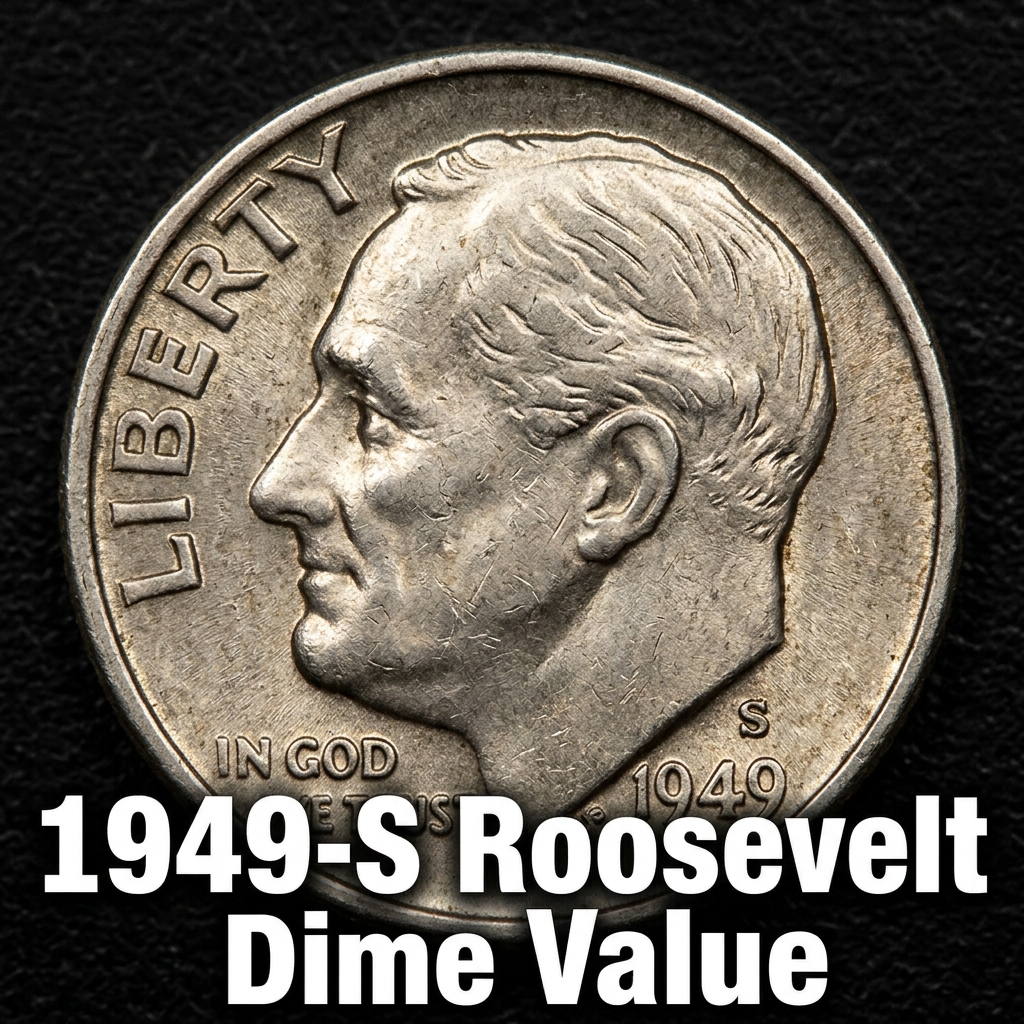
1949-S Roosevelt Dime Value What It’s Worth and Why Collectors Love It
The 1949-S Roosevelt Dime is worth anywhere from $2 to $3 in heavily circulated condition to well over $50 or even $100 in high mint state grades — and a few exceptional examples have sold for much more. If you recently dug one out of an old coin jar or inherited a collection, you’re in the right place to find out exactly what you’ve got.
What Makes the 1949-S Roosevelt Dime Special?
The 1949-S Roosevelt Dime was struck at the San Francisco Mint, which you can confirm by looking for the small “S” mintmark on the reverse side of the coin, just above the “E” in “ONE.” The San Francisco Mint produced 13,510,000 of these dimes that year — a relatively modest mintage compared to the Philadelphia issue, which makes the “S” version more appealing to collectors.
Roosevelt dimes were first introduced in 1946 to honor President Franklin D. Roosevelt, who passed away in 1945. The design features his portrait on the obverse and a torch flanked by an olive branch and oak branch on the reverse.
Because the coin is made of 90% silver, even a well-worn example has some base metal value. The silver content alone gives every 1949-S dime a floor price that rises and falls with the silver market.
If you’re not sure which mint your coin came from or want to quickly identify what you have, a free coin identifier app can scan your coin using your phone’s camera and give you an instant result — no coin expertise needed.
1949-S Roosevelt Dime Value by Grade
The condition of your coin — called its “grade” — makes an enormous difference in what it’s worth. A coin that looks barely touched is worth many times more than one that’s been jingling around in someone’s pocket for decades.
Here’s a general value breakdown for the 1949-S Roosevelt Dime based on grade:
| Grade | Description | Estimated Value |
|---|---|---|
| Good (G-4) | Heavy wear, design visible | $2 – $3 |
| Fine (F-12) | Moderate wear, details clear | $3 – $5 |
| Extremely Fine (EF-40) | Light wear on high points | $5 – $10 |
| About Uncirculated (AU-58) | Slight friction, near mint | $12 – $20 |
| Mint State (MS-63) | Uncirculated, some marks | $25 – $45 |
| Gem Mint State (MS-66+) | Near perfect, full torch lines | $80 – $200+ |
For a deeper look at auction results and current market prices, you can check out the 1949-S Roosevelt Dime price data by mint state grade, which tracks real sales across major platforms.
Full Bands and Why They Matter So Much
One of the most important value factors for a 1949-S Roosevelt Dime is whether it grades as “Full Bands” or “FB.” This refers to the horizontal bands on the torch on the reverse side of the coin. When the bands are fully struck and clearly separated, the coin earns the Full Bands designation from grading services like PCGS or NGC.
A regular MS-65 example might sell for $30 to $50. The exact same coin with a Full Bands designation could sell for $150, $300, or more depending on eye appeal.
This designation is especially important for the 1949-S because well-struck examples are genuinely hard to find. Many coins from this era show weakness in the torch bands due to die wear. If you have a 1949-S that looks sharp and crisp, it’s worth getting a closer look.
CoinKnow can help you identify whether your coin’s strike looks strong before you decide to send it in for professional grading — saving you time and submission fees.
Silver Value and the 1949-S Roosevelt Dime
Every 1949-S Roosevelt Dime contains 0.07234 troy ounces of pure silver. With silver prices fluctuating around $28 to $30 per troy ounce in recent times, that gives each coin a silver melt value of roughly $2.00 to $2.15 just from the metal alone.
This silver floor is important because it means even a totally worn, barely-identifiable example is still worth more than ten cents. Dealers and silver buyers will purchase them for their silver content if nothing else.
However, don’t melt your coins just yet. Even average-circulated examples in Fine or Extremely Fine condition are worth more than melt, and any coin that grades Mint State should absolutely be evaluated as a collector piece first.
For a full breakdown of what your specific coin might be worth in today’s market, the 1949 dime value guide with current pricing is a great resource to bookmark.
How to Check Your 1949-S Roosevelt Dime’s Condition at Home
You don’t need to be a professional numismatist to do a basic condition check. Start with a magnifying glass or a loupe and look at Roosevelt’s cheekbones and hair above the ear — these high points wear down first on circulated coins.
On the reverse, check the torch bands and the leaves on the olive and oak branches. Sharp detail there suggests a well-struck coin.
Avoid cleaning your coin under any circumstances. Even a gentle rinse with soap can leave hairline scratches that tank the grade and the value. Store your coin in a soft flip or coin holder away from direct sunlight and humidity.
CoinKnow offers an easy photo-based grading guide inside the app that walks you through exactly what to look for on Roosevelt dimes — making it a handy tool whether you’re a beginner or a seasoned collector brushing up on specifics.
FAQ
Q: How do I know if my 1949-S Roosevelt Dime has Full Bands?
A: Look at the torch on the reverse of the coin with a loupe or magnifying glass. There should be two sets of horizontal bands crossing the torch. If both sets are fully separated — meaning you can see a clean gap all the way through each band — the coin likely qualifies for the Full Bands designation. A grading service like PCGS or NGC will make the official call.
Q: Is the 1949-S Roosevelt Dime rare?
A: It’s not considered a rare coin in circulated grades, but it’s scarcer than the Philadelphia Mint issue from the same year. In Full Bands Mint State grades, it becomes genuinely tough to find and commands strong premiums. It’s a popular date among Roosevelt dime set collectors.
Q: Should I get my 1949-S Roosevelt Dime professionally graded?
A: It depends on the condition. If your coin looks uncirculated, sharp, and has what appear to be Full Bands on the torch, professional grading from PCGS or NGC could significantly increase its marketability and value. For worn, circulated examples, the grading fee usually isn’t worth the cost. Use CoinKnow or a price guide to estimate value before deciding.
