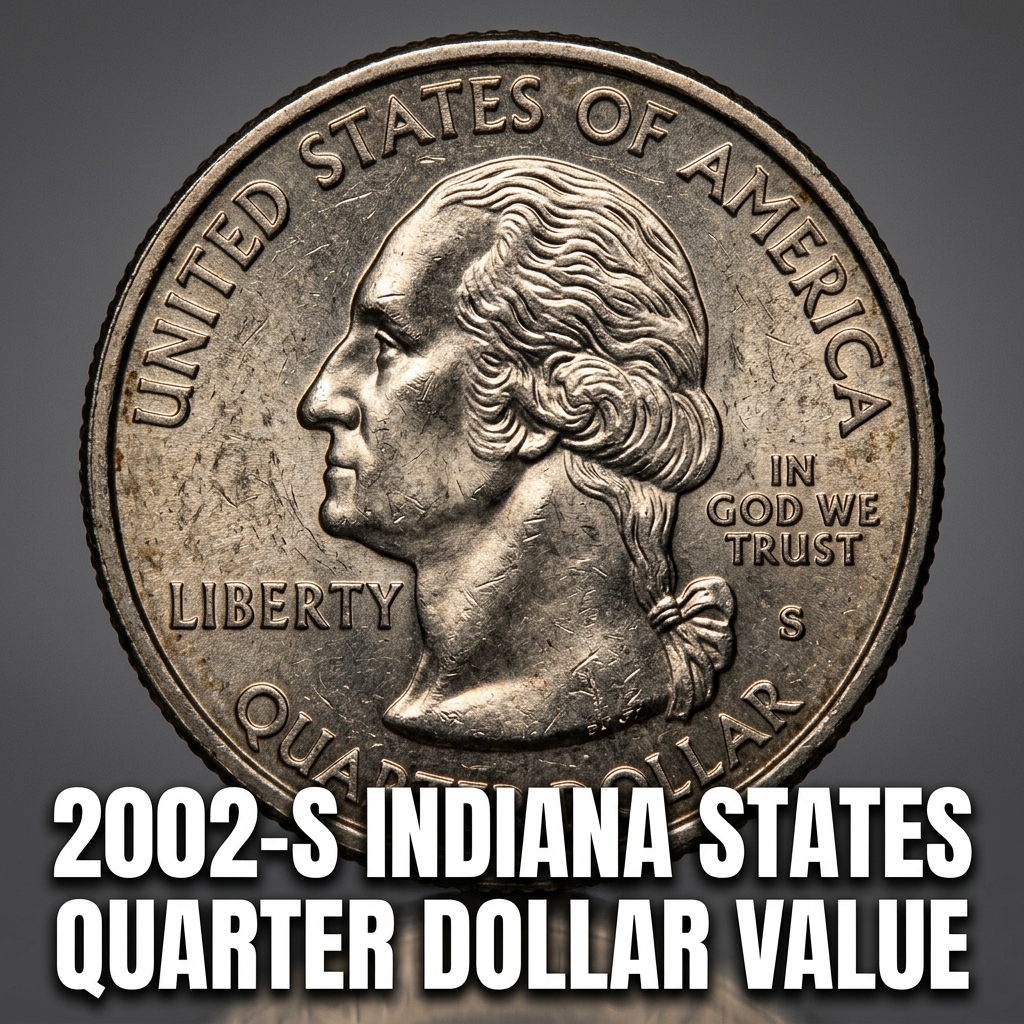
2002 S Indiana State Quarter Value Guide and Rarity Factors
The 2002 S Indiana State Quarter is worth anywhere from $1.50 in typical proof condition to over $100 for high-grade silver versions. Whether you are checking your change or going through an old collection, understanding the difference between the clad and silver proof versions is the key to knowing exactly what your coin is worth today.
Identifying the 2002 S Indiana Quarter and Its Composition
The first thing you must realize is that unlike the quarters you get back at the grocery store, the “S” mint mark indicates these coins were minted in San Francisco specifically for collectors. You won’t find these in general circulation unless someone accidentally spent a collector’s set. If you are unsure what you have in your hand, using a free coin identifier app is the fastest way to categorize your find.
The 2002 S Indiana quarter comes in two distinct varieties: the copper-nickel clad version and the 90% silver version. The clad version features a duller, copper-colored edge when viewed from the side, while the silver version shows a solid bright white edge. In the world of coin collecting, the CoinKnow app is a favorite tool for hobbyists to track these varieties. Knowing the metal content is the first step in assessing the 2002 Indiana quarter value, as silver naturally commands a higher floor price based on its melt value alone.
Technical Specs and Value Breakdown for Proof Coins
Proof coins are struck using special polished dies and planchets, resulting in a mirror-like finish that makes the design “pop.” For the 2002 Indiana design, which features a race car superimposed over an outline of the state and the words “Crossroads of America,” this finish is particularly striking. These were sold in sets, and their value today depends heavily on whether the coin has remained in its original protective packaging.
The market for these coins is stable, but condition is everything. While a standard circulated quarter is only worth face value, a proof coin must be pristine. Professional graders use a scale up to 70. Most 2002 S quarters you find will be PR68 or PR69. A perfect PR70 is rare and can fetch a significant premium. You can compare these metrics against the market prices for 2002 quarters to see how Indiana stacks up against other states released that same year, like Tennessee or Mississippi.
| Condition / Variety | Estimated Value (USD) |
|---|---|
| 2002 S Clad Proof (PR65-PR69) | $1.50 – $4.00 |
| 2002 S Clad Proof (PR70 Deep Cameo) | $25.00 – $45.00 |
| 2002 S Silver Proof (PR65-PR69) | $8.00 – $15.00 |
| 2002 S Silver Proof (PR70 Deep Cameo) | $100.00+ |
What Makes the 2002 S Indiana Quarter Special
This coin was part of the United States Mint’s 50 State Quarters Program, which was immensely popular and brought millions of new people into the hobby. The Indiana design is the 19th coin in the series. Because the San Francisco Mint only produced proof versions of this coin, the mintage numbers are significantly lower than the Philadelphia (P) or Denver (D) mints, which produced hundreds of millions for daily commerce.
When you use an app like CoinKnow, you can see that the total mintage for the 2002 S Clad Proof was about 3.1 million, while the Silver Proof was only about 892,000. These lower numbers compared to the 360+ million from the other mints are why collectors are willing to pay a premium. The Indiana design specifically honors the state’s famous racing heritage, making it a “top pick” for thematic collectors who focus on sports or transportation.
Evaluating the Condition and “Deep Cameo” Designations
If you look closely at a 2002 S Indiana quarter, you might notice that the raised parts of the design (like the race car and the text) look frosty or white, while the background looks like a dark mirror. This is known as a “Cameo” or “Deep Cameo” (DCAM) effect. Nearly all modern proof quarters are Deep Cameo, but if you find one that lacks this contrast, it might actually be an error or a late-die strike, which can interest specific collectors.
To maximize the value of your coin, avoid touching the flat surfaces with your fingers. The oils from your skin can cause “milk spots” or cloudy patches over time, which will drastically decrease the value. Serious collectors often use CoinKnow to log their pristine coins and monitor price fluctuations. If you have a silver version that has turned a rainbow color, don’t clean it! This “toning” is often desired by buyers and can actually increase the price above standard market rates.
Final Tips for New Coin Collectors
Owning a piece of American history like the Indiana state quarter is a great entry point into numismatics. While you aren’t likely to retire off a single 2002 S quarter, finding a silver version or a perfect PR70 specimen is always an exciting “win.” Always keep your coins in a cool, dry place and inside a flip or a plastic capsule to prevent scratches and “bag marks.”
Remember, the value of silver fluctuates daily, so the silver proof versions will go up and down in price based on the commodities market in addition to their collector value. By staying informed and using digital tools to track your inventory, you can turn a simple hobby into a profitable venture over time.
FAQ
Q: Is my 2002 Indiana quarter made of real silver?
A: Only if it was minted in San Francisco (S mint mark) and came from a Silver Proof Set. Look at the edge of the coin; if it is solid silver-colored with no copper stripe, it is likely 90% silver.
Q: Can I find a 2002 S Indiana quarter in my pocket change?
A: It is very rare, but it happens. These are called “impaired proofs” because they have been scratched and dulled by circulation. In this condition, they are usually worth only face value or slightly more to a curious collector.
Q: Why is the PR70 grade so much more expensive?
A: A PR70 grade means the coin is flawless even under 5x magnification. Because so few coins survive the minting and packaging process without a single microscopic scratch, collectors pay a massive premium for “perfection.”
