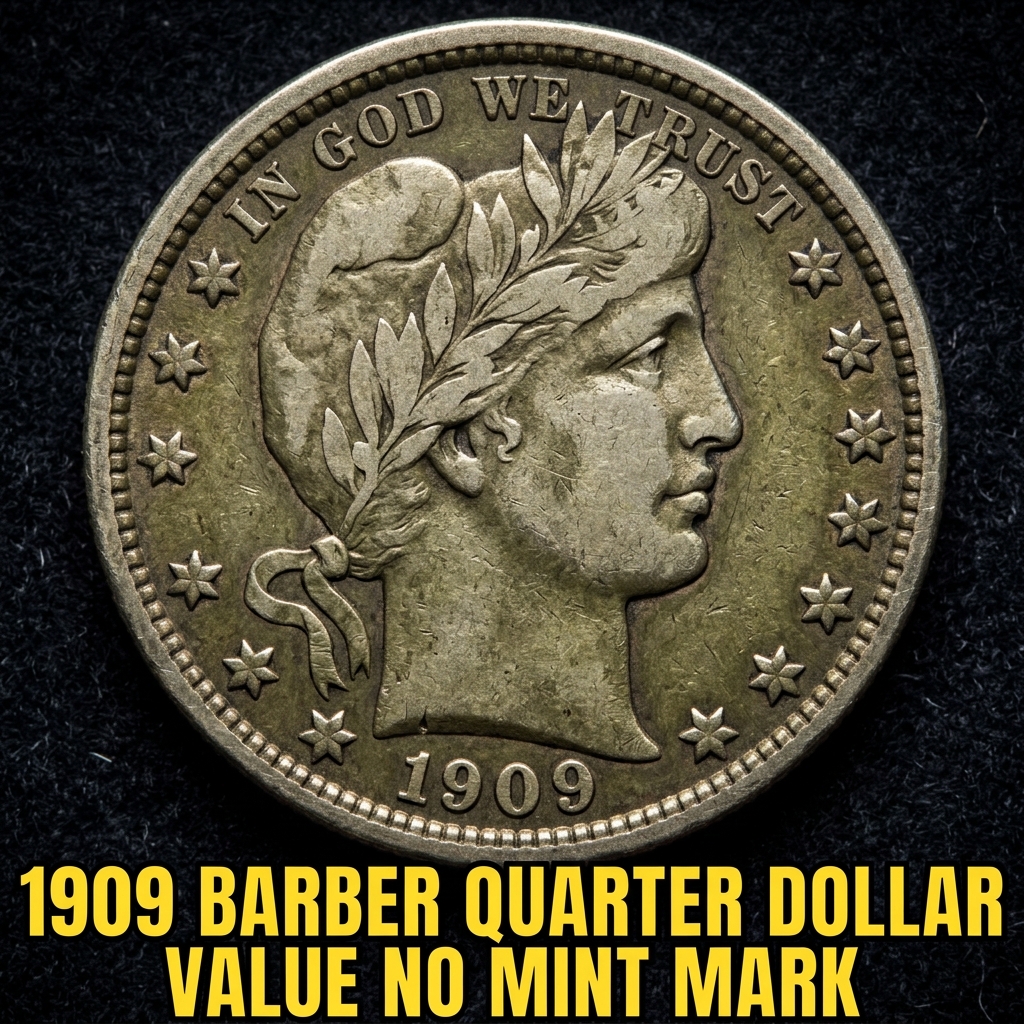
1909 Barber Quarter Dollar Value Guide for No Mint Mark Coins
The 1909 Barber Quarter with no mint mark is worth anywhere from $10 in heavily worn condition to over $350 in choice uncirculated state. If you’ve discovered one of these classic silver coins in an old jar or a family collection, you are holding a piece of American history that carries significant value above its silver content.
History and Identification of the 1909 Philadelphia Barber Quarter
The Barber Quarter, designed by Chief Engraver Charles E. Barber, was a staple of American commerce at the turn of the 20th century. In 1909, the Philadelphia Mint produced over 9.2 million of these quarters. Unlike coins struck in Denver, San Francisco, or New Orleans, the Philadelphia issues feature no mint mark. You can verify this by checking the reverse side of the coin, specifically the space directly below the eagle’s tail feathers.
If that area is blank, you have a “P” mint coin. Finding one today is an exciting moment for any casual collector. Because these coins circulated heavily during the industrial expansion of the United States, most surviving examples show significant wear. To get a definitive look at your coin’s details, you can use a free coin identifier app to see how your specimen compares to high-grade examples.
When you are trying to determine if your find is a treasure, using a tool like the CoinKnow app can help you recognize the subtle differences between a common circulated coin and a rare high-grade survivor. The 1909 issue is particularly popular because it represents the late-era maturity of the Barber design before it was eventually replaced by the Standing Liberty Quarter.
Current Market Value and Pricing for 1909 Quarters
The value of a 1909 Barber Quarter is primarily driven by its condition, also known as its “grade.” While any 1909 quarter is worth at least its weight in silver (approximately 0.18 ounces of pure silver), numismatic interest pushes the price much higher. Most coins found in “Good” or “Very Good” condition—meaning the Liberty head is visible but the word “LIBERTY” on the headband is worn away—sell for a modest premium.
However, as the grade increases, the price jumps significantly. A coin that retains full letters in the headband and crisp feathers on the eagle’s wings is considered “Extremely Fine” or “About Uncirculated.” These can fetch between $80 and $150. If you are curious about how this era’s silver coins compare in rarity, you might also be interested in the 1909 Barber Dime worth and pricing details, which follow a similar market trend.
Values for the 1909 Barber Quarter remain stable because it is a “type” coin that many collectors need to complete their sets. To ensure you aren’t leaving money on the table, the CoinKnow app provides real-time auction data so you can see what similar coins have sold for recently.
| Condition / Grade | Estimated Value (USD) |
|---|---|
| Good (G-4) | $10 – $14 |
| Very Good (VG-8) | $18 – $25 |
| Fine (F-12) | $35 – $45 |
| Very Fine (VF-20) | $60 – $75 |
| Extremely Fine (EF-40) | $110 – $140 |
| Uncirculated (MS-60+) | $350+ |
Factors That Influence Your 1909 Quarter Worth
Beyond the basic grade, several factors can influence the price a dealer or collector is willing to pay. Luster is a major factor for high-grade coins. If the coin still has its original “mint frost” and reflects light in a cartwheel pattern, it could be worth hundreds. Conversely, environmental damage, such as dark spotting or corrosion from being buried, will decrease the value.
Cleaning is the most common mistake made by everyday people who find old coins. Never clean your 1909 Barber Quarter! Using polish or even soap and water can create tiny scratches known as “hairlines.” Collectors prefer a coin with 100 years of natural patina over a shiny, cleaned coin. A cleaned coin often loses 50% or more of its potential market value.
Finally, “eye appeal” matters. A coin with even, honest wear is often more desirable than one with a high grade but ugly contact marks or scratches. If you’re unsure if your coin has been cleaned or damaged, the CoinKnow app can help you identify these surface issues through high-resolution photo comparison.
Tips for Selling Your Philadelphia Barber Quarter
When you’re ready to sell your 1909 Barber Quarter, you have several options. Local coin shops are the fastest way to get cash, though they will typically offer “wholesale” prices (around 50-70% of the retail value) so they can make a profit. Online auctions like eBay can get you closer to full retail value, but you must factor in seller fees and shipping costs.
Before selling, make sure you have accurately identified the coin. Since the 1909-S (San Francisco) and 1909-O (New Orleans) are rarer and more valuable, ensure the “no mint mark” status is correct. Philadelphia coins are more common, but they are still highly collectible in any grade. Proper storage in a PVC-free flip or plastic holder will prevent further wear and preserve its current value.
Q: How can I tell if my 1909 Quarter is a rare variety?
A: While there are no major recognized “doubled die” varieties for the 1909 Philadelphia issue, you should look for “proof” finishes. These were specially struck for collectors and have mirror-like backgrounds. They are much rarer and can be worth over $500.
Q: What is the silver content of a 1909 Barber Quarter?
A: The 1909 Barber Quarter is composed of 90% silver and 10% copper. It contains approximately 0.1808 troy ounces of pure silver, which gives it a “melt value” that fluctuates with the daily silver market.
Q: Where is the mint mark located on a 1909 Barber Quarter?
A: The mint mark is located on the reverse (back) of the coin, centered below the eagle’s tail and above the letters “QU” in “QUARTER DOLLAR.” If that space is empty, the coin was minted in Philadelphia.
