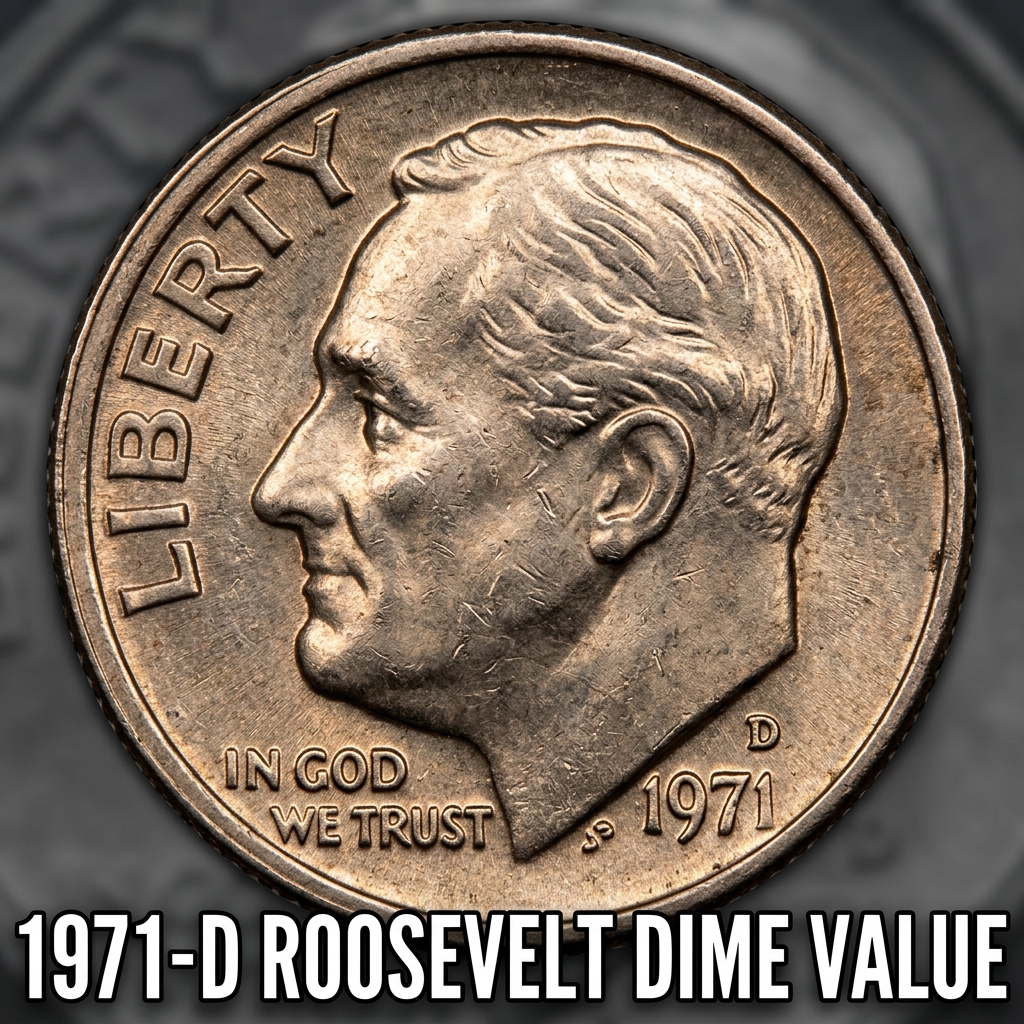
1971 D Roosevelt Dime Value and Rarity Guide for Collectors
The 1971-D Roosevelt Dime is worth anywhere from $0.10 in worn condition to over $500 in high-grade mint state. While most of these coins you find in your spare change are only worth their face value, certain rare specimens can be quite valuable to serious collectors and silver enthusiasts alike.
Understanding the 1971-D Roosevelt Dime History and Mintages
In 1971, the United States Mint produced a massive number of Roosevelt Dimes at the Denver facility. With over 430 million strikes, the “D” mint mark version is far from rare in the general sense. However, finding one in pristine, uncirculated condition is a different story altogether. These coins were minted from a base metal composition of copper and nickel, a shift that occurred after 1964 to move away from silver.
If you have a handful of old coins and aren’t sure where to start, using a free coin identifier app can help you quickly sort through your find. Many people who use the CoinKnow app are surprised to learn that even modern-looking dimes can hold a premium if they possess unique characteristics or a high level of preservation.
When examining your dime, look for the small “D” located just above the date. This indicates it was struck in Denver. If you find a dime with no mint mark from this same year, it was produced in Philadelphia. While the 1971-D is common, it remains a staple for anyone looking to complete a full set of the Roosevelt series.
Determining the Condition and Grade of Your Dime
The value of a coin is largely dictated by its “grade,” or its state of preservation. Professional graders use a scale from 1 to 70. Most 1971-D dimes found in pocket change will grade between “Good” and “Extra Fine,” meaning they show signs of wear, flattened hair details on Roosevelt, and smoothed-out torch lines on the reverse. For these circulated coins, the value stays firmly at $0.10.
However, collectors are always on the hunt for “Mint State” (MS) examples. A coin that has never been spent and retains its original luster can be worth significantly more. You can find detailed 1971-D Roosevelt Dime price guides for MS grades that show how value jumps as the grade increases from MS63 to MS67.
A specific detail to look for on the reverse of the coin is “Full Bands” (FB). This refers to the horizontal bands on the torch being fully separated and distinct. A 1971-D Roosevelt Dime with Full Bands is exceptionally rare and can command a high premium at auction, often reaching into the hundreds of dollars. Tools like CoinKnow can help you zoom in on these tiny details that the naked eye might miss.
1971-D Roosevelt Dime Value Reference Table
To help you understand what your coin might be worth, please refer to the price chart below. Note that these values are estimates based on recent auction data and market trends.
| Condition / Grade | Estimated Market Value |
|---|---|
| Circulated (Average Wear) | $0.10 – $0.15 |
| Uncirculated (MS60 – MS63) | $1.00 – $5.00 |
| Choice Uncirculated (MS65) | $10.00 – $25.00 |
| Gem Uncirculated (MS67+) | $150.00 – $450.00+ |
| MS67 with Full Bands (FB) | $600.00+ |
Identifying Rare Errors and Varieties
Beyond standard grades, error coins are where the real money is often found. For the 1971-D dime, there aren’t many famous “major” varieties like the 1971 No-S Proof (which was minted in San Francisco), but Denver strikes can still suffer from minting mishaps. Common errors include “broadstrikes,” where the coin is struck outside the collar, and “off-center” strikes.
Another interesting thing to look for is a “double die.” While not as prominent as some other years, a slight doubling on the letters or date can increase the price. If you think you’ve spotted an anomaly, checking the current 1971-D Roosevelt Dime value trends will give you an idea of what error hunters are currently paying.
For many casual collectors, the best way to verify an error is to compare it against high-resolution photos in the CoinKnow database. Seeing a confirmed error side-by-side with your coin can save you a lot of time and potentially prevent you from spending a valuable treasure.
Is Your 1971-D Dime Worth Keeping?
If you find a 1971-D dime in your change today, chances are it is worth just ten cents. Because these coins are made of copper and nickel, they do not have the “melt value” that silver dimes from 1964 and earlier possess. Therefore, if the coin is heavily scratched, dirty, or worn down, it is safe to spend.
However, if you have a coin that looks brand new—as if it just came from a fresh roll at the bank—it is worth putting in a protective sleeve. High-grade specimens are increasingly difficult to find because most of the 430 million minted have been circulated heavily over the last 50 years.
Always remember that the coin market fluctuates. What is worth $5 today might be worth $20 in a few years as high-quality survivors become scarcer. Keeping an eye on auction results and using modern tools to track your inventory is the best way to manage your growing collection.
Q: Is a 1971-D dime made of silver?
A: No, the 1971-D Roosevelt Dime is a clad coin made of a copper core with an outer layer of 75% copper and 25% nickel. The U.S. Mint stopped using silver for circulation dimes after 1964.
Q: What is the rarest 1971 dime?
A: The rarest dime from 1971 is the “No S” Proof dime. These were supposed to have an “S” mint mark for San Francisco, but a few sets were released without it. These can be worth tens of thousands of dollars.
Q: Where is the mint mark on a 1971-D dime?
A: The “D” mint mark is located on the obverse (front) of the coin, just above the year 1971, near the bottom of Roosevelt’s neck.
