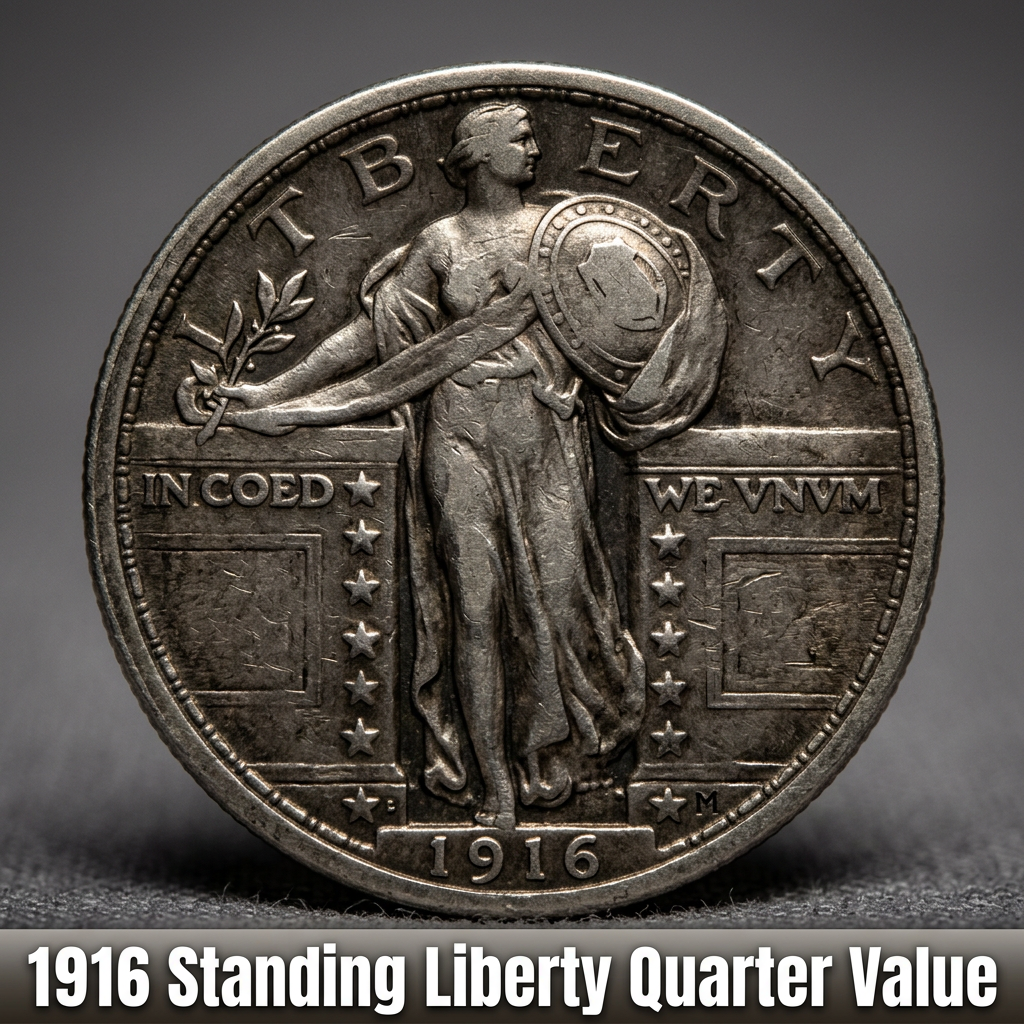
How Much is a 1916 Standing Liberty Quarter Worth Today
The 1916 Standing Liberty Quarter is worth anywhere from $2,800 in heavily worn condition to over $20,000 in mint state. This legendary coin is considered the “holy grail” for many collectors, and finding one in your attic or a family collection could mean you are holding a life-changing sum of money.
History and Rarity of the 1916 Standing Liberty Quarter
The 1916 Standing Liberty Quarter marks the very first year of a beautiful new design created by Hermon Atkins MacNeil. Unlike the previous Barber design, this coin featured Lady Liberty walking through a gate, holding a shield and an olive branch. However, because production began late in the year, only 52,000 coins were minted. This is an incredibly low number compared to most circulating coins, which often see mintages in the millions. Due to this scarcity, the 1916 Standing Liberty Quarter value is among the highest in 20th-century American numismatics.
If you aren’t sure if the coin you found is truly from 1916, you can use a free coin identifier app to get a professional perspective. Many beginners confuse the 1917 version with the 1916, but the 1916 is far more valuable. When you use the CoinKnow app, you can quickly differentiate between these subtle varieties. Collectors often look for the lack of stars below the eagle on the reverse to confirm the Series 1 design used in late 1916.
Identifying the Condition and Grade of Your Quarter
When determining value, condition is everything. Because these coins were made of 90% silver and 10% copper, they were relatively soft and wore down quickly in circulation. Most 1916 quarters found today are very worn, sometimes with the date barely visible. A coin with a clear “1916” date is already worth thousands. If the details of Liberty’s gown and the feathers on the eagle’s wings are sharp, you are looking at a premium specimen.
The market for high-end versions is very competitive. You can view
current market prices for uncirculated 1916 quarters to see how much collectors are willing to pay for pristine examples. Many owners use the CoinKnow app to photograph their coins and get a better sense of where they fall on the grading scale. Even a small improvement in grade can mean a difference of several thousand dollars in the final sale price.
Estimated 1916 Standing Liberty Quarter Value Chart
To give you a better idea of what your coin might be worth, we have compiled a price guide based on standard grading categories. Please note that coins that have been cleaned or damaged may sell for significantly less than the prices listed here. Professional grading by a service like PCGS or NGC is highly recommended for this specific year.
| Condition / Grade | Estimated Value |
|---|---|
| About Good (G-4) | $2,800 – $3,500 |
| Fine (F-12) | $4,500 – $5,800 |
| Extremely Fine (EF-40) | $8,000 – $10,500 |
| About Uncirculated (AU-50) | $12,000 – $14,000 |
| Mint State (MS-63) | $18,000 – $22,000 |
| Mint State (MS-65 FH) | $35,000+ |
Design Varieties and the Famous Full Head Designation
One of the most important factors for the 1916 Standing Liberty Quarter value is the “Full Head” (FH) designation. This refers to the strike quality on Lady Liberty’s head. If the detail in her hair and the helmet-like crown is fully visible, the coin is considered a “Full Head” strike. These are exceptionally rare for the 1916 issue because the dies used at the mint often didn’t strike the metal deep enough to capture those fine details.
Finding a coin with these features is like winning the lottery. You can check the detailed value breakdown for the 1916 Standing Liberty Quarter to understand why the Full Head version sells at such a massive premium. If you are examining a coin at home, tools like the CoinKnow app can help you identify if your coin has the “bare breast” design feature, which was only present in 1916 and early 1917 before the design was modified for modesty.
Why You Should Never Clean Your 1916 Quarter
If you find a 1916 Standing Liberty Quarter, the most important advice is: do not clean it! Many people see an old, dark coin and think they should polish it to make it look “new.” In the world of coin collecting, cleaning a coin permanently destroys its numismatic value. A cleaned 1916 quarter might lose 50% or more of its potential worth because collectors prefer the natural patina that develops over decades.
Instead of cleaning, handle the coin by its edges and place it in a protective plastic flip or holder. The high 1916 Standing Liberty Quarter value is based on its original surfaces. If you want to show it to an expert or list it for sale, having it in its raw, “as-found” state is the best way to ensure you get the maximum profit.
Frequently Asked Questions
Q: How can I tell the difference between a 1916 and a 1917 quarter?
A: The easiest way is to look at the reverse side (the side with the eagle). In 1916 and early 1917 (Type 1), there are no stars directly underneath the flying eagle. However, since the 1916 mintage is so much lower, any Type 1 quarter with a legible “1916” date is worth a significant premium.
Q: Is the 1916 Standing Liberty Quarter made of silver?
A: Yes, it is composed of 90% silver and 10% copper. While the silver melt value is around $5, the collector value of the 1916 date far exceeds the price of the metal, often being worth thousands of times its weight in silver.
Q: Where is the mint mark on a 1916 Standing Liberty Quarter?
A: All 1916 Standing Liberty Quarters were minted in Philadelphia. Philadelphia coins of this era do not have a mint mark. If you see an “S” (San Francisco) or “D” (Denver) mint mark, the coin was minted in 1917 or later, as only Philadelphia produced quarters in 1916.
