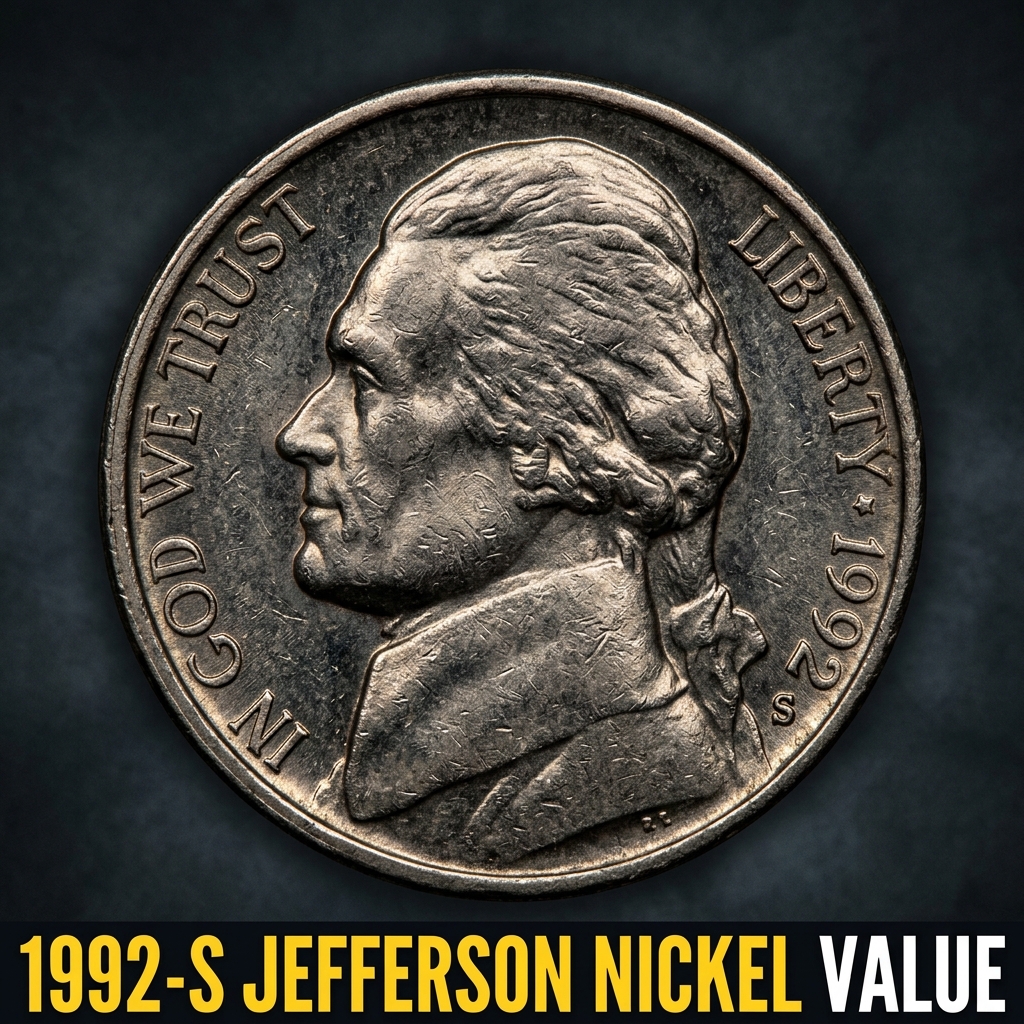
1992 S Jefferson Nickel Value Guide for Collectors and Pocket Change Hunters
The 1992-S Jefferson Nickel is worth anywhere from $2 to $5 in standard proof condition to over $1,500 for rare high-grade Deep Cameo specimens. While it may look like ordinary pocket change at first glance, the “S” mint mark makes it a special piece intended only for collectors.
Understanding the 1992-S Jefferson Nickel and Its Origins
The 1992-S Jefferson Nickel is a unique coin because it was never released into general circulation. Produced exclusively at the San Francisco Mint, these coins were part of the 1992 Mint Proof Sets. If you have found one of these in your spare change, it likely came from a broken set or was spent by someone unaware of its numismatic status.
If you are unsure whether your coin is a standard business strike or a proof, using a free coin identifier app can help you distinguish the mirrored finish of an “S” mint coin from the matte finish of the P or D versions. The CoinKnow app is particularly helpful for this, as it uses high-resolution imaging to detect the specific “S” mint mark located to the right of Monticello on the reverse.
Because these were struck using specially polished dies and planchets, they possess a sharp, mirror-like background and frosted details. Most examples found today are still in their original plastic packaging, but “circulated” proofs do exist and carry a slight premium over a common nickel.
Market Pricing and Value Tiers for 1992-S Nickels
When determining the market price of your 1992-S nickel, condition is everything. Unlike regular nickels from Philadelphia or Denver that are graded on a Mint State (MS) scale, these are graded as Proofs (PR). Most 1992-S nickels are graded PR69 or PR70, which are near-perfect or perfect conditions.
Lower-grade proofs that have been handled or scratched might only be worth a few dollars. However, the current market values for 1992 Jefferson Nickels show that even modest specimens hold their value better than their circulating counterparts. If you find a coin with exceptional “Deep Cameo” (DCAM) contrast, the price can climb significantly.
Collectors often look for the “Full Steps” (FS) designation on the reverse of the coin, though this is much more common on proof strikes than on business strikes. To get a better idea of how your find compares to others, check the detailed 1992 nickel value chart provided by industry experts to see recent auction records.
| Condition / Grade | Estimated Market Value |
|---|---|
| PR 65 (Typical Proof) | $2.50 – $4.00 |
| PR 69 Deep Cameo | $12.00 – $20.00 |
| PR 70 Deep Cameo (Perfect) | $150.00 – $1,800.00+ |
| Circulated/Impaired Proof | $0.10 – $1.00 |
Identifying Rare Varieties and Error Coins
While the standard 1992-S Proof Nickel is well-documented, many collectors hunt for errors or specific varieties that can skyrocket the value. The CoinKnow app is an excellent tool for magnifying the coin’s surface to look for doubling or “die clashes” that aren’t visible to the naked eye.
One thing to look for is the “Deep Cameo” effect. This is a visual contrast where the portrait of Thomas Jefferson and the Monticello building look thick and white (like frosting), while the field (the flat part) looks like a deep black mirror. If your 1992-S lacks this contrast, it is simply a “Proof,” but if the contrast is stark, it is a “Deep Cameo,” which is much more desirable to investors.
Errors in 1992 are relatively rare for the San Francisco Mint because of their strict quality control. However, clipped planchets or off-center strikes on proof coins are extremely valuable because they shouldn’t have left the mint. If you think you’ve found a “Proof Error,” it should be professionally graded by a service like PCGS or NGC immediately.
How to Care for Your 1992-S Proof Nickel
If you discover a 1992-S nickel, the most important rule is: Do not clean it. Many beginners make the mistake of trying to “shine up” an old nickel with polish or cloth, but this creates micro-scratches that ruin the proof finish and destroy the numismatic value. A proof coin’s value is derived from its pristine, untouched surface.
To keep your coins in top condition, handle them only by the edges and store them in PVC-free flips or capsules. Using CoinKnow allows you to digitally catalog your collection so you don’t have to handle the physical coins more than necessary. Keeping the coin in its original mint packaging is the best way to ensure it retains its maximum value over time.
As the years pass, the supply of perfect 1992-S nickels decreases as they are lost, damaged, or hidden away in private collections. Even a standard $5 proof coin today could become a more significant treasure for the next generation of collectors, making it a fun and affordable entry point into the world of coin collecting.
Q: How can I tell if my 1992 nickel is from the San Francisco Mint?
A: Look on the reverse (tails) side of the coin. To the right of the Monticello building, you will see a small letter “S.” If the letter is a “P” or “D,” it was made for general circulation; the “S” means it is a proof coin.
Q: Is a regular 1992 nickel from my pocket worth more than five cents?
A: Most 1992-P and 1992-D nickels found in circulation are only worth their face value of 5 cents. However, if they are in exceptionally perfect, uncirculated condition, they can be worth several dollars to a collector.
Q: Why do some 1992-S nickels sell for over $1,000?
A: Only coins that achieve the perfect “PR70 Deep Cameo” grade by professional grading companies reach these high prices. These coins must have zero visible flaws under 5x magnification and perfect “frosted” contrast.
