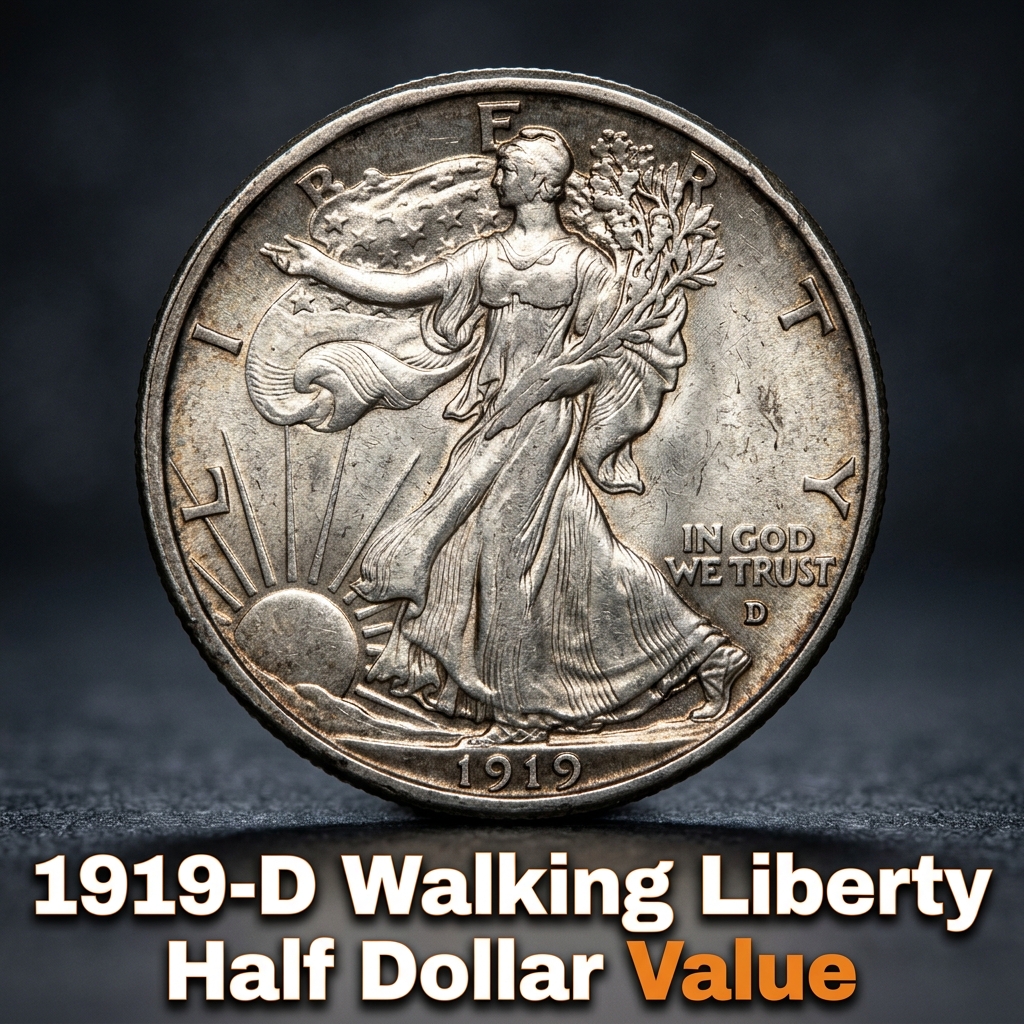
How Much is a 1919 D Walking Liberty Half Dollar Worth Today
The 1919-D Walking Liberty Half Dollar is worth anywhere from $25 in heavily worn condition to over $25,000 in pristine mint state. This vintage silver coin is highly coveted by collectors due to its low mintage and the iconic design that defined an era of American numismatics.
History and Rarity of the 1919 Denver Mint Half Dollar
The 1919-D Walking Liberty Half Dollar comes from a time when the United States was transitioning into a post-WWI economy. Struck at the Denver Mint, this particular issue is well-known among enthusiasts for being a “condition rarity.” While the Mint produced 1,165,000 of these coins, very few were saved in high grades. Most entered heavy circulation, passing through the hands of everyday Americans to buy groceries or pay for movie tickets.
If you have discovered one of these coins in an old jar or a family collection, you might be holding a piece of history worth hundreds or even thousands of dollars. To get a quick idea of what you have, you can use a free coin identifier app to check the mint mark and basic condition. Many people use the CoinKnow app to organize their finds and see if their 1919-D has the sharp details required for a premium valuation.
When examining your coin, look for the small “D” on the reverse side, near the rim at the bottom left. This letter indicates it was made in Denver. Coins without a mint mark were made in Philadelphia, while those with an “S” were made in San Francisco. The Denver strike from 1919 is particularly tricky because many were struck with worn dies, meaning even some “new” looking coins lack the crisp detail collectors crave.
Determining the Grade and Value of Your Coin
The value of a 1919-D Walking Liberty Half Dollar depends almost entirely on its “grade,” which is a measure of how much wear and tear the coin has endured. In a “Good” or “Very Good” condition, the coin will look flat, and Liberty’s dress lines will be mostly faded. However, because this specific year and mint are scarce, even a worn specimen still commands a price far above its silver melt value.
For those lucky enough to find a coin with original luster and no signs of wear, the 1919-D Walking Liberty Half Dollar value in mint state can skyrocket into the tens of thousands. Most amateur treasure hunters find coins in the “Fine” to “Extremely Fine” range. In these grades, you can still see the folds in Lady Liberty’s gown and the feathers on the eagle’s breast.
If you aren’t sure how to grade your coin, the CoinKnow app can provide side-by-side comparisons to help you identify the level of preservation. Professional grading services like PCGS or NGC are recommended for high-value coins, as a single grade jump can mean a difference of several thousand dollars in market value.
| Condition / Grade | Estimated Market Value |
|---|---|
| Good (G-4) | $25 – $40 |
| Fine (F-12) | $110 – $150 |
| Extremely Fine (XF-40) | $450 – $600 |
| About Uncirculated (AU-50) | $1,200 – $1,800 |
| Mint State (MS-63) | $12,000 – $15,000+ |
Why the 1919-D is a Key Date for Collectors
In the world of coin collecting, the 1919 Denver issue is considered a “key date.” This means it is one of the harder-to-find coins in the entire Walking Liberty series, which ran from 1916 to 1947. Collectors who are trying to complete a full set often struggle to find a 1919-D that fits their budget and quality standards. The 1910s were a decade of low production for half dollars compared to the 1940s, making these early dates much more valuable.
The design itself, created by Adolph A. Weinman, is often cited as the most beautiful in American history. It features Lady Liberty walking toward the sun, draped in the American flag. On the reverse, a powerful bald eagle stands on a mountain crag. Because the 1919-D is often weakly struck, finding one where the thumb of Liberty or the eagle’s leg is fully detailed is extremely rare.
Before selling your coin to a local pawn shop, it is vital to research the detailed historical prices and auction records for the 1919 half dollar. Many local buyers might offer only the silver melt price, which is a fraction of what a collector would pay for a key date like this. Using the CoinKnow app can help you track recent auction trends so you don’t undersell your treasure.
Factors That Influence the Price
Beyond the grade, several other factors can influence what a buyer is willing to pay. “Eye appeal” is a term numismatists use to describe how attractive a coin looks at first glance. A 1919-D with beautiful rainbow toning—the natural oxidation that occurs over decades—can sell for a significant premium over a “blast white” coin that looks like it was recently cleaned.
Cleaning your coin is the biggest mistake you can make. If you find a 1919-D, never scrub it with soap, vinegar, or metal polish. Collectors prefer “original skin,” which is the natural patina a coin develops over time. A cleaned coin can lose up to 50% or more of its numismatic value instantly because cleaning leaves microscopic scratches that ruin the coin’s surface integrity.
Finally, keep an eye out for errors. While major errors are rare for the 1919-D, things like “re-punched mint marks” or “die cracks” can occasionally add a bit of interest and value to the piece. If you think you see something unusual through a magnifying glass, it is worth having it looked at by a professional or verified through a high-resolution identification app.
Q: Where is the mint mark on a 1919-D Walking Liberty Half Dollar?
A: On the 1919-D, the “D” mint mark is located on the reverse side (the tail side). Look toward the bottom left rim, just below the branch the eagle is perched on.
Q: Is every 1919-D half dollar made of silver?
A: Yes, all Walking Liberty Half Dollars minted in 1919 are composed of 90% silver and 10% copper. They contain approximately 0.36169 ounces of pure silver.
Q: Should I get my 1919-D half dollar professionally graded?
A: If the coin appears to be in “Extremely Fine” condition or better (showing very little wear on Liberty’s dress or the eagle’s feathers), it is likely worth the cost of professional grading, as the value could exceed $500.
