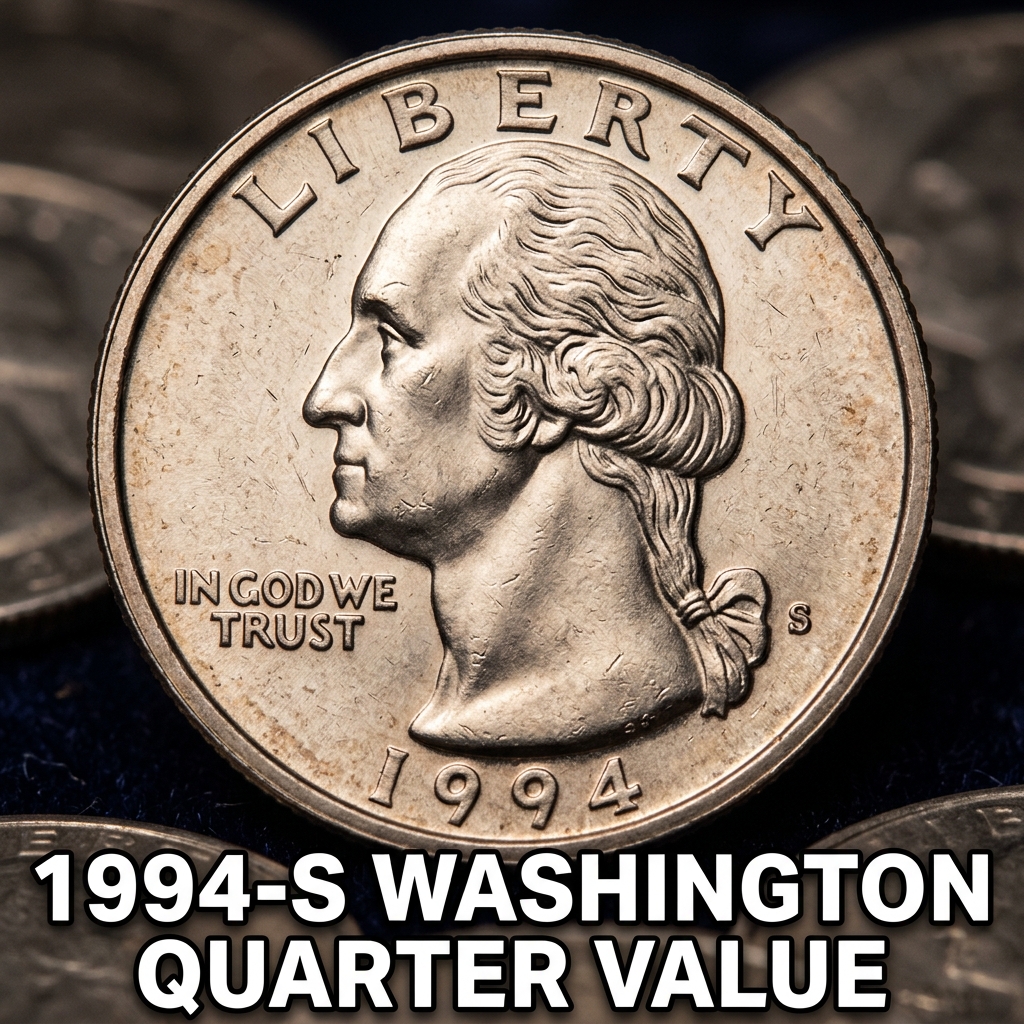
How Much is a 1994 S Washington Quarter Worth Today
The 1994-S Washington Quarter is worth anywhere from $5 in standard proof condition to over $1,000 for rare perfection-grade specimens. While you won’t find this specific coin in your pocket change, it is a prized possession for many collectors who enjoy the mirror-like finish and sharp details of San Francisco coinage.
Understanding the Unique 1994-S Proof Quarter
If you have stumbled upon a 1994 quarter with an “S” mint mark, you have found a coin that was never intended for general circulation. Unlike the common quarters minted in Philadelphia or Denver, the San Francisco mint produced these specifically for collectors. These are known as “Proof” coins. They were struck twice using polished dies and blanks, resulting in a stunning reflective background and frosted details. To accurately identify your find and ensure it’s not a common business strike, using a free coin identifier app is the quickest way to get a professional technical diagnosis.
In 1994, the U.S. Mint offered two distinct types of these quarters. The first is the standard copper-nickel clad version, which looks like a normal quarter but with a “mirror” finish. The second is the Silver Proof version, which consists of 90% silver and 10% copper. Identifying which one you have is crucial, as the silver content significantly boosts the baseline value regardless of the coin’s grade. Many people use the CoinKnow app to quickly tell the difference between clad and silver versions based on visual cues and weight.
How Construction and Material Affect Market Value
The market value of a 1994-S quarter depends heavily on its composition. The clad version is quite affordable, usually retailing between $5 and $12 in its original packaging. These were produced in a quantity of over 2.4 million sets. While that seems like a lot, finding one in perfect, flawless condition (PR70) is difficult. For those looking for historical context, you can research the 1994 Washington Quarter price trends to see how the proof versions compare to their standard business-strike cousins.
The Silver Proof 1994-S is where things get interesting for the “everyday” investor. Because it contains about 0.18 ounces of pure silver, its value will never drop below the current “melt” price of silver. However, because collectors want the set, these usually sell for $15 to $35. If you are curious about the long-term appreciation of these coins, checking the current resale value of 1994 quarters will show that silver proofs have maintained much higher stability than clad versions over the last decade.
| Coin Type | Grade / Condition | Estimated Value |
|---|---|---|
| 1994-S Clad Proof | PR65 (Deep Cameo) | $5.00 – $8.00 |
| 1994-S Clad Proof | PR70 (Perfect) | $40.00 – $65.00 |
| 1994-S Silver Proof | PR69 (Near Perfect) | $25.00 – $35.00 |
| 1994-S Silver Proof | PR70 (Perfect) | $800.00 + |
Spotting the Rare Deep Cameo Contrast
When evaluating a proof coin, collectors look for something called “Cameo” or “Deep Cameo” (DCAM). This refers to the contrast between the frosted image of George Washington and the shiny, mirror-like “field” or background. In 1994, the Mint’s technology was quite advanced, so most 1994-S quarters will have some level of cameo. However, only those with exceptionally heavy frosting and deep, dark mirrors receive the “Deep Cameo” designation from grading services like PCGS or NGC.
A standard 1994-S Silver Proof in PR69 Deep Cameo might be worth $30, but that same coin in a PR70 Deep Cameo—signifying a perfect coin under five-times magnification—can skyrocket in value. Auction records have shown these “perfect” silver quarters selling for over $1,200 at major heritage auctions. If you think your coin looks absolutely flawless, it is worth using the CoinKnow app to compare your coin’s luster against high-resolution images of confirmed PR70 specimens.
How to Tell if Your 1994 Quarter is Silver
Many people find a loose 1994-S in an old desk drawer or a jewelry box and wonder if they’ve hit the silver jackpot. There are three easy ways to check. The first is the “edge test.” Look at the rim of the coin. If you see a solid silver-colored edge, it is likely the 90% silver version. If you see a strip of orange-brown copper, it is the clad version.
The second method is the weight test. A standard clad quarter weighs 5.67 grams, while a silver quarter weighs 6.25 grams. You can use a simple jewelry scale to verify this. Finally, the “ping test” is a traditional favorite; silver coins have a much higher-pitched, longer-lasting ring when tapped or dropped (carefully!) compared to the dull thud of nickel-clad copper. For a more modern approach, the CoinKnow mobile tool can help you catalog and identify the specific variety of your 1994 coins instantly.
Q: Can I find a 1994-S Washington Quarter in my pocket change?
A: It is very rare. Since these were only sold in sets to collectors, they usually only enter circulation if someone spends a collection by mistake. If you find one, it will likely be scratched and lose its “Proof” premium.
Q: How much silver is in a 1994-S Silver Quarter?
A: Each silver proof quarter from 1994 contains 0.1808 troy ounces of pure silver. This means its value will rise and fall with the global price of silver precious metals.
Q: What is the highest price ever paid for a 1994-S Quarter?
A: While most sell for under $50, a perfect PR70 Deep Cameo Silver version was auctioned for over $1,000 due to its extreme rarity in that specific grade. High-grade clad versions can also fetch hundreds of dollars in perfect condition.
