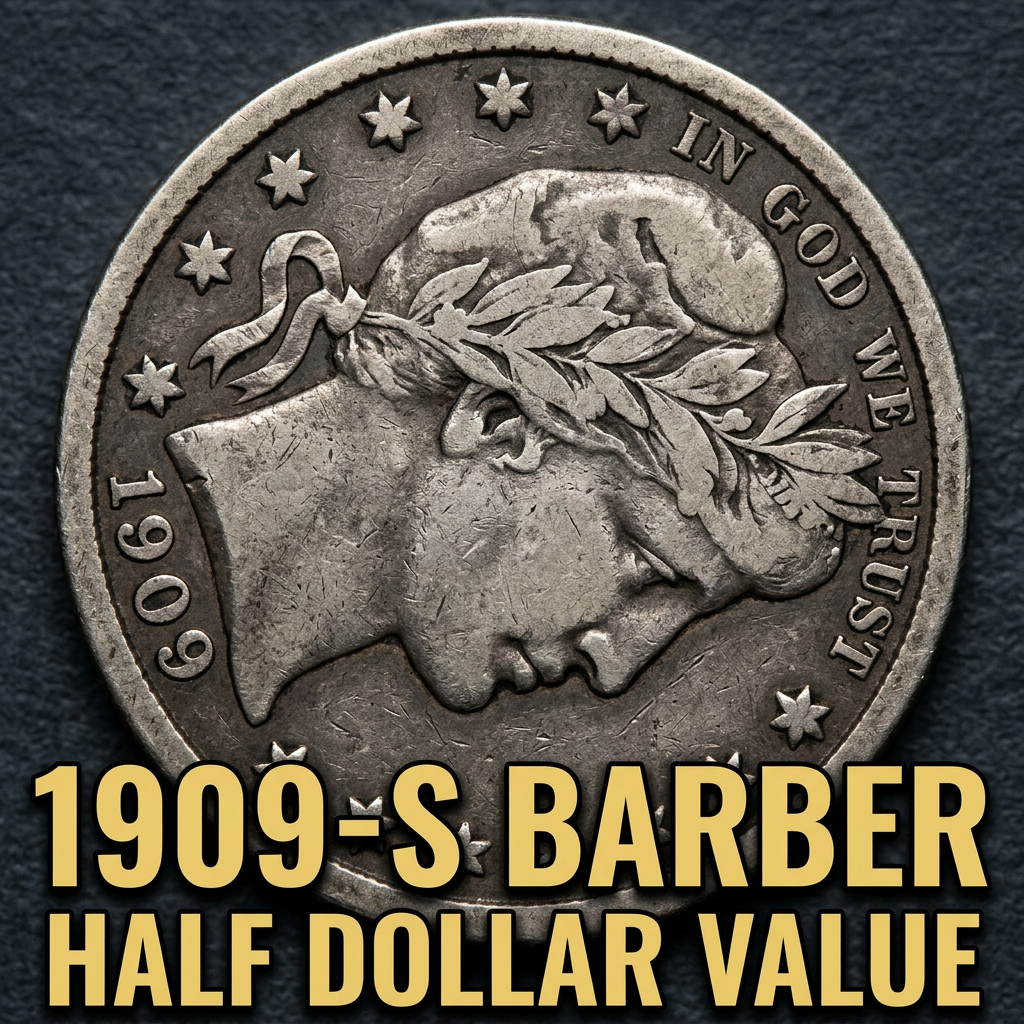
How Much Is Your 1909-S Barber Half Dollar Value Worth Today
The 1909-S Barber Half Dollar is worth anywhere from $40 in heavily worn condition to over $2,500 in uncirculated mint state. Whether you found this silver coin in an old family collection or inherited a jar of change, its specific mint mark and date make it a highly sought-after piece for collectors.
Understanding the Scarcity of the 1909-S Half Dollar
Finding a 1909-S Barber Half Dollar is an exciting discovery because it hails from the twilight years of the Barber series. Designed by Charles E. Barber, these coins were the workhorses of the American economy at the turn of the century. The “S” mint mark indicates it was struck at the San Francisco Mint, which typically produced fewer coins than the main mint in Philadelphia. In 1909, only 925,218 of these half dollars were produced in San Francisco, making it a “sub-1 million” mintage year.
If you are unsure if your coin is authentic, you can use a free coin identifier app to get an instant preliminary assessment. Because so many of these coins were used in daily transactions, most survivors are very worn. Finding one with crisp details on Liberty’s head or the eagle’s feathers is a rare occurrence that significantly drives up the price. Tools like the CoinKnow app can help you compare your coin’s condition against high-resolution images to see where it falls on the grading scale.
Current Market Values and Price Chart
The value of your 1909-S half dollar is primarily determined by its “grade,” or the amount of wear and tear it has sustained over the last century. Most everyday finds will fall into the “Good” or “Very Good” categories, meaning the letters in “LIBERTY” on the headband are mostly worn away. However, even in these lower grades, the 1909-S carries a premium because of its relatively low mintage.
Investors and collectors are always looking for valuable half dollars worth money, and the 1909-S is a frequent flyer on their want lists. Unlike common dates from the 1900s that sell for just their silver weight, the San Francisco issue from 1909 holds significant numismatic value. Using CoinKnow allows you to track auction results to see what buyers are currently paying for this specific date and mint mark.
| Condition (Grade) | Estimated Value |
|---|---|
| Good (G-4) | $40 – $55 |
| Fine (F-12) | $125 – $160 |
| Extremely Fine (EF-40) | $450 – $525 |
| About Uncirculated (AU-50) | $850 – $1,100 |
| Uncirculated (MS-63) | $2,400 – $3,000+ |
Key Features to Look for on Your 1909-S Half Dollar
To determine the 1909-S Barber Half Dollar value accurately, you must first verify the mint mark. Flip the coin to the reverse (the “tails” side) and look at the bottom, just above the “D” in “DOLLAR.” You should see a small “S.” If the space is blank, it was minted in Philadelphia and is much more common. If there is an “O,” it was minted in New Orleans, which was the final year that mint produced half dollars.
In addition to the mint mark, the condition of the “LIBERTY” inscription on the obverse is the biggest factor in price. On a high-grade coin, all seven letters will be sharp and clear. On a “Good” grade coin, the letters may be completely smoothed over. Remember, do not clean your coin! Even if it looks dirty or dark, “toning” is often preferred by collectors, and scrubbing it with chemicals can cut the value in half instantly. The CoinKnow app provides guides on how to handle and store your coins to preserve their maximum market value.
Why the 1909 San Francisco Mint Strike is Special
The year 1909 was a transitional time in American coinage. While the Lincoln Penny was making its debut, the Barber Half Dollar was entering its final years of production. The San Francisco Mint was busy striking various denominations, and the half dollar didn’t receive the highest priority. This resulted in a lower mintage compared to the millions struck in Philadelphia earlier in the decade.
Because the 1909-S is 90% silver, it will always be worth at least its weight in precious metal (the “melt value”). However, because of its history and rarity, the numismatic value is almost always three to four times higher than the silver price, even for the most worn examples. For people who have stumbled upon one of these in a collection, it represents a tangible piece of American history from the era of steamships and the early days of the automobile.
Q: Where is the mint mark located on the 1909-S Barber Half Dollar?
A: The “S” mint mark is located on the reverse side of the coin, centered directly above the “D” in the word “DOLLAR” and below the eagle’s tail feathers.
Q: Is a 1909-S Barber Half Dollar made of real silver?
A: Yes, all Barber Half Dollars minted between 1892 and 1915 are composed of 90% silver and 10% copper. They contain approximately 0.3617 ounces of pure silver.
Q: Should I get my 1909-S Half Dollar professionally graded?
A: If your coin appears to be in “Extremely Fine” condition or better (showing distinct leaves in the crown and clear feathers on the eagle), it is likely worth several hundred dollars. In these cases, professional grading by services like PCGS or NGC is recommended to certify its value for sale.
