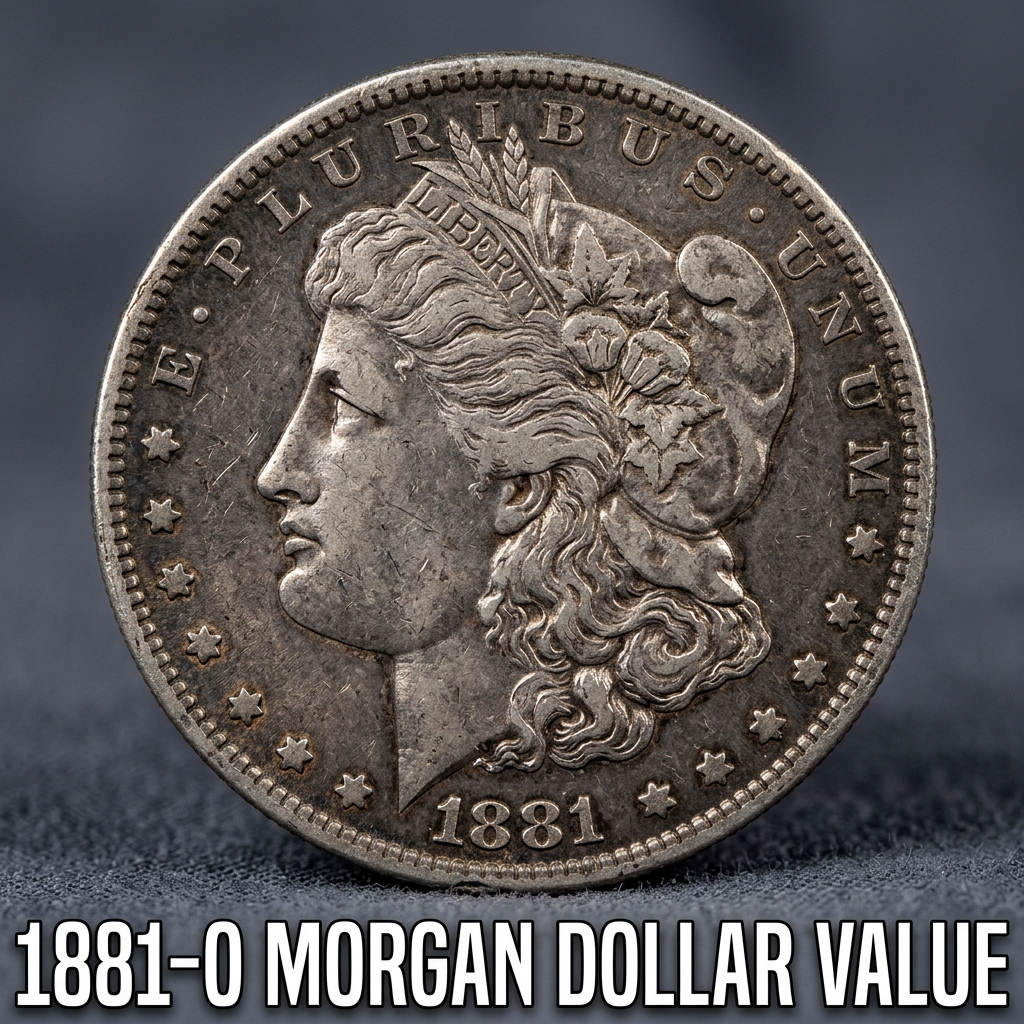
1881 O Morgan Dollar Value and Collector Price Guide
The 1881-O Morgan Dollar is worth anywhere from $35 in worn condition to over $600 in high-grade mint state. Most examples found in old collections fall into the “About Uncirculated” range, typically fetching between $50 and $70 depending on the current silver market and the coin’s eye appeal.
Current Market Value for the 1881-O Morgan Silver Dollar
If you have just discovered an 1881-O Morgan Dollar among your family heirlooms, you are likely wondering exactly how much it is worth today. These coins were struck at the New Orleans Mint, denoted by the small “O” mint mark on the reverse side. The value of this specific year is largely dictated by its preservation level. While millions were minted, many were melted down or heavily circulated in the late 19th century.
To get an instant estimate of your coin’s condition, many collectors now use a free coin identifier app to evaluate their finds. For a standard 1881-O in “Very Good” to “Fine” condition, you can expect a value that stays slightly above the spot price of silver. However, once the coin reaches the “Uncirculated” stage, the price jumps significantly.
The CoinKnow app can help you identify these subtle differences in wear that separate a $50 coin from a $500 treasure. Because the New Orleans Mint was notorious for producing coins with “weak strikes,” finding one with sharp details on Lady Liberty’s hair or the eagle’s breast feathers is quite rare and highly desirable for serious numismatists.
Understanding the Importance of the New Orleans Mint Mark
The “O” mint mark is the key feature that distinguishes this coin from its Philadelphia or San Francisco counterparts. You can find this small letter on the back of the coin, located just above the “D” and “O” in the word “DOLLAR.” The New Orleans Mint played a vital role in American history, and coins from this facility often carry a premium due to their historical charm.
When searching for the 1881 Morgan Silver Dollar worth, you will notice that the 1881-O is generally more common than the 1881-CC (Carson City), but much scarcer in high grades than the 1881-S. This makes the 1881-O a “middle-of-the-pack” coin that offers great opportunities for new collectors.
If your coin looks particularly shiny and lacks scratches, you might be looking at a Mint State (MS) specimen. Checking the specialized 1881-O Morgan Dollar MS prices shows that even a small jump in grade, such as from MS63 to MS64, can double the market value. Using the CoinKnow app ensures you don’t accidentally spend a high-value rarity at face value.
| Condition / Grade | Estimated Market Value |
|---|---|
| Good (G-4) to Very Good (VG-8) | $35 – $40 |
| Fine (F-12) to Very Fine (VF-20) | $42 – $48 |
| Extremely Fine (XF-40) | $50 – $55 |
| About Uncirculated (AU-50) | $60 – $75 |
| Mint State (MS-60) | $110 – $140 |
| Choice Mint State (MS-63) | $220 – $275 |
| Gem Mint State (MS-65+) | $650 – $1,200+ |
Key Varieties and Errors to Look For
While most 1881-O Morgan Dollars follow the standard pricing, there are specific “VAM” varieties that can drive the price much higher. VAM stands for the researchers Van Allen and Mallis, who cataloged different die varieties. Some 1881-O coins feature “doubled dies” where you can see parts of the design appearing twice under a magnifying glass.
One popular variety for this year is various “clashed die” errors, where the image of the eagle from the reverse is lightly impressed onto the obverse (front) of the coin behind Liberty’s head. Professional collectors often pay a premium for these oddities. If you suspect your coin has a unique error, the CoinKnow app can provide high-resolution images to help you compare your coin to known varieties.
Always remember that cleaning your coin will drastically reduce its value. Even if the coin looks dirty or dark, leave it in its original state. Buyers prefer “original skin” or natural toning over a shiny, chemically cleaned surface. A cleaned MS60 coin might only sell for the price of a circulated AU50 coin because the original luster has been stripped away.
Tips for Selling Your 1881-O Silver Dollar
When you are ready to sell, your first step should be determining if the coin needs professional grading by services like PCGS or NGC. Generally, for an 1881-O, it is only worth paying for professional grading if the coin is in MS63 condition or higher. For lower-grade coins, the cost of the grading service might exceed the profit you would gain.
To get the best price, avoid “we buy gold” shops or pawn stores, as they often pay only the silver melt value. Instead, look for reputable local coin dealers or specialized auction sites. Bringing your data from a mobile valuation tool like CoinKnow can also give you more confidence during negotiations, ensuring you receive a fair market price for your silver dollar.
The 1881-O is a favorite among collectors because it represents a time of massive expansion in the American South. Whether you keep it as a piece of history or sell it to fund a new hobby, understanding its value is the first step in being a responsible coin owner.
Q: Where is the mint mark on an 1881-O Morgan Dollar?
A: The “O” mint mark is located on the reverse (back) of the coin, centered just above the “DO” in the word “DOLLAR,” between the eagle’s tail feathers and the wreath.
Q: Is the 1881-O Morgan Dollar made of solid silver?
A: It is made of 90% silver and 10% copper. Each coin contains approximately 0.7734 troy ounces of pure silver, giving it significant “melt value” even if it is in poor condition.
Q: Why are some 1881-O coins so much more expensive than others?
A: Value is determined by “grade” (condition). Most 1881-O coins were struck poorly at the New Orleans mint, so coins with very sharp details and high luster are rare and command a massive premium from collectors.
