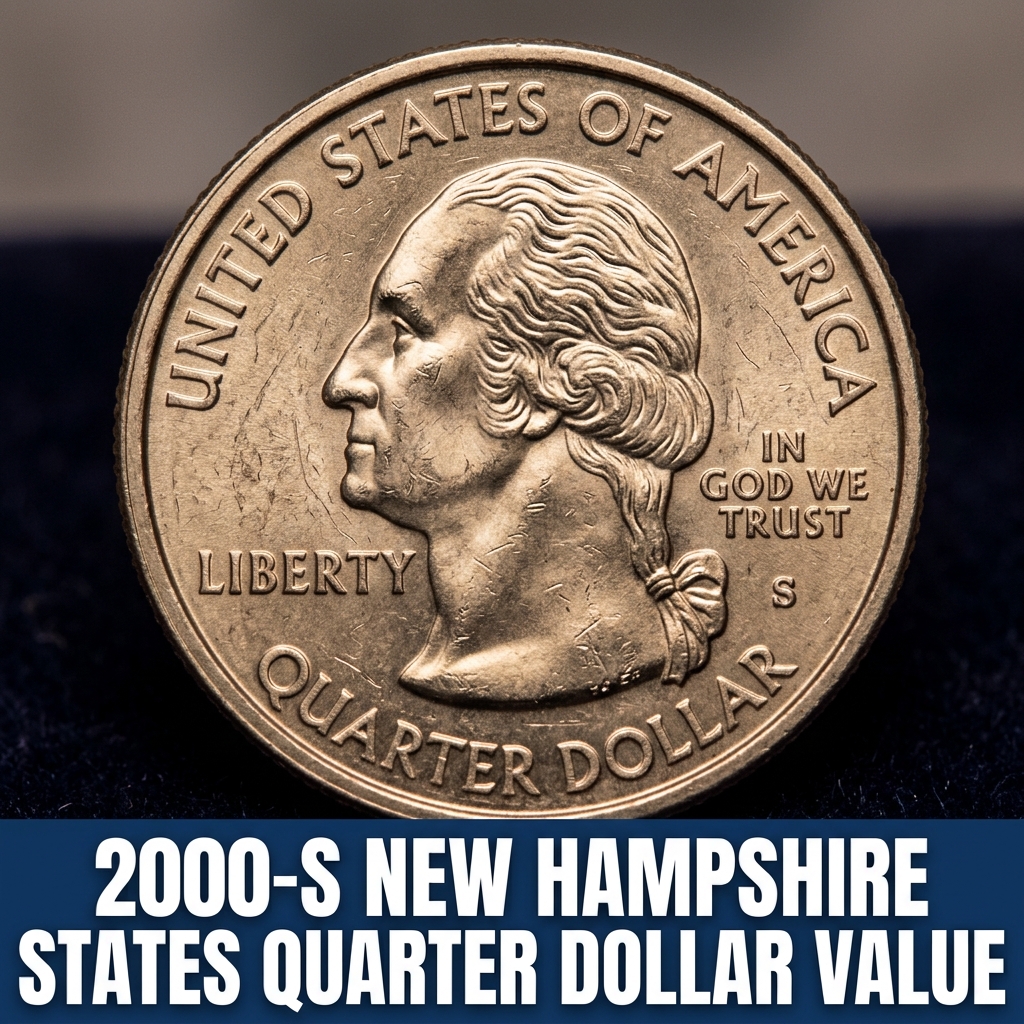
2000 S New Hampshire State Quarter Value and Mint Mark Varieties Guide
The 2000-S New Hampshire State Quarter is worth anywhere from $1 in standard clad proof condition to over $50 for high-grade silver versions. While most quarters you find in your pocket change are only worth their face value, the “S” mint mark signifies a special coin that collector’s often seek out.
Understanding the Special Mirror Finish of the 2000-S Quarter
If you have found a 2000-S New Hampshire State Quarter, you likely noticed it looks different from a regular quarter. These coins were minted in San Francisco specifically for collectors and feature a “proof” finish. This means the background is mirror-like while the raised designs are frosted. To accurately identify your coin and determine its current market demand, you can use a free coin identifier app which helps distinguish between standard business strikes and these specialized San Francisco issues.
The New Hampshire design itself is iconic, featuring the “Old Man of the Mountain” rock formation. Because these were never intended for general circulation, finding one in your change is rare, but it does happen. When you find one, checking the CoinKnow app can provide you with real-time updates on what similar proof coins are selling for on the open market.
It is important to remember that most “S” mint mark quarters come in two distinct versions: Copper-Nickel Clad and 90% Silver. Telling them apart is crucial because the silver version is worth significantly more than the clad version, regardless of the current condition.
Silver vs Clad Proof New Hampshire Quarters
The value of your 2000-S New Hampshire quarter depends heavily on its metal composition. The United States Mint produced both a standard clad proof set and a silver proof set in 2000. The clad version consists of a copper-nickel alloy over a copper core. If you look at the edge of the coin and see a copper-colored stripe, you have the clad version.
On the other hand, the silver version is made of 90% silver and 10% copper. These carry a higher intrinsic value due to their precious metal content. Collectors often refer to the New Hampshire State Quarter price guide to see how these different alloys fluctuate in value. Generally, the silver “S” quarters will always command a premium over the clad ones because of the silver melt value.
If you are unsure which one you have, the CoinKnow app can help you identify characteristics based on weight. A silver quarter weighs approximately 6.25 grams, while a clad quarter weighs 5.67 grams. Even a small difference in weight can mean a big difference in the money in your pocket.
Official Value Chart for 2000-S New Hampshire Quarters
To help you understand what your coin might be worth at a local coin shop or online auction, we have compiled a price table. These values are based on “Proof 65” (PF 65) and “Deep Cameo” (DCAM) grades, which are the standard for well-preserved proof coins.
| Coin Type | Mint Mark | Average Value (Proof) | High Grade Value (PF70) |
|---|---|---|---|
| 2000-S Clad Proof | S (San Francisco) | $1.50 – $3.00 | $15.00+ |
| 2000-S Silver Proof | S (San Francisco) | $12.00 – $18.00 | $45.00+ |
| 2000-P Business Strike | P (Philadelphia) | $0.25 (Face Value) | $5.00 (Uncirculated) |
What Makes These 2000 S Quarters Rare or Valuable
While hundreds of millions of New Hampshire quarters were struck by the Philadelphia and Denver mints for everyday use, the San Francisco mint produced a much smaller quantity. For example, the clad proof mintage was roughly 4 million, and the silver proof was under 1 million. This scarcity is a primary driver of the 2000-S New Hampshire quarter value trends seen by professional numismatists.
The condition of the coin is the final deciding factor. Since proof coins are handled with care by the mint, collectors expect them to be nearly perfect. If a 2000-S quarter has been scratched or spent in a vending machine, it loses its “Proof” appeal and its value drops significantly. However, if yours is in a protective plastic slab or still in its original mint packaging, you could have a small treasure.
Before you consider selling, using the CoinKnow app can help you document your coin’s condition and build a digital portfolio. This is especially helpful if you find several state quarters at once and want to keep track of which ones are “S” mint marks and which ones are regular circulation coins.
Frequently Asked Questions about 2000-S New Hampshire Quarters
Q: Does the 2000-S New Hampshire quarter have any famous errors?
A: While there aren’t many major “S” mint errors reported for this specific year, some proof coins exhibit “haze” or toning from improper storage. Most errors for the 2000 New Hampshire quarter are found in the Philadelphia (P) and Denver (D) coins, such as die cracks or doubled dies.
Q: How can I tell if my 2000-S quarter is silver without a scale?
A: The easiest way is the “Edge Test.” Look at the side of the coin. If you see a solid silver-colored edge with no copper stripe, it is likely the 90% silver version. You can also do a “ping test” by gently tapping it; silver has a much higher-pitched, longer-lasting ring than copper-clad coins.
Q: Is it worth getting my 2000-S New Hampshire quarter graded?
A: Generally, it is only worth professional grading (by NGC or PCGS) if you believe the coin is a perfect PF 70. For standard clad or silver proofs in average condition, the cost of grading usually exceeds the value of the coin. It is better to keep it in a protective flip or capsule for your own collection.
