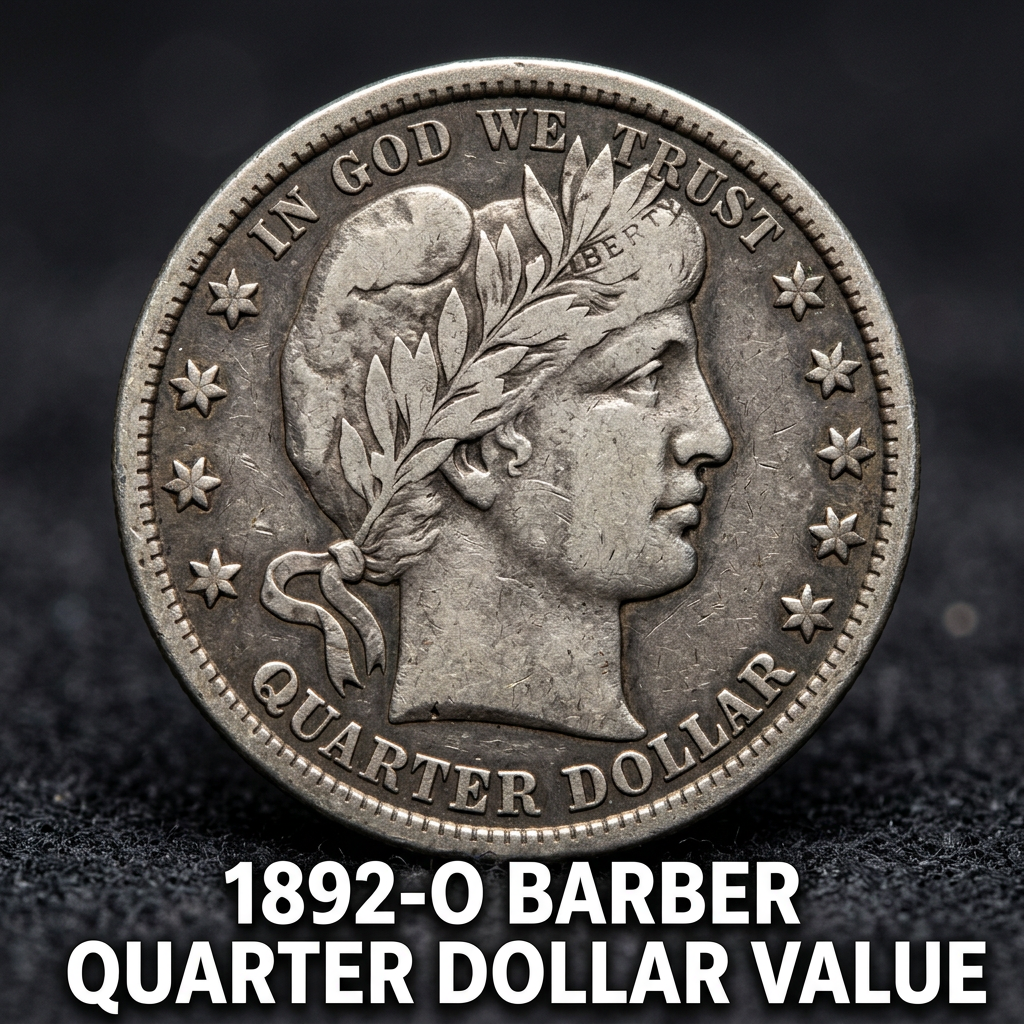
1892 O Barber Quarter Value Guide and Price Chart for Collectors
The 1892-O Barber Quarter Dollar is worth anywhere from $40 in worn condition to over $1,500 in high-grade mint state. Finding one of these silver treasures in a drawer or a family collection is exciting because 1892 marks the very first year this iconic design was minted by the United States.
Understanding the History and Rarity of the 1892-O Barber Quarter
The 1892-O Barber Quarter is a cornerstone of American numismatics, representing the inaugural year of Charles E. Barber’s neoclassical design. Minted at the historic New Orleans facility, these coins carry the distinct “O” mint mark on the reverse, just below the eagle’s tail. Collectors highly prize this specific issue because it belongs to the first-year-of-type series, which always carries historical significance.
If you are unsure whether you have a genuine New Orleans strike, using a free coin identifier app can help you zoom in on the mint mark and verify the coin’s origin. During its first year, the New Orleans Mint produced a relatively modest number of quarters compared to the Philadelphia Mint. This lower mintage, combined with over a century of circulation, means that finding an 1892-O in any condition is a win for the casual hunter.
Whether yours is heavily worn from decades of commerce or still retains some of its original luster, the silver content alone gives it intrinsic value. However, the numismatic premium often far exceeds the melt price. Identifying the specific characteristics of your coin is the first step in determining if you’ve found a common relic or a high-value rarity with the CoinKnow app.
How Condition Impacts the 1892 O Quarter Value
When determining how much your 1892-O Barber Quarter is worth, the “grade” or condition is the most critical factor. Most coins found in old jars or inherited sets are in “Good” or “Very Good” condition. In these states, the coin will show significant wear, with Liberty’s hair nearly smooth and the word “LIBERTY” on her headband barely visible or partially missing.
As the condition improves to “Fine” or “Extremely Fine,” the details in the laurel wreath and the feathers of the eagle on the reverse become much clearer. Coins that have survived in “Uncirculated” or “Mint State” condition are exceptionally rare for this year. These specimens look as though they just left the New Orleans Mint, featuring a full frosty luster and no signs of wear on the high points of the design.
For those who are also checking other silver coins from this era, you might find that the 1892 Morgan Silver Dollar price follows a similar trend where the mint mark location and preservation level dictate the final market price. Use the CoinKnow app to compare your quarter against high-resolution images of graded coins to see where yours fits on the scale.
1892 O Barber Quarter Value Chart
To give you a better idea of what dealers and collectors are paying, refer to the price guide below. Please note that these are estimated market values based on recent auction data and professional grading standards.
| Condition / Grade | Estimated Market Value |
|---|---|
| Good (G-4) | $40 – $55 |
| Very Good (VG-8) | $75 – $95 |
| Fine (F-12) | $150 – $180 |
| Very Fine (VF-20) | $240 – $300 |
| Extremely Fine (EF-40) | $450 – $550 |
| About Uncirculated (AU-50) | $700 – $900 |
| Mint State (MS-60+) | $1,500 – $5,000+ |
Key Identifying Features and Mint Mark Location
To ensure you have the 1892-O version and not the Philadelphia (no mint mark) or San Francisco (“S”) version, you must look at the reverse of the coin. The “O” is located directly above the “QU” in “QUARTER DOLLAR” and right below the eagle’s tail feathers. Because these coins are over 130 years old, the mint mark can sometimes be obscured by dirt or heavy scratches.
The composition of the coin is also important for its value. Every 1892 Barber Quarter is made of 90% silver and 10% copper. This means that even if the coin is so worn that the date is barely readable, it still retains “melt value” based on the current price of silver. However, because 1892-O is a better-date coin, it is almost always worth more to a collector than its raw silver content.
If you are struggling to see the details, don’t clean the coin! Cleaning a vintage silver coin can permanently damage the surface and strip away up to 50% of its collector value. Instead, take a clear photo and use CoinKnow to get a better look at the details. Professional collectors prefer “original” surfaces, even if they are dark or toned.
Where to Sell Your 1892 O Barber Quarter
Once you’ve identified your coin and estimated its grade, you might wonder where the best place is to turn it into cash. Local coin shops are a great starting point for a quick appraisal. For higher-grade examples worth several hundred dollars, you might consider sending the coin to a professional grading service like PCGS or NGC, as “certified” coins often fetch much higher prices at public auctions.
Online marketplaces are also a popular choice, but they require good photography and a clear understanding of what you have. Always compare your coin to recent “sold” listings rather than “active” listings to get a realistic view of the market. The 1892-O remains a favorite among Barber series enthusiasts, so there is usually a ready market of buyers looking for this specific New Orleans minting.
Q: Where is the mint mark on an 1892-O Barber Quarter?
A: The “O” mint mark is located on the reverse (back) of the coin, centered just above the words “QUARTER DOLLAR” and below the eagle’s tail.
Q: Is the 1892-O Quarter made of real silver?
A: Yes, it is composed of 90% silver and 10% copper. It contains approximately 0.1808 troy ounces of pure silver.
Q: Should I clean my old 1892 quarter to make it look better?
A: No, never clean your coins. Harsh chemicals or even soft cloths can leave microscopic scratches that collectors hate, significantly reducing the coin’s resale value.
