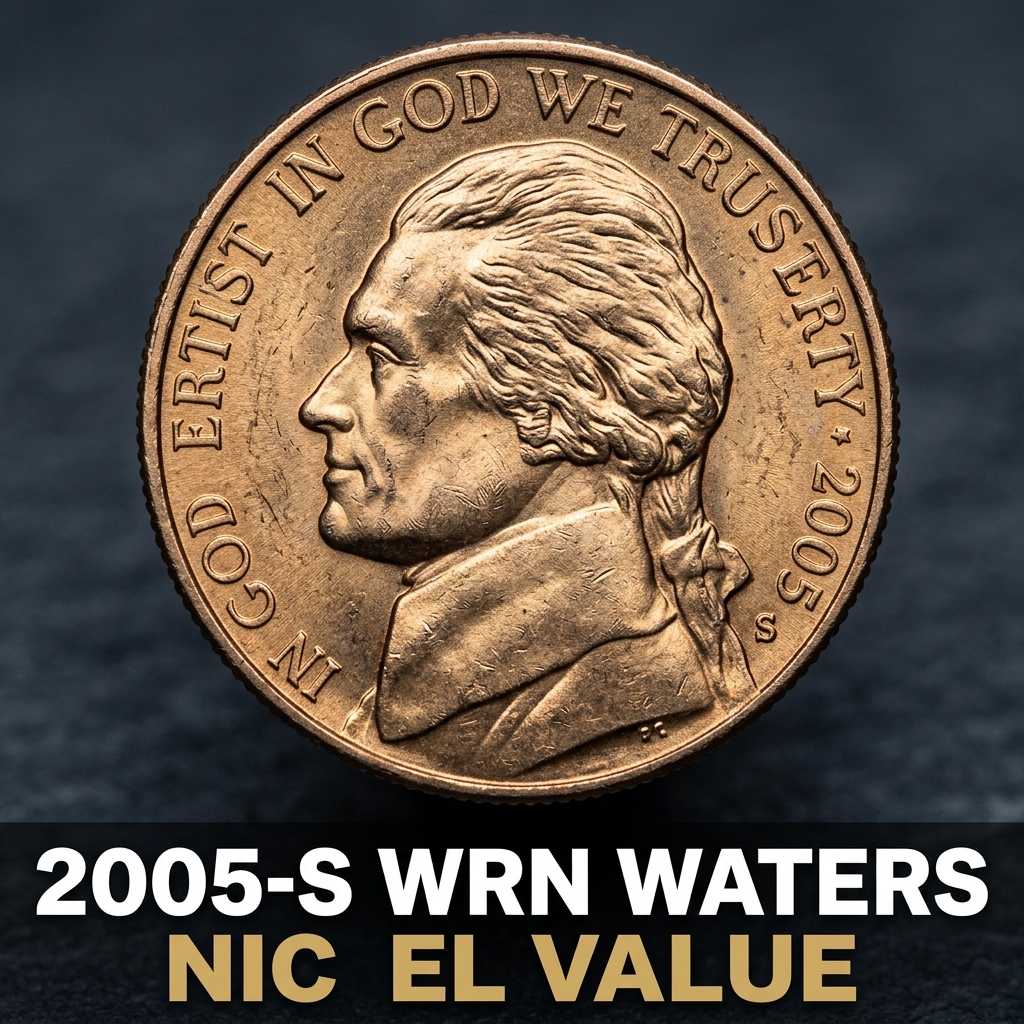
How Much is a 2005 S Western Waters Jefferson Nickel Worth Today
The 2005-S Western Waters Jefferson Nickel is worth anywhere from $5 in typical Proof condition to over $100 for specimens in flawless deep cameo grades. Whether you found one in a collection or are curious about this unique reverse design, understanding its place in the Westward Journey series is the first step.
Understanding the 2005 S Jefferson Nickel Design and History
The year 2005 was a special time for American coinage. As part of the “Westward Journey Nickel Series,” the United States Mint released two distinct designs to commemorate the bicentennial of the Lewis and Clark Expedition. The “Western Waters” design, often called the “Ocean in View” nickel, captures the moment Captain William Clark famously wrote in his journal, “Ocean in view! O! the joy!”
If you aren’t sure which version you have, utilizing a free coin identifier app can help you distinguish between the circulation strikes and the special collector editions. Unlike the billions of nickels made for pocket change in Philadelphia and Denver, the 2005-S version was minted exclusively in San Francisco.
These coins feature a modern, close-up portrait of Thomas Jefferson on the obverse, which was a significant departure from the profile used since 1938. Because the “S” mint mark signifies a Proof coin intended for collectors, these pieces boast a mirror-like finish and sharp details that make them stand out in any coin folder.
Evaluating the 2005 S Western Waters Nickel Value and Grade
When determining the value of your 2005-S nickel, the most critical factor is the grade. Since these coins were sold in United States Mint Proof Sets, they didn’t circulate in the traditional sense. However, if they are removed from their protective plastic cases, they can develop scratches or fingerprints that lower their market price.
For those looking for precise market data, checking the current 2005 nickel market rates will show that most “S” mint proofs trade at a premium over face value. While a standard Proof-65 specimen might sell for a few dollars, a “Deep Cameo” (DCAM) example—where the frosted devices contrast sharply against a black, watery background—can command much more from serious collectors.
To get an instant estimate of your coin’s condition, you can use the CoinKnow app, which uses image recognition to help identify grading features. This is particularly helpful for beginners who might not know how to spot “hairlines” or surface imperfections that experts look for.
| Condition / Grade | Estimated Market Value |
|---|---|
| PR 65 (Standard Proof) | $3.50 – $5.00 |
| PR 69 Deep Cameo | $12.00 – $18.00 |
| PR 70 Deep Cameo (Perfect) | $45.00 – $110.00 |
Factors That Influence the Ocean in View Nickel Value
Beyond the “S” mint mark, collectors often look for specific strike qualities. The 2005-S nickels were struck with specially polished dies. If you find a 2005 nickel in your change that doesn’t have a mirror-like finish, it is likely a P or D mint mark coin intended for circulation. You can learn more about the comprehensive 2005 Jefferson nickel price guide to see how the San Francisco proofs compare to the high-mintage business strikes.
Toning is another factor. Some silver-colored nickels develop “rainbow” toning over time due to the chemicals in the paper or plastic they were stored in. While many collectors prefer a bright white coin, some will pay a significant premium for a 2005-S nickel with attractive, vibrant colors.
If you are unsure whether your coin has natural toning or just surface damage, uploading a photo to the CoinKnow app can connect you with community insights. This can prevent you from accidentally spending a coin that might actually be a high-grade collector’s item worth twenty times its face value.
The Rarity of 2005 S Proof Nickels
In 2005, the San Francisco Mint produced 3,344,679 Proof Jefferson nickels. While three million might sound like a lot, it is a tiny fraction of the nearly 1.5 billion nickels minted in Philadelphia and Denver that same year. This relative scarcity is why the “S” mint mark version is rarely found in change and carries a higher value.
Most of these coins are still tucked away in original 2005 Proof Sets. If you find a loose 2005-S Western Waters nickel, it is considered an “impaired proof.” Even if it is a bit scratched, it is still worth more than five cents because of its copper-nickel composition and collectibility.
Collectors often seek out “First Strike” or early-release designations from grading services like PCGS or NGC. These labels indicate the coin was among the first produced from new dies, often resulting in superior detail on the waves of the Pacific Ocean depicted on the reverse. For any collector, the 2005-S remains a vital piece of the Westward Journey story.
FAQ
Q: How can I tell if my 2005 nickel is a Proof?
A: Look for the “S” mint mark located on the obverse (front) of the coin, to the right of Jefferson’s ponytail. Proof coins also have a distinct mirror-like background compared to the dull, matte finish of regular nickels.
Q: Is the 2005-S Western Waters Nickel made of silver?
A: No, the standard 2005-S nickel is made of a cupronickel alloy (75% copper, 25% nickel). While the Mint does make silver proof sets for some denominations, the 2005 nickels in those sets remained the standard composition.
Q: Can I find a 2005-S nickel in my pocket change?
A: It is very rare, but possible. Usually, this happens when someone breaks open a Proof Set to spend the money. These are called “impaired proofs” and are usually worth about $1 to $2 due to the wear from circulation.
