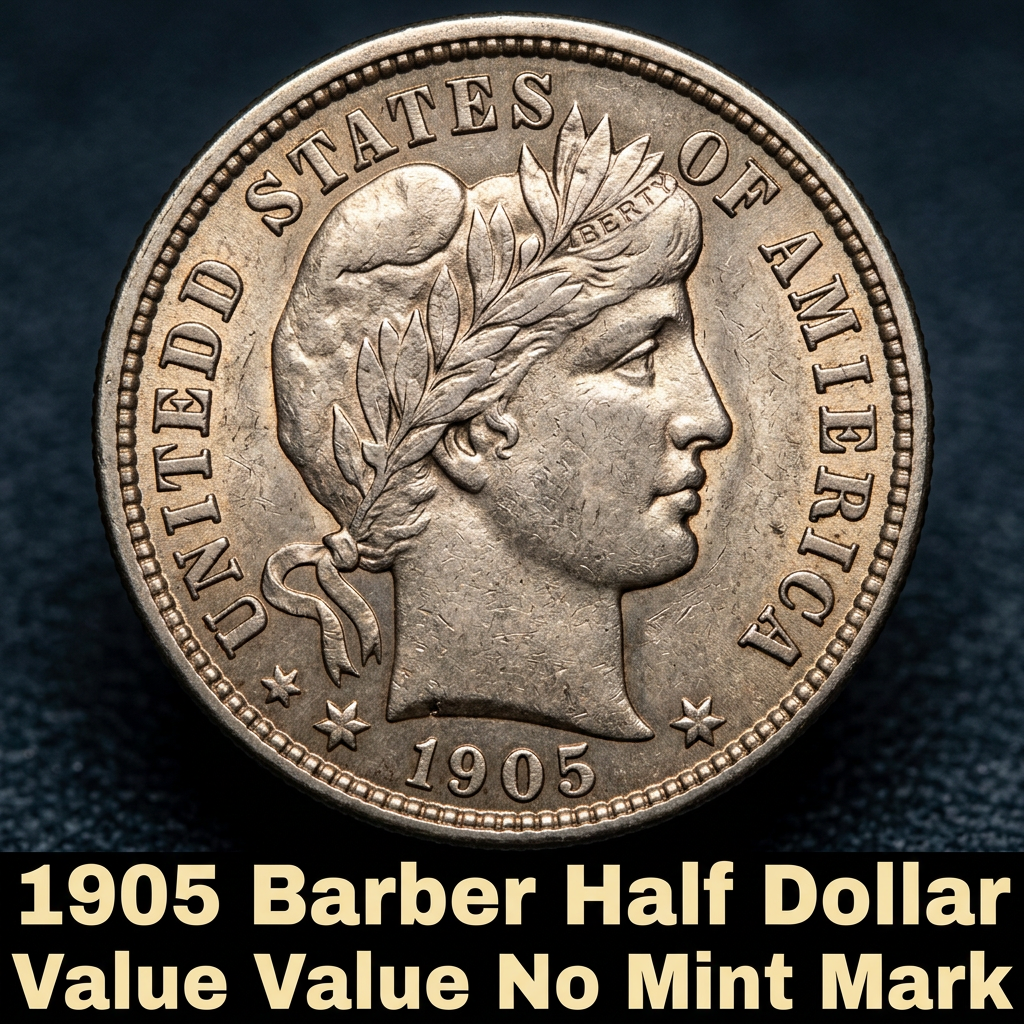
1905 Barber Half Dollar Value Guide for No Mint Mark Coins
The 1905 Barber Half Dollar with no mint mark is worth between $15 in heavily circulated condition and over $800 in high-grade uncirculated condition. Finding one of these heavy silver coins in an old jar or a passed-down collection is an exciting discovery that connects you directly to early 20th-century American history.
The History and Rarity of the 1905 Philadelphia Half Dollar
The 1905 Barber Half Dollar is a classic piece of American numismatics, designed by Charles E. Barber. These coins are often referred to as “Barber halves” and represent a period when silver was the standard for high-value everyday transactions. In 1905, the Philadelphia Mint struck roughly 662,000 of these coins. This is a relatively low mintage compared to modern standards, which naturally adds to its desirability among collectors today.
If you find a half dollar from this year that has no small letter (mint mark) on the reverse, it was minted in Philadelphia. For beginners trying to verify their finds, using a free coin identifier app is the fastest way to confirm the date and mint origin. To get the most accurate results, you should ensure your coin is well-lit before scanning it. Using the CoinKnow app can help you distinguish between a common circulated specimen and a high-value rarity.
Because so many of these coins were used in daily commerce for decades, most survivors are heavily worn. Finding a 1905 silver half dollar that still shows the fine details in Liberty’s hair or the leaves in her crown is quite uncommon. Collectors are always on the lookout for specimens that escaped the heavy friction of pocket change.
Determining the Condition and Grade of Your 1905 Half Dollar
When assessing the 1905 Barber Half Dollar value, the “grade” or physical condition is the most important factor. Coin collectors use a scale from 1 to 70. A coin graded “Good 4” will look very flat, with the design mostly merged into the rims. In this state, the coin is mostly valued for its silver content and its basic historical appeal.
As you move up to “Fine” or “Very Fine” grades, you start to see the word “LIBERTY” become visible on the headband. If you can read all the letters clearly, the value jumps significantly. If you are unsure about the grade, the CoinKnow app provides a great baseline by comparing your coin’s image to known grading standards.
The highest values are reserved for “Uncirculated” or “Mint State” coins. These are pieces that look like they just came from the mint, with a bright luster and no signs of wear on the high points. For those wondering how much a 1905 half dollar is worth in top-tier condition, the prices can easily climb into the thousands of dollars at professional auctions.
1905 Barber Half Dollar Value Chart
Understanding the market price requires looking at how condition affects the bottom line. Below is a price guide for the 1905 Philadelphia (No Mint Mark) Half Dollar based on standard market averages.
| Condition / Grade | Estimated Market Value |
|---|---|
| Good (G-4) | $15 – $22 |
| Very Good (VG-8) | $25 – $35 |
| Fine (F-12) | $65 – $85 |
| Very Fine (VF-20) | $140 – $180 |
| Extremely Fine (EF-40) | $250 – $310 |
| Uncirculated (MS-60+) | $550 – $1,100+ |
Silver Content and Precious Metal Value
Even if your 1905 Barber Half Dollar is in terrible condition—perhaps it is bent, scratched, or almost completely worn smooth—it still holds “melt value.” Every Barber half dollar minted between 1892 and 1915 is composed of 90% silver and 10% copper.
Specifically, a fresh coin contains approximately 0.3617 troy ounces of pure silver. This means that as the price of silver fluctuates on the global market, the floor price of your coin changes as well. You should never spend these for their 50-cent face value! Even at low silver prices, the metal alone is usually worth at least $10.
To keep track of the silver melt value and how it impacts your collection, the CoinKnow tool is an excellent resource for everyday users. It helps you stay updated on whether your coin is worth more for its silver or more for its rarity as a historical artifact.
Identifying Mint Marks on 1905 Half Dollars
In 1905, the U.S. Mint also produced half dollars in New Orleans (O) and San Francisco (S). To find the mint mark, look at the reverse side of the coin, directly below the eagle’s tail feathers and above the letters “HALF DOLLAR.”
If that area is blank, you have the Philadelphia Mint version discussed in this article. If you see a small “O,” it hails from Louisiana, and if you see an “S,” it comes from California. While the Philadelphia “no mint mark” version is relatively scarce, some of the branch mints from this year can be even more valuable in certain grades.
Always handle your coins by the edges. Even a 1905 Barber Half Dollar with no mint mark can lose value if natural skin oils cause new damage or discoloration. If you think you’ve found a high-grade specimen, consider placing it in a protective PVC-free flip or capsule to preserve its current state.
FAQ
Q: Why does my 1905 Half Dollar have no mint mark?
A: During this era, the Philadelphia Mint did not use a mint mark. If the space above “HALF DOLLAR” on the reverse is empty, it simply means it was struck at the main mint in Philadelphia.
Q: Is it okay to clean my 1905 Barber Half Dollar to make it look better?
A: No! You should never clean old coins. Cleaning removes the original surface (patina) and creates microscopic scratches that collectors hate. A cleaned coin can lose over 50% of its numismatic value instantly.
Q: How can I tell if my coin is silver or just a copy?
A: Genuine 1905 half dollars are 90% silver. They have a specific weight (12.5 grams) and a distinctive “ring” when gently tapped. If a magnet sticks to your coin, it is a fake, as silver is not magnetic.
