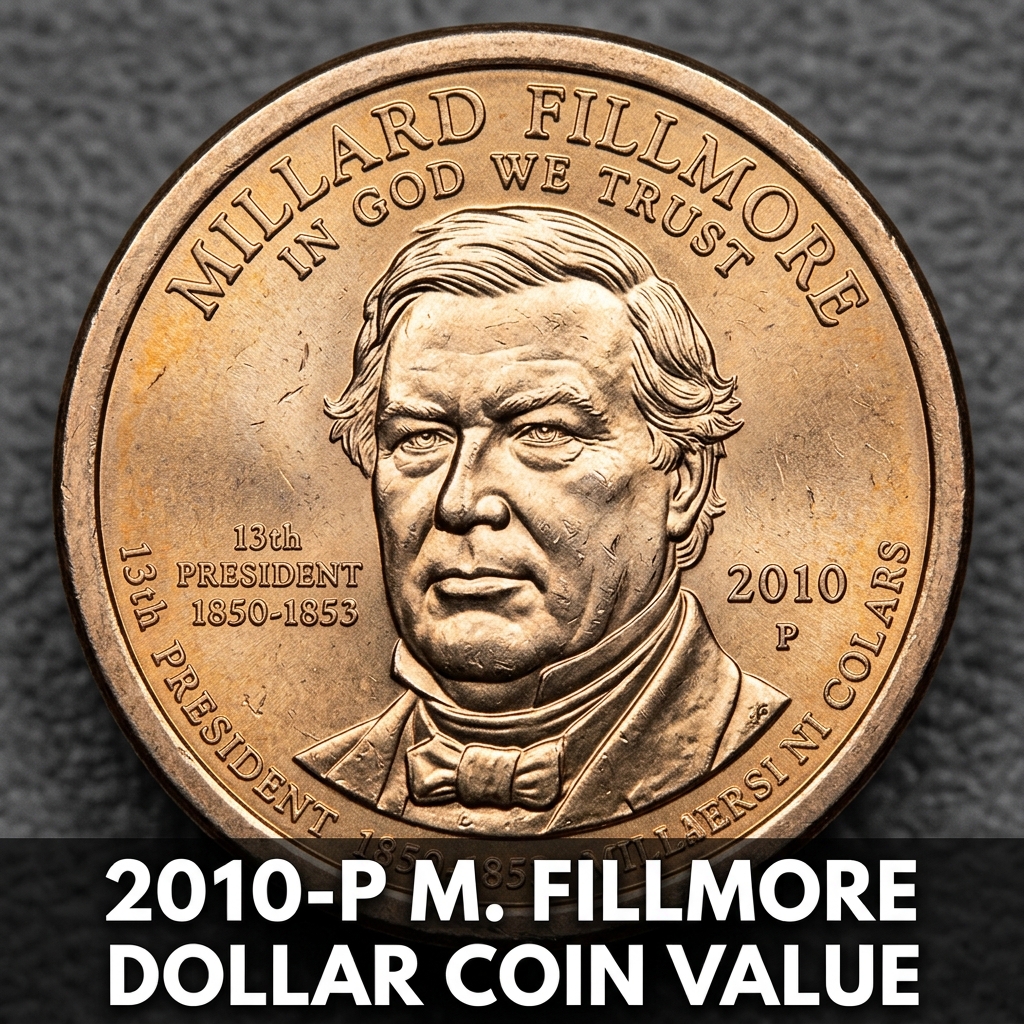
2010 P Millard Fillmore Dollar Value Guide and What Your Coin Is Worth Today
The 2010 P Millard Fillmore Dollar is worth anywhere from its $1 face value in circulated condition to over $50 in high-grade mint state. Most examples found in pocket change today are only worth face value, but specific collector versions and coins in pristine condition can fetch a modest premium.
An Overview of the Millard Fillmore Presidential Dollar Series
If you just looked into your coin jar and found a golden-colored coin featuring the 13th U.S. President, you have a piece of the Presidential $1 Coin Program. These coins were minted to honor the leaders of the United States, and the Millard Fillmore version was released in 2010. While they look like gold, they are actually composed of a copper core cladded with manganese brass, which gives them that distinct yellow shine.
The “P” mint mark indicates that your coin was struck at the Philadelphia Mint. Because these were produced in large quantities—over 36 million for the Philadelphia mint alone—they are very common. If you are unsure if your coin is a “P” or a “D,” you can check the edge of the coin. The year, mint mark, and the motto “E Pluribus Unum” are all incused on the rim. Using a free coin identifier app is the fastest way to confirm exactly which variation you have in your hand.
Many beginners use CoinKnow to manage their collections because small details like rim dings or surface scratches can heavily impact the final price. While Millard Fillmore isn’t usually the most sought-after president among history buffs, his coin remains a staple for those trying to complete a full set of the series.
Understanding the Current Market Value and Price Grading
When determining the value of your 2010-P dollar, condition is the most critical factor. For coins found in everyday circulation, the value rarely exceeds one dollar. This is because banks still have massive stockpiles of these coins. However, if you have an uncirculated coin that looks like it just came out of a fresh mint roll, you might be looking at a small profit.
Professional grading services like PCGS or NGC use a scale from 1 to 70. A coin graded MS65 (Mint State 65) is considered high quality. For this specific issue, looking at the current market value for 2010 uncirculated dollars shows that “gems” can sell for $5 to $10. If you are lucky enough to find a coin that scores an MS67 or higher, the price can jump significantly because such perfect specimens are rare.
Most hobbyists use CoinKnow to track these price fluctuations in real-time. Since the market for modern dollars is relatively stable, you aren’t likely to see overnight price spikes, but keeping an eye on historical trends for the 2010 presidential dollar value and auction records helps you know when to sell.
| Condition / Grade | Estimated Value (USD) |
|---|---|
| Circulated (Average Wear) | $1.00 |
| Uncirculated (MS60 – MS63) | $2.00 – $4.00 |
| Choice Uncirculated (MS65) | $8.00 – $12.00 |
| Superb Gem (MS67+) | $45.00+ |
| Proof Finish (S Mint Mark) | $3.00 – $7.00 |
Key Errors and Varieties to Look For
While the standard 2010-P Fillmore dollar is common, error collectors are always on the hunt for “minting mistakes.” These errors occur during the production process and can make a normal one-dollar coin worth hundreds of dollars. The most famous errors in the Presidential Dollar series involve the edge lettering.
In some cases, the coin might skip the edge-lettering machine entirely, resulting in a “smooth edge” error. These are highly prized. Another common variation is “double edge lettering,” where the coin passes through the machine twice, creating overlapping text. If you find a coin with missing stars or blurry lettering on the rim, do not spend it!
To verify an error, many people use CoinKnow to compare their coin against known error photos. Because these coins were minted by the millions, minor die cracks or “grease strikes” (where part of the design looks faint) are common but usually don’t add much value. Only major, visible errors will lead to a significant payday at a coin show or online auction.
Tips for Selling and Preserving Your 2010 P Dollar
If you have determined that your Fillmore dollar is in top-tier condition or features a rare error, you need to handle it properly. Never clean your coins. Common household cleaners or even a soft cloth can leave microscopic scratches that ruin the “mint luster,” instantly dropping the coin’s value to face value.
Instead, hold the coin only by its edges and store it in a PVC-free flip or a plastic capsule. This prevents oils from your skin from causing dark spots or “toning.” If you decide to sell, you can list it on platforms like eBay or visit a local coin shop. However, keep in mind that for a coin worth $10, the cost of professional grading (around $30-$50) might be higher than the coin itself.
For the everyday American, these coins are a fun piece of history to hold onto. While you likely won’t retire on the value of a 2010-P Millard Fillmore dollar, finding one in your change is a great way to start a new hobby.
Q: Is the 2010 P Millard Fillmore dollar made of real gold?
A: No, the coin is made of a base metal alloy consisting of 88.5% copper, 6% zinc, 3.5% manganese, and 2% nickel. It has a golden color but contains no actual gold.
Q: Where is the mint mark located on this coin?
A: The mint mark (P, D, or S) is located on the edge of the coin, along with the year and the motto “E Pluribus Unum.” You have to look at the side of the coin rather than the front or back.
Q: Why are some 2010 P dollars worth more than others?
A: Value is driven by “Grade” (how perfect the coin looks) and “Errors.” A coin that has never been touched and has no scratches is worth more to a collector than one used in a vending machine.
