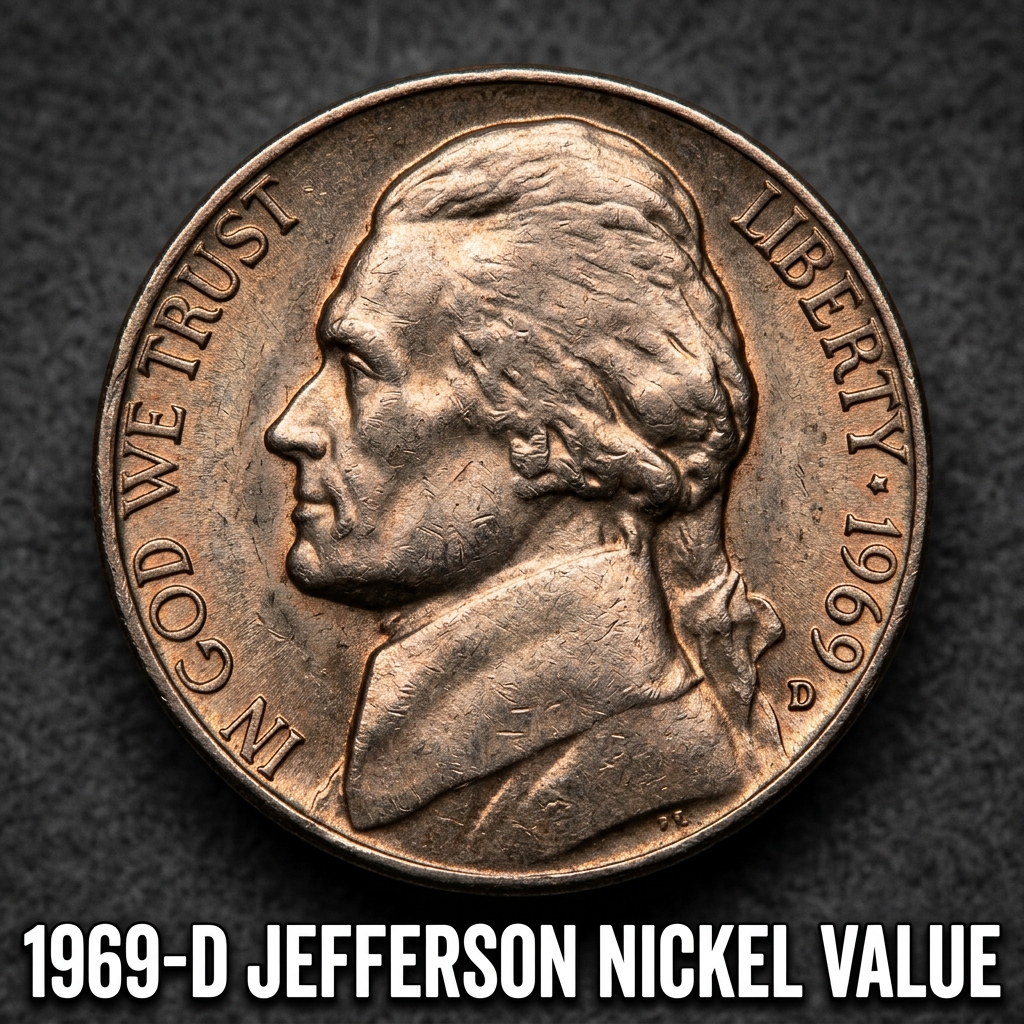
1969 D Jefferson Nickel Value and History Guide for Collectors
The 1969 D Jefferson Nickel is worth anywhere from $0.05 in worn condition to over $1,000 for rare specimens with Full Steps. While most of these coins you find in pocket change are only worth their face value, certain high-grade examples and error coins can be a significant payday for lucky finders.
The Basics of the 1969 D Jefferson Nickel and Its Rarity
If you just pulled a 1969 nickel out of your jar, the first thing to look for is the “D” mint mark on the reverse side. This mark indicates it was struck at the Denver Mint, which produced over 200 million of these coins. Because of this high mintage, a common circulated 1969 D nickel isn’t rare. However, finding one in pristine, uncirculated condition is a completely different story. Many people use a free coin identifier app to check if their coins have the sharp details required for a higher value.
Most of these coins were hit and scratched in huge bins at the mint, making high-grade “Mint State” versions quite scarce. Collectors are always on the hunt for pieces that look like they just came off the press. If you think you’ve found something special, the CoinKnow app can help you compare your coin’s condition against high-value auction records to see where yours stands.
Determining the Market Price for the 1969 D Nickel
When it comes to the actual market price, your coin’s grade is everything. Coin grading scales from 1 to 70, and for a 1969 D nickel, the jump from a grade of MS64 to MS65 can mean a difference of hundreds of dollars. Most collectors refer to professional data to see the current 1969 D nickel price trends for uncirculated specimens.
Commonly circulated nickels from this year are essentially worth five cents, or perhaps a small premium of 10 to 15 cents to a casual collector. However, if the coin has a beautiful natural toning or possesses exceptionally sharp strikes on Thomas Jefferson’s hair and the building details of Monticello, the price climbs quickly. To get a better sense of value, it’s helpful to look at a comprehensive guide to 1969 nickel worth across all mint marks and conditions.
| Condition / Grade | Estimated Market Value |
|---|---|
| Circulated (Average Wear) | $0.05 – $0.15 |
| Uncirculated (MS63) | $1.00 – $5.00 |
| Choice Uncirculated (MS65) | $25.00 – $50.00 |
| Superb Gem (MS66+) | $150.00 – $400.00 |
| MS65 with Full Steps (Rare) | $1,000.00+ |
The Full Steps Designation and What It Means for You
The “Holy Grail” for Jefferson Nickel collectors is the “Full Steps” (FS) designation. On the reverse of the coin, there are steps leading up to Monticello. In 1969, the dies used at the Denver Mint were often worn down, resulting in coins where these steps look like a flat blur. If you find a 1969 D nickel where at least five or six steps are clearly visible and separated, you have found a treasure.
Using the CoinKnow app allows you to zoom in on these fine details to see if your coin meets the criteria. A 1969 D nickel with Full Steps in a high grade can sell for over $1,000 at major auctions because they are so difficult to find. Even if the coin isn’t perfect, having those distinct lines makes it much more desirable than a standard strike.
Common Errors to Look For on 1969 Denver Nickels
Beyond standard grading, error hunters love the 1969 D Jefferson Nickel. Because quality control in the late 60s wasn’t as strict as it is today, several interesting mistakes made it out of the mint. Look for “Repunched Mint Marks” where the “D” looks like it was stamped twice, slightly overlapping. These can add a nice $10 to $50 premium to the coin’s value depending on how obvious the error is.
Another common error is the “clipped planchet,” where the coin looks like a bite was taken out of the edge. You should also keep an eye out for “die cracks,” which appear as raised lines of metal running across the coin’s surface. If you aren’t sure if what you’re seeing is an error or just damage from 50 years of circulation, the CoinKnow community and image recognition tools are excellent resources for verification.
Q: Where is the mint mark on a 1969 D Jefferson Nickel?
A: The “D” mint mark is located on the reverse side of the coin, to the right of Monticello, near the rim.
Q: Is a 1969 nickel made of silver?
A: No, the 1969 D Jefferson Nickel is made of a cupro-nickel alloy (75% copper and 25% nickel). Silver was removed from nickels after 1945.
Q: How can I tell if my 1969 D nickel is uncirculated?
A: An uncirculated coin will have “mint luster,” a frosty or satiny sheen that reflects light in a fan-like pattern. If the highest points of Jefferson’s cheek or the building show any dullness or smoothness, the coin is likely circulated.
