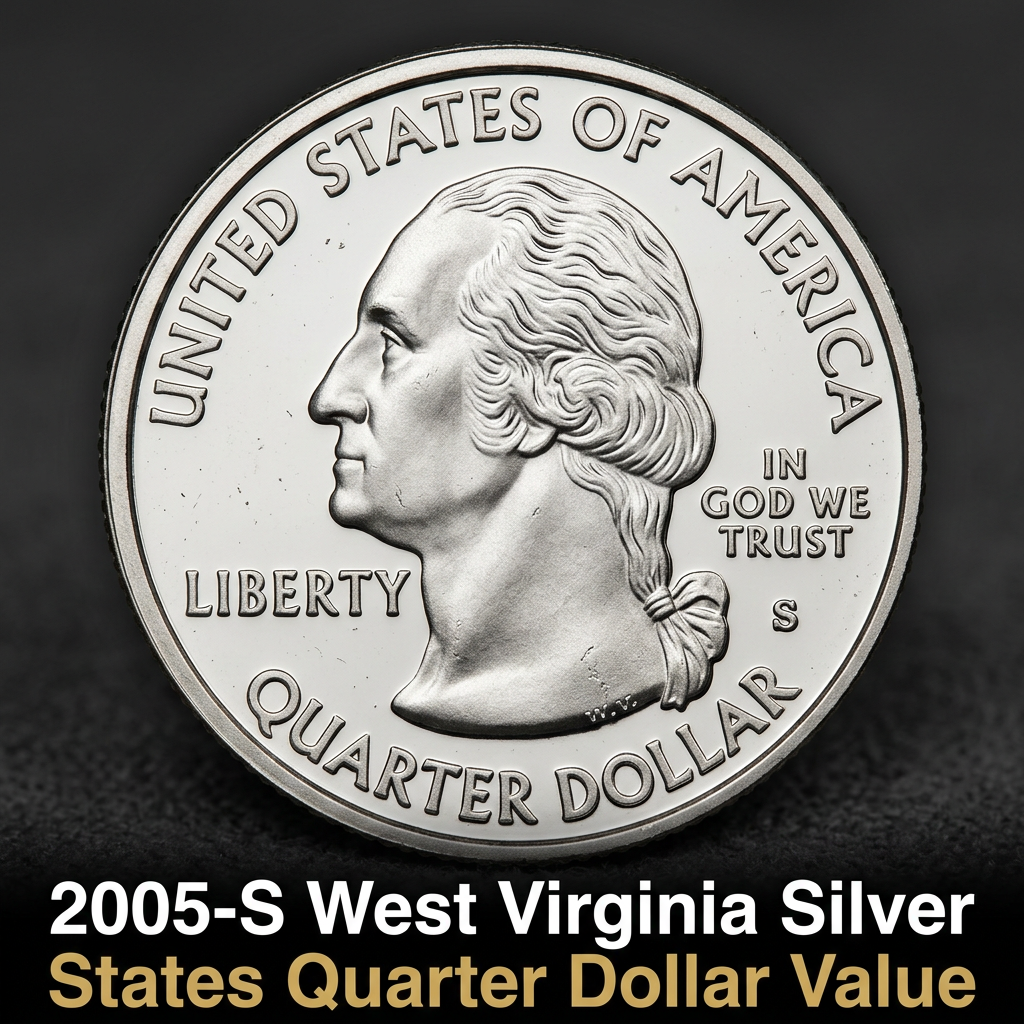
2005 S Silver West Virginia Quarter Value and Collector Information
The 2005 S West Virginia Silver State Quarter is worth anywhere from $8 in typical proof condition to over $50 for high-grade specimens. If you have stumbled upon one of these shiny treasures in a collection or a special set, you are likely looking at a coin minted specifically for collectors rather than general circulation.
Understanding the 2005 S Silver West Virginia Quarter
The West Virginia state quarter was the 35th coin released in the 50 State Quarters Program. While the Philadelphia and Denver mints produced billions of copper-nickel quarters for daily spending, the San Francisco Mint produced a limited number of “S” mint mark silver proofs. These coins are distinct because they are composed of 90% silver and 10% copper, unlike the standard pocket change you find today.
Before you assume your coin is silver, check the edge. A silver quarter will show a solid silver-colored stripe, whereas a standard quarter has a visible copper ring. To get an instant confirmation of what you have, you can use a free coin identifier app to scan the obverse and reverse of your coin. Using a tool like CoinKnow helps everyday people avoid the mistake of spending a valuable silver coin at a vending machine.
Many people find these coins when inheriting a collection or purchasing “Silver Proof Sets.” Because they were never intended to circulate, they often retain their “deep cameo” finish, which features frosted images against a mirror-like background. If you are unsure of the grade, CoinKnow can provide a visual reference to help you estimate the condition.
Specific Value Ranges for Silver West Virginia Quarters
The value of the 2005 S Silver West Virginia quarter depends heavily on its “Grade” and its “Strike.” Since these were handled with care at the mint, most survive in excellent condition. A standard PR 69 (Proof 69) specimen is quite common and usually sells for about $10 to $12. However, if the coin is graded as a perfect PR 70, the value can jump significantly due to its rarity in that perfect state.
It is helpful to compare these prices to other coins from the same era. For instance, you might find that the market value for 2005 state quarters varies depending on the specific state and the minting location. While the West Virginia silver version is generally worth more than a business-strike California quarter, both have unique places in a complete set.
If your coin is still in its original US Mint plastic packaging, it generally holds its value better. Once a silver proof is removed and handled with bare fingers, oils from the skin can cause “toning” or cloudiness, which might lower the price. Always handle these coins by the edges or use cotton gloves to preserve their premium status.
| Condition / Grade | Estimated Market Value |
|---|---|
| PR 65 (Proof) | $7.50 – $9.00 |
| PR 67 (Proof) | $10.00 – $12.00 |
| PR 69 (Near Perfect) | $14.00 – $18.00 |
| PR 70 (Perfect Grade) | $45.00 – $65.00 |
Design Features and Minting Secrets
The reverse design of the West Virginia quarter features a stunning view of the New River Gorge and the New River Gorge Bridge. This bridge was, at the time of the coin’s design, the longest steel-arch bridge in the world. The design also includes the inscriptions “West Virginia,” “1863” (the year of statehood), and “2005.” Collectors often look for the “S” mint mark located on the obverse (the side with George Washington) to confirm it is a proof coin.
While viewing the current 2005 silver quarter worth and price data, you may notice that silver prices affect the “floor” value of this coin. Since it contains 0.1808 troy ounces of pure silver, it will always be worth at least its weight in silver metal (melt value), even if the coin is scratched or damaged. This provides a “safety net” for the value of your find.
To ensure you aren’t missing any rare errors, you can use CoinKnow to browse high-resolution images of known variety coins. While errors are rare in proof sets, “Double Dies” or “Striking Errors” can occasionally occur, significantly increasing the coin’s desirability among specialist collectors.
How to Sell or Store Your 2005 S Silver Quarter
If you decide to sell your West Virginia Silver Quarter, you have several options. Local coin shops are the fastest route, though they will typically offer a “wholesale” price so they can resell it for a profit. For the highest return, private sales on numismatic platforms or auction sites are preferred. Always ensure you have a clear photo of the coin’s “S” mint mark and the reflective surface.
Proper storage is crucial for maintaining the value of silver coins. Because silver reacts with sulfur in the air (tarnish), you should store your coin in a PVC-free plastic holder or a dedicated coin album. Avoid keeping them in envelopes or cardboard folders that aren’t specifically designated as “acid-free,” as these can cause ugly black spots over time.
Before selling, check the latest auction results to see what similar coins have recently sold for. Pricing can fluctuate based on the current “Spot Price” of silver. Whether you are a casual hobbyist or someone who just found a shiny coin in a drawer, understanding the difference between a common quarter and a 90% silver proof is the first step toward building a valuable collection.
Q: How can I tell if my 2005 West Virginia quarter is silver or clad?
A: Check the edge of the coin. If you see a solid silver stripe with no copper color, it is likely the 90% silver version. You can also weigh it; a silver quarter weighs 6.25 grams, while a clad quarter weighs 5.67 grams.
Q: Is the 2005 S Silver West Virginia Quarter rare?
A: It is not “rare” in the sense that millions were made (approximately 1.6 million), but it is much scarcer than the hundreds of millions of regular quarters minted in Philadelphia and Denver that year.
Q: Can I find a Silver West Virginia quarter in my pocket change?
A: It is very unlikely, but possible. Sometimes people accidentally spend proof sets or “break” them to use as cash. If you find one in circulation, it is called a “circulated proof” and will usually be worth less than a pristine one.
