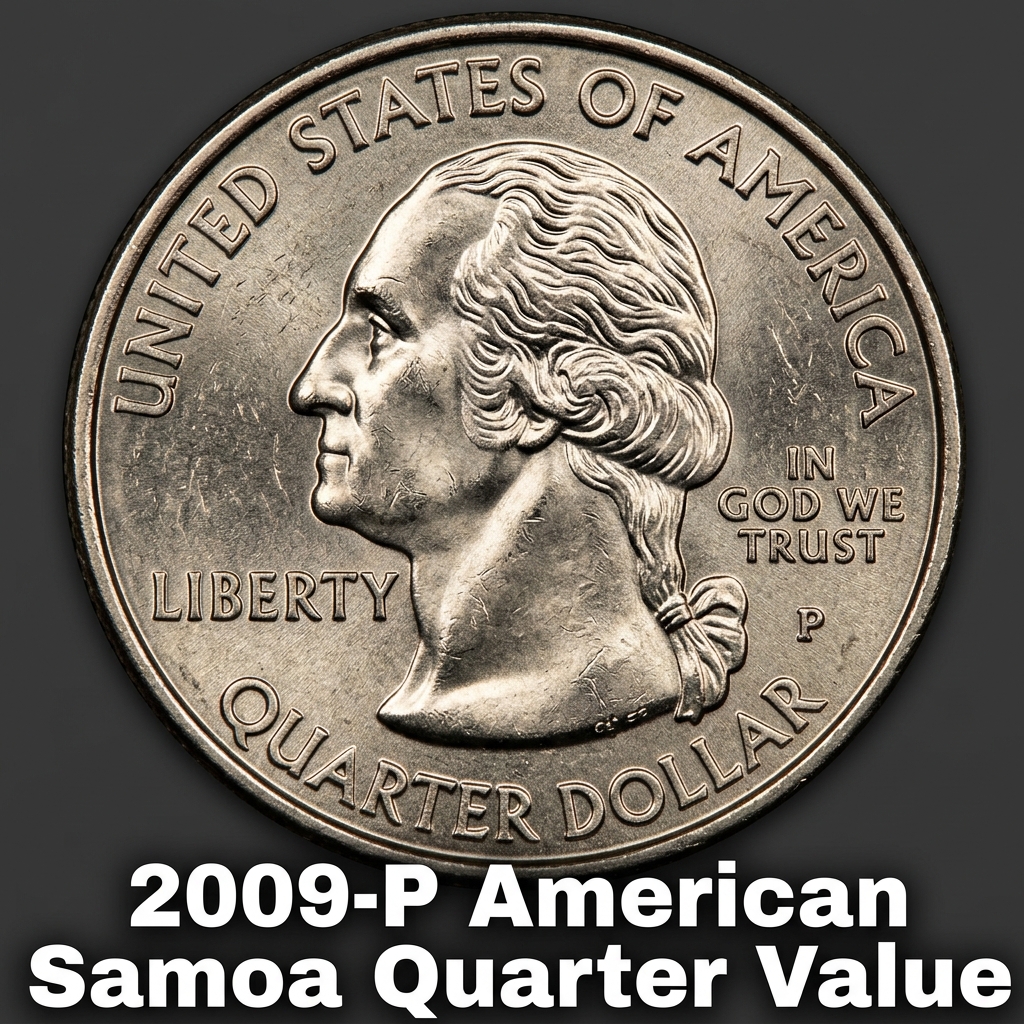
2009 P American Samoa Quarter Value and Rarity Guide for Collectors
The 2009-P American Samoa Quarter is worth anywhere from its face value of $25 cents in worn condition to over $30 for high-grade uncirculated specimens. While most of these coins found in your change are only worth a quarter, certain rare errors and pristine business strikes can command a significant premium among collectors.
What Makes the 2009 P American Samoa Quarter Special
The 2009 American Samoa Quarter was the fourth release in the District of Columbia and U.S. Territories Quarters Program. This specific coin features an image of an ava bowl, a whisk, and a staff, which are symbols of the traditional authority of Samoan chiefs. The “P” mint mark indicates that the coin was produced at the Philadelphia Mint. During 2009, the United States was in the midst of an economic recession, which led the Mint to significantly lower production numbers compared to previous years.
Because of these lower mintage figures, 2009 quarters are generally harder to find in pocket change today than those from the statehood series of 1999-2008. If you are unsure if you have a genuine Philadelphia strike, a free coin identifier app can help you zoom in on the mint mark and confirm its origin. Many people use the CoinKnow app to quickly catalog these finds before deciding whether to sell them or keep them in a collection.
Finding a 2009-P quarter in “pocket change” condition usually means it has been circulated heavily. In these cases, the coin is typically only worth 25 cents. However, if you happen to find one that looks brand new with a sharp luster, it might be an uncirculated “Mint State” coin. These are the ones that collectors look for on platforms like CoinKnow to fill gaps in their territory quarter sets.
Current Market Value and Price Chart
The value of the 2009-P American Samoa Quarter is heavily dependent on its “grade,” which is a professional assessment of its condition. Coins are graded on a scale from 1 to 70. Most coins in your wallet are between Grade 12 (Fine) and Grade 50 (About Uncirculated). To get a better idea of what your specific coin might be worth, check out this detailed breakdown of 2009 quarter prices across all mint locations.
Collectors often look for “MS65” or higher. An MS67 grade is considered exceptional for a Philadelphia strike and can fetch a much higher price at auction than a standard quarter. Below is a price guide based on recent market trends for the 2009-P American Samoa Quarter:
| Condition / Grade | Estimated Value |
|---|---|
| Circulated (Good to About Uncirculated) | $0.25 – $0.50 |
| Uncirculated (MS63) | $1.00 – $2.50 |
| Choice Uncirculated (MS65) | $5.00 – $8.00 |
| Superb Gem Uncirculated (MS67+) | $30.00 – $150.00+ |
Identifying Rare Errors on American Samoa Quarters
One of the most exciting ways a 2009-P quarter can be worth significant money is if it contains a mint error. Errors occur when something goes wrong during the striking process at the Philadelphia Mint. While no major “doubled die” varieties are famous for this specific year yet, many collectors keep an eye out for off-center strikes or “die chips.”
Die chips are small bumps of extra metal on the coin’s surface, often appearing near the letters or the Ava bowl design. An off-center strike happens when the coin blank isn’t aligned correctly, resulting in a portion of the design being missing. These errors can turn a common 25-cent coin into a hundred-dollar treasure.
To spot these tiny details, many hobbyists use the CoinKnow app, which allows you to compare your coin against high-resolution images of known errors. Because the 2009 quarters had lower production, any error found on a 2009-P American Samoa quarter is considered quite rare compared to errors on more common years.
How to Store and Protect Your 2009 Quarters
If you find a 2009-P American Samoa Quarter that appears to be in perfect condition, it is vital to protect it. Even a single fingerprint can leave oils that eventually tarnish the metal and lower the coin’s value. Collectors recommend using cardboard “2×2” holders or plastic coin capsules to keep the air and moisture away from the surface.
Avoid cleaning your coins at all costs. Many beginners think that “shining up” a coin will make it worth more, but professional graders can easily spot a cleaned coin. Cleaning actually removes a microscopically thin layer of the original metal, which can plumment the value of a potentially expensive uncirculated quarter to just its face value.
Instead of cleaning, focus on identifying the quality of the strike. The “P” mint mark should be clear and sharp. The feathers on the whisk and the texture of the Ava bowl are the first places to show wear. If those details are crisp, you may have a winner on your hands.
Q: How can I tell if my 2009 American Samoa Quarter is a “P” or “D” mint?
A: Look on the right side of George Washington’s portrait on the front (obverse) of the coin. You will see a small letter next to his ponytail. A “P” stands for Philadelphia, and a “D” stands for Denver.
Q: Why are 2009 quarters rarer than other years?
A: Due to the 2009 economic downturn, the demand for new coinage dropped. Consequently, the U.S. Mint produced significantly fewer quarters in 2009 than in previous or subsequent years, making them harder to find today.
Q: Is a 2009-P American Samoa Quarter worth getting professionally graded?
A: It is generally only worth the cost of professional grading if the coin is in near-perfect condition (MS66 or higher) or if it has a very obvious and significant mint error. Most circulated coins should just be kept as fun collectibles.
