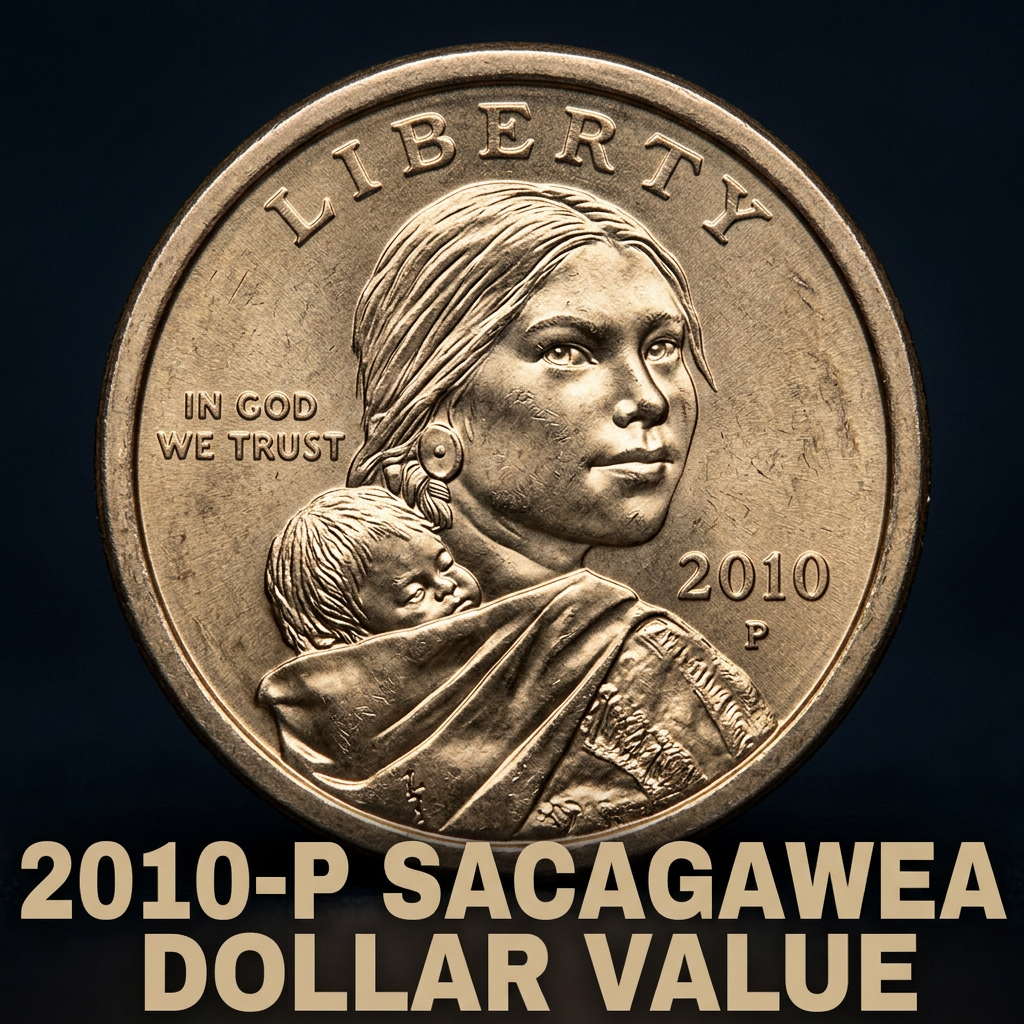
2010 P Sacagawea Dollar Value and What Your Golden Coin is Worth Today
The 2010 P Sacagawea Dollar is worth anywhere from its face value of $1 in circulated condition to over $100 for high-grade specimens in original mint packaging. While most of these “golden dollars” are common pocket change, certain versions featuring the Great Law of Peace design can be quite collectible for enthusiasts.
What Makes the 2010 P Sacagawea Native American Dollar Special
If you just found a shiny gold-colored coin in your change, you are likely looking at the 2010 Native American Dollar. While the front still features the iconic image of Sacagawea and her infant son, Jean Baptiste Charbonneau, the back changed significantly this year. The 2010 reverse depicts the Great Law of Peace, showing the Hiawatha Belt and five bundled arrows. This design honors the Iroquois Confederacy and represents the theme of “Government.”
Because these coins were primarily minted for circulation, many people believe they are rare gold coins. However, they are actually made of a copper core clad in manganese brass, which gives them that distinct yellow shimmer. To get a quick idea of what you have, you can use a free coin identifier app to check the mint mark and condition instantly. Most of the coins you find in daily life will be “P” mint marks, meaning they were produced at the Philadelphia Mint.
When evaluating your collection, using a professional tool like CoinKnow can help you distinguish between a standard strike and a high-quality uncirculated specimen. The mintage for the 2010-P was approximately 32 million, which sounds like a lot, but is much lower than the hundreds of millions produced in the year 2000. This relative scarcity compared to earlier years keeps the interest alive for modern coin hunters.
Understanding the 2010 P Sacagawea Dollar Value and Grading
The market value of your 2010-P dollar is heavily dependent on its “Mint State” (MS) grade. Most coins found in cash registers are “Circulated,” meaning they have scratches, dullness, or fingerprints. These are usually worth exactly $1. However, if you have a coin that was tucked away in a roll or a mint set, it could be worth much more. collectors look for sharp details on the arrows and the feathers of Sacagawea’s wrap.
For those looking for specific market data, checking the 2010-P Sacagawea Dollar MS price trends reveals that coins graded MS66 or MS67 can fetch a significant premium. These top-tier coins often exhibit a “satin finish” or a very clean surface free of contact marks. If yours looks exceptionally bright and perfect, it might be worth sending to a grading service.
If you are unsure whether your coin is a standard strike or something more valuable, the CoinKnow app provides high-resolution comparisons to help you spot the difference. For a deeper dive into why some years are more expensive than others, you can read more regarding the 2010 Native American dollar valuation guide which highlights historical auction records and rarity factors.
Current Market Value Price Chart for 2010-P Dollars
To help you understand what your coin might sell for on sites like eBay or at a local coin shop, we have compiled a price guide based on the Sheldon Grading Scale (1-70). Note that most coins found in everyday change fall into the “Circulated” category.
| Coin Condition / Grade | Estimated Value (USD) |
|---|---|
| Circulated (Average Wear) | $1.00 |
| About Uncirculated (AU58) | $1.50 – $2.50 |
| Mint State (MS63) | $5.00 – $8.00 |
| Gem Mint State (MS65) | $15.00 – $25.00 |
| Superb Gem (MS67+) | $120.00+ |
Edge Letterings and Varieties to Look For
One of the most interesting features of the 2010 P Sacagawea Dollar is the edge lettering. Since 2009, the date, mint mark, and the motto “E Pluribus Unum” have been moved from the face of the coin to the edge. This was done to allow more space for the beautiful artwork on the obverse and reverse. When searching through your coins, check the rim carefully.
There are two “positions” for the edge lettering: Position A (where the lettering is upside down when the portrait faces up) and Position B (where it is right-side up). Interestingly, neither position is rarer than the other, as they occur randomly during the minting process. However, collectors often try to find one of each to complete their sets.
If you find a 2010 dollar that is missing its edge lettering entirely, you have found a major mint error! These “plain edge” dollars are highly sought after and can be worth hundreds of dollars. Before you get too excited, use CoinKnow to verify if the edge is truly missing lettering or if it has just been worn down by heavy use. Authentic errors are rare, but they are the “holy grail” for modern dollar collectors.
FAQs About the 2010 P Sacagawea Dollar
Q: Is the 2010 P Sacagawea Dollar made of real gold?
A: No, the coin is made of a composite of copper, zinc, manganese, and nickel. It has a golden color due to the manganese brass coating, but it contains zero actual gold.
Q: Where can I find the mint mark on a 2010 dollar?
A: Unlike older coins where the mint mark is on the face, the “P” (Philadelphia) or “D” (Denver) mint mark for the 2010 dollar is located on the edge of the coin, along with the date.
Q: Should I clean my 2010 Sacagawea dollar to make it worth more?
A: No! You should never clean collectible coins. Cleaning creates microscopic scratches that professional graders can easily detect, which significantly reduces the coin’s value. Leave it in its original condition.
