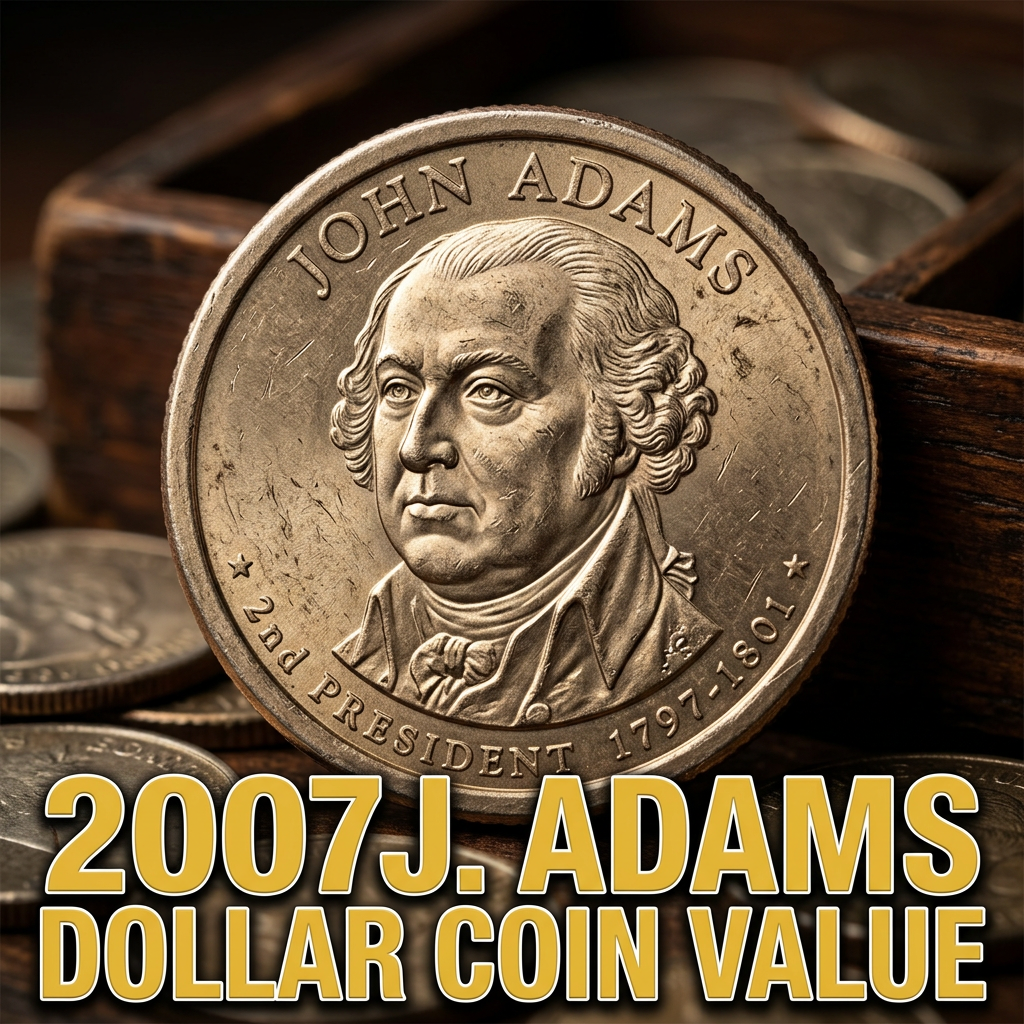
How Much is a 2007 J Adams Dollar Coin Worth Today
The 2007 J. Adams Dollar Coin is worth anywhere from $1.05 in circulated condition to over $150 for rare mint errors. While most of these Presidential Dollars you find in pocket change are only worth their face value, certain high-grade specimens and production mistakes can make them quite valuable to collectors.
Value and Rarity of the John Adams Dollar
If you just discovered a golden-colored coin featuring the second U.S. President, you might be wondering if you’ve struck gold. In reality, these coins are made of a manganese-brass clad composition. Most of the 2007 John Adams dollar coins were minted in huge quantities—over 224 million between the Philadelphia and Denver mints—meaning they aren’t inherently rare. However, the value shifts significantly when you look at the condition and specific mint marks.
For those trying to determine the exact worth of a collection, using a free coin identifier app is the fastest way to get a real-time estimate. Most everyday Americans will find “circulated” coins, which are worth exactly $1. But if your coin looks like it just came out of the mint, with a mirror-like finish or no scratches, it could be a “Mint State” (MS) coin worth $5 to $20.
Collectors often use the CoinKnow app to track these price fluctuations, as the market for modern presidential coins can change depending on auction trends. If you find a coin with a “S” mint mark, which denotes it was made in San Francisco as a Proof coin for collectors, it is generally worth more than the standard “P” or “D” versions found in your wallet.
Spotting Valuable Mint Errors and Edge Lettering
The most exciting part about the 2007 John Adams dollar is the potential for “naked” or “plain edge” errors. This was the first year the U.S. Mint placed the date and the motto “E Pluribus Unum” on the edge of the coin rather than the face. In the rush to produce millions of coins, some skipped the edge-lettering process entirely. These “Plain Edge” John Adams dollars became an instant hit in the numismatic world and can sell for $20 to $50 depending on their condition.
Another error to look for is “double edge lettering,” where the coin passed through the lettering machine twice, resulting in overlapping text. Because modern coins are produced so quickly, these mistakes are the primary way a common dollar coin gains significant value. To see how these errors compare to other modern issues, you can research the current market trends for vintage dollar errors which often share similar collector interest.
If you aren’t sure if your coin has an error, you can snap a photo with CoinKnow. The app uses image recognition to help identify strange markings that might actually be lucrative mint mistakes. Remember, a common $1 coin is just currency, but a documented error is a collector’s item.
2007 J. Adams Dollar Price Comparison Table
To help you understand what your coin might be worth at a glance, refer to the table below. These prices represent average market values for coins that have been graded by professional services or sold in recent auctions.
| Coin Condition/Type | Estimated Value Range |
|---|---|
| Circulated (P or D Mint) | $1.00 – $1.05 |
| Uncirculated Mint State (MS65) | $3.00 – $8.00 |
| Proof Finish (S Mint) | $5.00 – $12.00 |
| Plain Edge Error | $20.00 – $60.00 |
| High Grade MS67+ Certified | $100.00+ |
Factors That Influence Modern Coin Prices
Modern coins like the John Adams Presidential Dollar are valued based on the “Pop” (population) of surviving high-grade examples. Because these were stored in rolls by the thousands, finding one in perfect condition is surprisingly difficult. Bag marks—tiny nicks caused by coins hitting each other during transport—reduce the grade and the price.
When analyzing your collection, compare your findings to the valuation of high-grade uncirculated dollars to see how condition impacts the final sale price. Even a tiny scratch on the portrait of John Adams can drop the value from $50 down to $1.
To get the most out of your find, keep your coins in a cool, dry place and avoid cleaning them. Cleaning a coin with chemicals or clothes can create micro-scratches that ruin the numismatic value instantly. If you believe your 2007 Adams dollar is a high-grade specimen or has a rare error, checking it against the verified database in CoinKnow can help you decide if it’s worth the fee to have it professionally graded by the PCGS or NGC.
Frequently Asked Questions
Q: Is the 2007 John Adams dollar made of real gold?
A: No, it does not contain any gold. The “golden” color comes from a specific blend of copper, zinc, manganese, and nickel. While it looks like gold, its metal value is much lower than its face value.
Q: Where is the mint mark located on a John Adams dollar?
A: Unlike older coins, the mint mark (P, D, or S) is located on the edge of the coin. You will need to turn the coin on its side to see the year, the mint mark, and the inscriptions “In God We Trust” and “E Pluribus Unum.”
Q: Why do some John Adams coins have the edge lettering upside down?
A: This is actually not a rare error. The U.S. Mint applies edge lettering in a separate process where the coins are fed randomly. As a result, roughly 50% of the coins have “Position A” (lettering is upside down when the portrait is up) and 50% have “Position B” (lettering is right-side up). Both are equally common and worth the same price.
