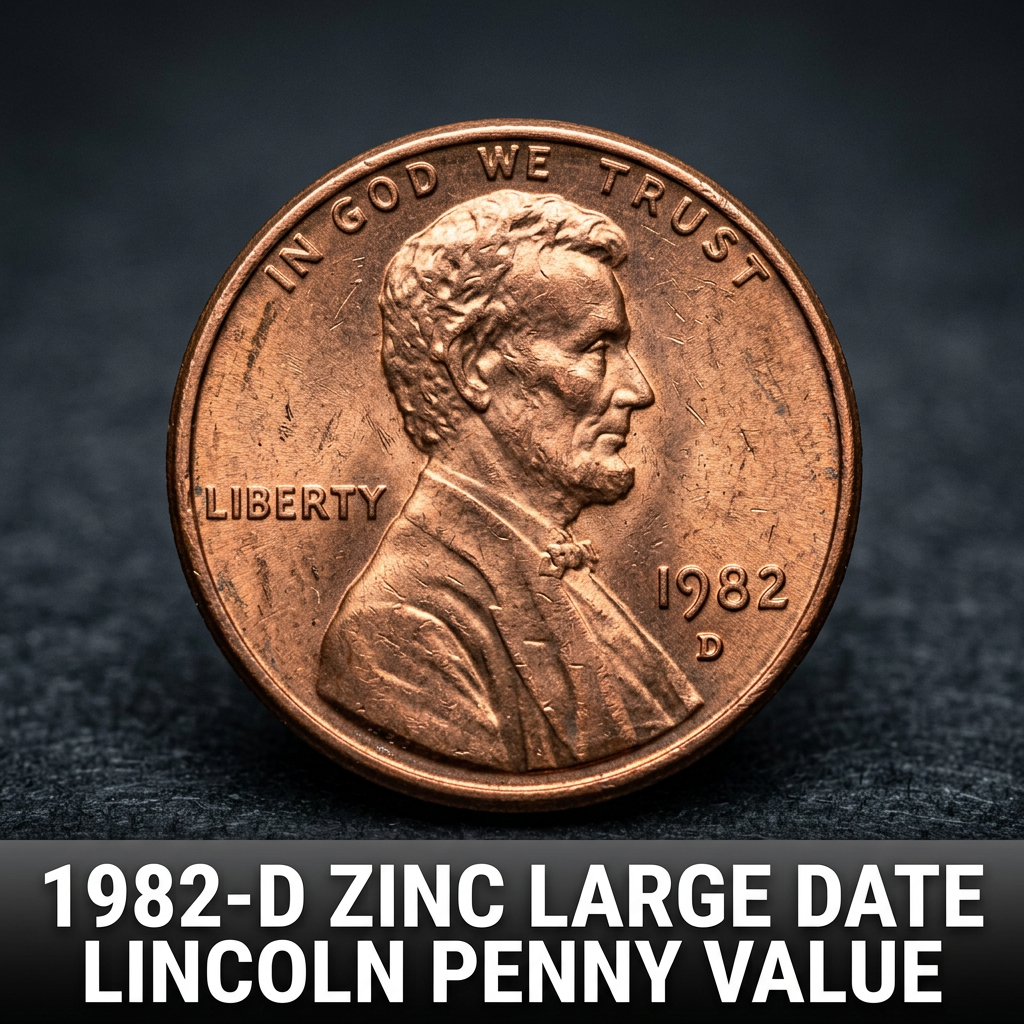
1982 D Zinc Large Date Lincoln Penny Value and How to Identify It
The 1982-D Zinc Large Date Lincoln Penny is worth anywhere from its 1-cent face value in circulated condition to over $100 in high-grade mint state. Finding one of these coins in your pocket change is extremely common, but determining if yours is a rare variety requires a bit of detective work and a steady scale.
Understanding the 1982 Transition and Your Penny
If you just emptied your piggy bank or found a handful of change in your couch, you likely noticed several 1982 pennies. This was a “transition year” for the United States Mint, making it one of the most confusing years for collectors. Because the price of copper was rising, the Mint switched from a 95% copper alloy to a zinc core plated with a thin layer of copper. Using a free coin identifier app can help you quickly distinguish between the different types produced this year.
When you look at your 1982-D Zinc Large Date, the “D” stands for the Denver Mint. The “Large Date” refers to the size and placement of the numbers. In the Large Date variety, the numbers are closer to the edge of the coin, and the “2” has a straight neck rather than a curved one. While the zinc versions are the most common, thousands of enthusiasts use CoinKnow to check if they’ve accidentally stumbled upon a rare copper error instead.
Determining the Market Value of 1982 D Zinc Large Date Pennies
For most Americans, the 1982-D Zinc Large Date is a “spender.” Since billions were minted, a coin that shows signs of wear—scratches, brown toning, or smoothed-out details—is generally only worth one cent. However, the value climbs significantly if the coin looks like it just came off the printing press. Collectors look for “Red” (RD) luster, which indicates the coin has maintained its original copper-orange glow.
The highest prices are reserved for coins graded by professional services. You can find detailed 1982 penny auction records and price guides that show how a perfect specimen can fetch a premium. For a standard zinc large date, you might get $5 to $15 for a nice uncirculated specimen, but only if it is in a protective slab. CoinKnow users often track these price fluctuations to see when it’s the best time to sell their collections.
| Condition / Grade | Estimated Value |
|---|---|
| Circulated (Average Pocket Change) | $0.01 |
| Uncirculated (MS-63) | $1.00 – $3.00 |
| Choice Uncirculated (MS-65 Red) | $10.00 – $25.00 |
| Superb Gem (MS-67+ Red) | $100.00+ |
How to Tell Your Zinc Penny Apart from Copper
The most important step in evaluating your 1982-D penny is weighing it. Because zinc is lighter than copper, the weight is the “smoking gun” for identification. A zinc penny weighs approximately 2.5 grams, whereas the older copper version weighs 3.11 grams. If you have a 1982-D Large Date that weighs 2.5 grams, you have the standard zinc variety.
Many people get excited because they hear stories of rare 1982 pennies worth thousands. Usually, they are referring to the 1982-D Small Date Copper, which is the “holy grail” error of this year. For more information on identifying these specific varieties, you can review this 1982 Lincoln Cent valuation breakdown. Understanding the difference between a Large Date and a Small Date is crucial before you get your hopes up about a high-value find.
Visual Cues for the Large Date Variety
If you don’t have a sensitive digital scale, you can look at the “8” and the “2” in the date. On a Large Date variety, the “8” has two circles of nearly equal size, and the “2” has a very straight diagonal bar leading down to the base. On the Small Date, the top circle of the “8” is noticeably smaller, and the “2” has a distinct curve.
Most 1982-D Large Dates you find will be zinc. You can often tell by looking for “zinc rot”—tiny bubbles or black spots under the copper plating where the inner zinc has begun to corrode. If you see these bubbles, your coin is definitely zinc and likely only worth face value. CoinKnow recommends keeping uncirculated zinc pennies in a dry environment to prevent this corrosion from destroying their modest collector value.
Q: How can I tell if my 1982-D penny is zinc without a scale?
A: You can perform a “drop test” by gently dropping the coin on a hard surface. A copper penny will have a high-pitched ring, while a zinc penny will produce a dull “thud.” However, using a digital scale is the only 100% accurate method.
Q: Is the 1982-D Zinc Large Date rare?
A: No, it is extremely common. The Denver Mint produced billions of these coins to ensure there was enough currency in circulation during the metal transition. Only those in nearly perfect “Mint State” condition carry a premium.
Q: Are there any errors to look for on a 1982-D Zinc penny?
A: While the 1982-D Small Date Copper is the famous rarity, zinc pennies can sometimes have “doubled die” errors or “off-center” strikes. These errors can increase the value of a zinc penny to $20 or more depending on the severity of the mistake.
