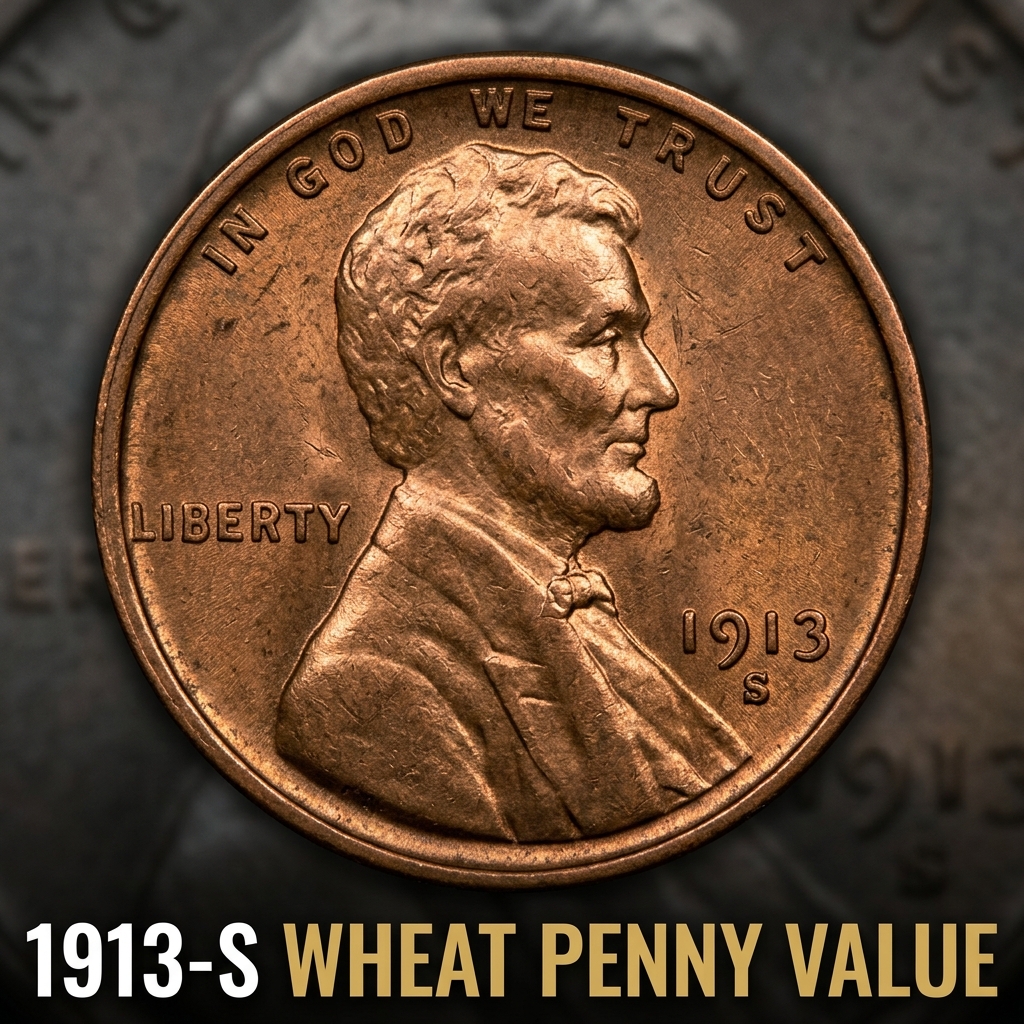
1913 S Wheat Penny Value and Price Guide for Collectors
The 1913-S Wheat Penny is worth anywhere from $15 in worn condition to over $1,200 in choice mint state. Finding one of these bronze beauties in your pocket change or an old jar is a fantastic discovery because it is considered a semi-key date in the Lincoln cent series.
How Much Is a 1913-S Lincoln Wheat Cent Worth Today
If you have stumbled upon a 1913-S penny, you are looking at a coin that was minted over a century ago at the San Francisco Mint. Unlike the common pennies from Philadelphia, San Francisco produced significantly fewer coins this year, making them much rarer today. To get an instant estimate of what your coin might be worth before heading to a dealer, you can use a free coin identifier app to check the basics.
The value of your coin depends heavily on its “grade,” which is just a fancy way of describing how much wear and tear it has endured. Most 1913-S pennies found today are in “Good” or “Fine” condition, meaning they have visible wear on Lincoln’s cheek and the wheat stalks on the back. Even in this rough shape, collectors are willing to pay a premium. For those curious about high-end market trends, you can explore the current auction records for red 1913-S pennies to see how much the finest specimens fetch.
If you are unsure whether your coin is a genuine San Francisco strike, look for the small “S” mint mark just below the date. Using the CoinKnow app can help you magnify that area to ensure you aren’t misidentifying a common Philadelphia cent. The scarcity of the “S” mint mark is the primary driver of value for this specific year.
Identifying the Condition and Grade of Your 1913-S Penny
Grading is the most important factor in determining the final price of any vintage coin. For the 1913-S Wheat Penny, the difference between a coin worth $20 and one worth $500 comes down to the fine details. In “Good” condition, the letters and date are legible, but the rim is worn down. As you move up to “Extremely Fine,” you should start to see distinct lines in the wheat ears on the reverse side.
The most valuable versions are “Uncirculated” or “Mint State.” These coins never spent time in people’s pockets and still retain their original copper luster. Copper coins are further categorized by color: Brown (BN), Red-Brown (RB), or Red (RD). A “Red” 1913-S penny is the holy grail for collectors because copper naturally turns brown over time. Keeping your coins in a cool, dry place and cataloging them with CoinKnow will help you keep track of their condition over the years.
To understand the broader market context and how this coin compares to other years in the 1910s, you can review this comprehensive 1913 Wheat Penny value guide. This will give you a better idea of why the San Francisco “S” mint mark is so much more desirable than the “D” or No-Mint-Mark versions.
| Condition / Grade | Estimated Value (USD) |
|---|---|
| Good (G-4) | $15 – $20 |
| Very Good (VG-8) | $25 – $30 |
| Fine (F-12) | $35 – $45 |
| Very Fine (VF-20) | $55 – $75 |
| Extremely Fine (EF-40) | $100 – $135 |
| About Uncirculated (AU-50) | $175 – $250 |
| Uncirculated (MS-63 Brown) | $400 – $600 |
| Choice Uncirculated (MS-65 Red) | $1,200+ |
Mintage Figures and Rarity of the 1913-S Penny
In the world of coin collecting, the lower the mintage, the higher the potential value. In 1913, the Philadelphia Mint produced over 76 million pennies. By comparison, the San Francisco Mint produced only 6,132,000 units of the 1913-S Wheat Penny. While six million sounds like a large number, most of those coins were lost to circulation, damage, or the melting pot over the last century.
This relatively low mintage makes the 1913-S a “semi-key” date. It is the type of coin that collectors need to complete their albums, ensuring there is always a steady demand. If you are starting a collection, tools like CoinKnow can help you identify which years are the “keys” and which are the common fillers.
Because the 1913-S is valuable, you should be aware of alterations. Sometimes, people try to “glue” an S onto a regular 1913 penny. Authentic mint marks should look like they are part of the coin, not added on top. If the deal seems too good to be true, it probably is. Always verify high-value purchases with a professional grading service like PCGS or NGC.
Summary for Casual Coin Hunters
If you find a 1913-S Wheat Penny, do not clean it! Amateur collectors often think that scrubbing a coin to make it shiny will increase its value, but the opposite is true. Cleaning a coin with chemicals or abrasives leaves microscopic scratches that ruin its numismatic value. A dirty, authentic 1913-S is worth much more than one that has been polished.
Keep your find in a protective flip or a small plastic baggie to prevent further scratches. Even a small “nick” on Lincoln’s face can drop the price by $10 or $20. For everyday Americans, these coins represent a piece of history you can hold in your hand—a tiny copper window into the era of the Model T and the dawn of the 20th century.
Q: Where is the mint mark on a 1913-S Wheat Penny?
A: The “S” mint mark is located on the obverse (front) of the coin, directly underneath the date “1913.” If there is no letter there, it was minted in Philadelphia.
Q: Is the 1913-S Penny made of real gold?
A: No, the 1913-S Wheat Penny is made of 95% copper and 5% tin and zinc. It may have a golden “luster” if it is in pristine condition, but it is a bronze coin.
Q: How can I sell my 1913-S Wheat Penny?
A: You can sell it to a local coin shop, through online auction sites like eBay, or at a coin show. For very high-grade examples, it is best to have them professionally graded first to get the highest price.
