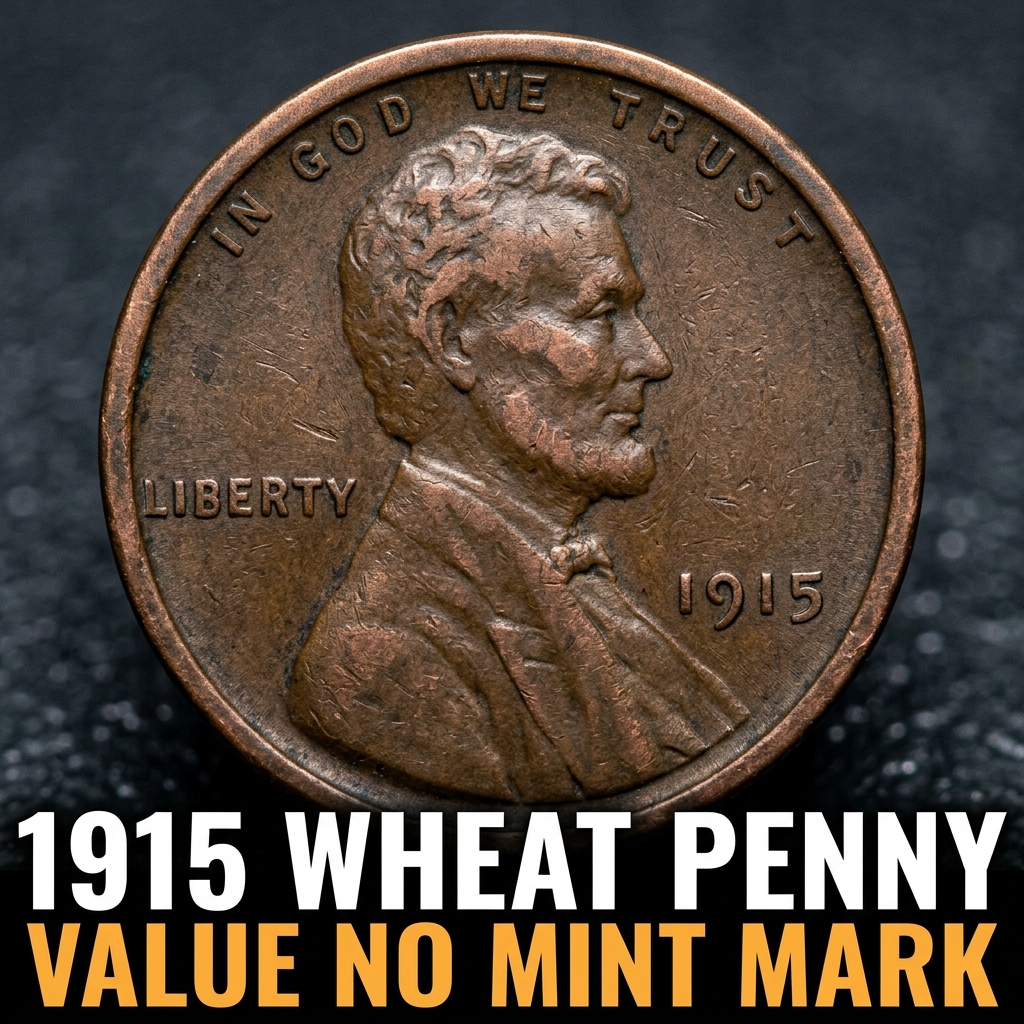
1915 Wheat Penny Value and Price Guide for No Mint Mark Coins
The 1915 Wheat Penny is worth anywhere from $1.50 in worn condition to over $450 in pristine mint state. If you have just discovered one of these century-old copper treasures in a jar or an old collection, you are likely wondering if you have found a small fortune.
How to Identify a 1915 Lincoln Penny Without a Mint Mark
Finding a 1915 penny in your pocket change is a rare treat. When collectors talk about “no mint mark,” they are referring to coins struck at the main United States Mint in Philadelphia. During this era, the Philadelphia Mint did not use a letter below the date to identify its work. Therefore, if your penny simply says “1915” with nothing underneath it, you have a Philadelphia issue.
Because this coin was minted over 100 years ago, most surviving examples show significant wear. If you are unsure about the authenticity or the specific subtype of your find, using a free coin identifier app can help you zoom in on the details. The Philadelphia Mint produced about 29 million of these cents in 1915, which is quite a low mintage compared to modern standards.
To get an accurate valuation, it is often helpful to use professional tools like the CoinKnow app, which allows you to compare your coin against a database of similar sales. Most people find these coins in “Good” or “Very Good” condition, meaning the wheat stalks on the back are smoothed out and Lincoln’s beard lacks detail.
Determining the Market Value of a 1915 Wheat Penny
The value of a 1915 penny is primarily driven by its “Grade.” Professional graders look at the amount of copper luster remaining on the surface. For a circulated 1915 cent, you are looking at a value roughly 150 to 500 times its face value. However, collectors are willing to pay a massive premium for coins that look like they just came off the press.
While a common circulated coin might only buy you a candy bar, the 1915 Wheat Penny price in Mint State Red condition can soar into the hundreds or even thousands of dollars. The term “Red” refers to the original orange-copper glow the coin had when it was first minted. Over time, copper turns brown (BN) or red-brown (RB), which significantly lowers the market price.
If you are trying to sell your coin, remember that most local coin shops will pay a wholesale price. For the most current retail data, the CoinKnow app provides real-time auction results so you don’t get underpaid by a dealer.
| Condition / Grade | Estimated Value (USD) |
|---|---|
| Good (G-4) | $1.50 – $2.50 |
| Fine (F-12) | $4.00 – $6.50 |
| Extremely Fine (XF-40) | $15.00 – $22.00 |
| Uncirculated (MS-63 Brown) | $65.00 – $85.00 |
| Uncirculated (MS-65 Red) | $450.00+ |
Rarity Factors and Why This Year Matters
1915 was a transitional period for the U.S. Mint. While the 1915 Philadelphia penny is not the rarest in the entire Wheat series, it is much harder to find than pennies from the 1940s or 50s. If you happen to find one that looks remarkably shiny, you should check it for “Proof” characteristics.
Proof coins were specially made for collectors and have a matte-like finish. A 1915 Matte Proof penny is exceptionally rare, with only about 1,000 originally struck. These can be worth thousands of dollars. Information regarding the 1915 penny worth and collector demand suggests that even non-proof versions are gaining value as high-quality examples disappear from the market.
Before you consider cleaning your coin, stop! Cleaning a penny with chemicals or cloths will actually destroy its numismatic value. Collectors prefer a coin with “original skin” or natural patina. Using the CoinKnow app’s identification features can help you determine if your coin’s surface is original or damaged.
Tips for Selling Your 1915 Lincoln Cent
When you are ready to sell your 1915 Wheat Penny, presentation and verification are key. For coins that appear to be in “About Uncirculated” or “Mint State” condition, it may be worth getting them certified by a service like PCGS or NGC. A certified grade guarantees the value to a potential buyer.
For lower-grade coins, selling them individually on platforms like eBay or at a local coin show is usually the best bet. Always take high-quality photos in natural light so the buyer can see the “Wheat” ears clearly. The detail in the lines of the wheat stalks is the first thing a buyer looks at to determined if the coin is worth $1 or $20.
If you find a 1915 penny with a “D” or an “S” under the date, those are different mintages entirely (Denver and San Francisco). While this guide focuses on the Philadelphia “No Mint Mark” version, the 1915-S is actually one of the key dates of the series and is worth significantly more in almost every grade.
Q: Why does my 1915 penny have no mint mark?
A: This means it was minted in Philadelphia. At that time, the Philadelphia Mint did not use a “P” mint mark on pennies; they simply left the space below the date blank.
Q: Is a 1915 penny made of real copper?
A: Yes, 1915 Wheat Pennies are made of 95% copper and 5% tin and zinc. They are much heavier and more valuable for their metal content than modern zinc pennies.
Q: Should I clean my 1915 Wheat Penny to make it look new?
A: No, never clean an old coin. Cleaning leaves microscopic scratches that coin experts can easily see, and it can reduce the value of the coin by 50% or more.
