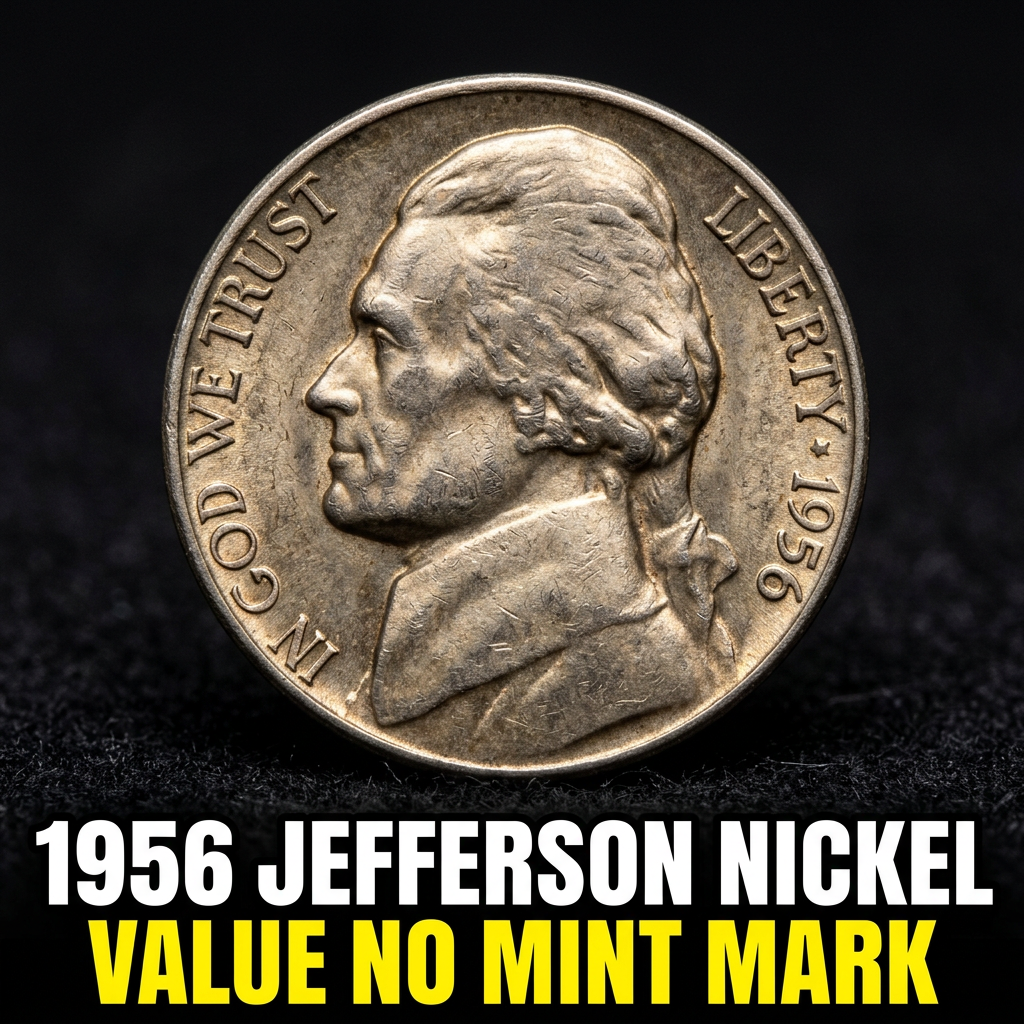
1956 Jefferson Nickel Value and History of Coins Without a Mint Mark
The 1956 Jefferson Nickel is worth anywhere from $0.10 in worn condition to over $1,500 in high-grade mint state with Full Step details. Finding one of these silver-colored treasures in your pocket change is always an exciting moment for any casual collector hoping to strike it rich.
How to Identify a 1956 Jefferson Nickel With No Mint Mark
If you are looking at a 1956 nickel and cannot find a small letter near the building on the back, don’t worry—you haven’t found a mistake. In 1956, the United States Mint produced over 100 million nickels at the Philadelphia facility. At that time, coins minted in Philadelphia did not feature a mint mark. This distinguishes them from the 1956-D nickels produced in Denver.
To quickly verify if your find is a genuine Philadelphia strike or perhaps a rare error, you can use a free coin identifier app to get instant results. Many everyday Americans use the CoinKnow app to scan their loose change while waiting in line at the grocery store. It is the fastest way to bridge the gap between “pocket change” and “collector’s item.”
The design features Thomas Jefferson on the obverse and his home, Monticello, on the reverse. Because millions were made, most circulated examples are only worth their face value or a small premium. However, collectors pay close attention to the sharpness of the strikes, especially the steps leading up to the mansion.
Detailed Price Guide for 1956 Jefferson Nickel
When determining the market price for your coin, condition is the single most important factor. Most nickels you find in jars or old piggy banks will fall into the “Circulated” category. These coins show wear on Jefferson’s hair and the pillars of Monticello. For those lucky enough to find a pristine version, the 1956 Jefferson Nickel MS price guide shows how values jump significantly in higher grades.
Professional grading services like PCGS or NGC use a 70-point scale. A “Mint State” (MS) coin shows no signs of wear and retains its original luster. If you aren’t sure where your coin sits on this scale, the CoinKnow mobile tool can provide a visual comparison to help you estimate the grade accurately.
| Condition Grade | Estimated Market Value |
|---|---|
| Good (G-4) to Fine (F-12) | $0.05 – $0.15 |
| Extremely Fine (EF-40) | $0.25 – $0.50 |
| Uncirculated (MS-60) | $1.00 – $3.00 |
| Choice Uncirculated (MS-65) | $15.00 – $35.00 |
| MS-67 with Full Steps | $800.00 – $1,600.00+ |
Why Full Steps Make a Huge Difference in Value
In the world of Jefferson Nickel collecting, the term “Full Steps” (FS) is the holy grail. This refers to the steps of Monticello on the back of the coin. Because the dies used in the 1950s weren’t always perfectly sharp, most nickels came out with the steps blurred together. If you find a 1956 nickel where at least five or six steps are clearly visible and separated, you have a very rare specimen.
According to current 1956 nickel value information, a standard MS-66 coin might sell for $50, but the same coin with the “Full Steps” designation can easily fetch $500 or more at auction. This massive price gap is why it’s worth taking a magnifying glass to your collection.
If you are confused by the tiny details on the back of the coin, CoinKnow offers high-resolution guides that show you exactly what to look for. Detecting these “Full Steps” is often the difference between a coin that is worth fifty cents and one that pays for a whole vacation.
Rare 1956 Nickel Errors and Proof Sets
Beyond the standard business strikes, 1956 was also a big year for Proof sets. The Philadelphia mint produced over 669,000 proof nickels. These coins were made specifically for collectors using polished dies and planchets, giving them a mirror-like finish. A high-quality proof 1956 nickel can be worth between $10 and $500, depending on if it has a “Cameo” or “Deep Cameo” effect.
There are also a few known errors for this year, such as “clipped planchets” or “off-center strikes.” These happen when the machinery malfunctions. If your nickel looks misshapen or is missing part of the design, it might actually be worth more than a perfect coin! Collectors love oddities, and a dramatic error can sell for over $100 even in worn condition.
Always keep an eye out for these anomalies. Most people spend them without a second thought, but a little bit of knowledge goes a long way in the numismatic world. The 1956 Jefferson Nickel may seem common, but the right combination of condition and strike quality makes it a standout piece of American history.
Frequently Asked Questions
Q: Does a 1956 nickel contain any silver?
A: No, the 1956 Jefferson Nickel is made of 75% copper and 25% nickel. “War Nickels” containing silver were only produced between 1942 and 1945.
Q: Where is the mint mark located if it had one?
A: For the 1950s series, the mint mark is located on the reverse side, to the right of the Monticello building, between the building and the rim. If it is blank, it was minted in Philadelphia.
Q: How can I tell if my 1956 nickel is a Proof coin or just shiny?
A: Proof coins have very sharp details and mirror-like backgrounds. If you can see your reflection clearly in the flat parts of the coin, it is likely a Proof strike from a collector’s set.
