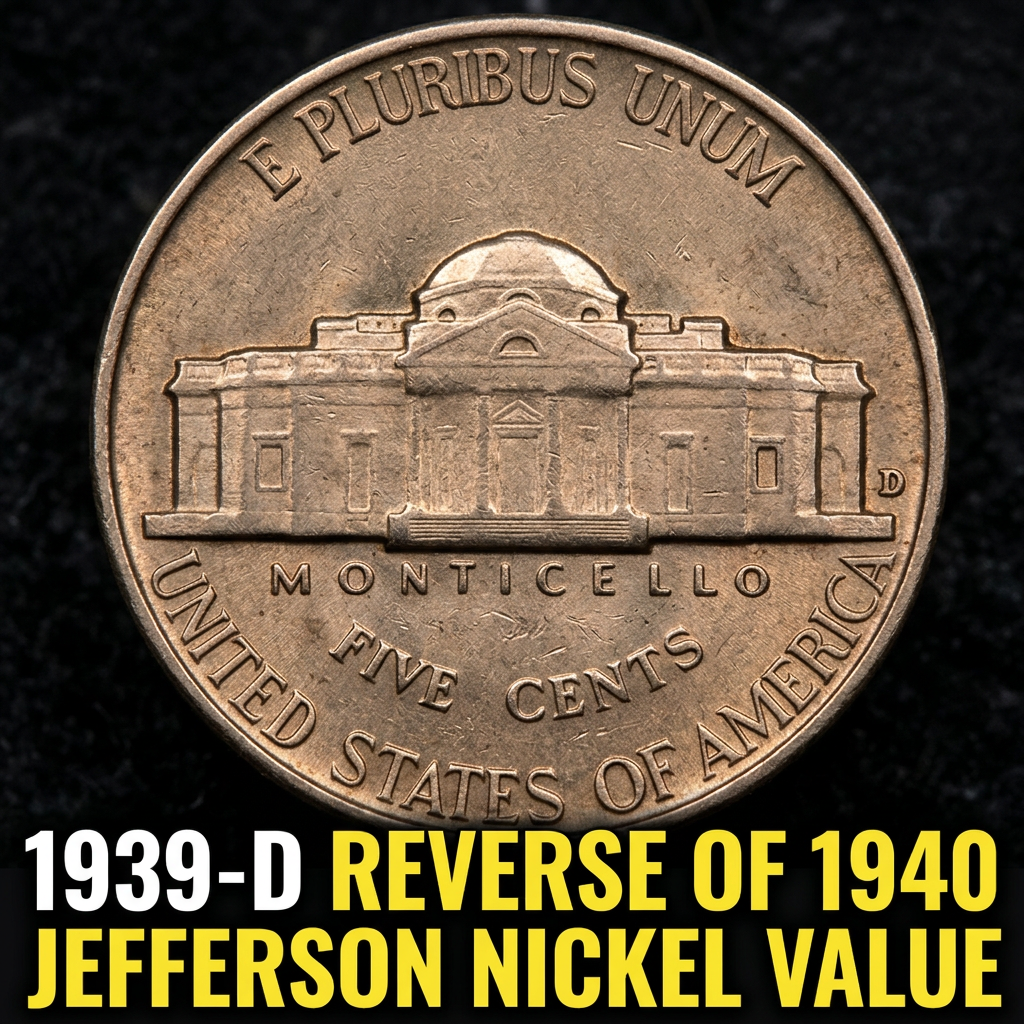
1939 D Reverse of 1940 Jefferson Nickel Value and Rarity Guide
The 1939-D Reverse of 1940 Jefferson Nickel is worth anywhere from $15 in heavily circulated condition to over $1,500 in high-grade mint state. Finding one of these in your change is a rare treat, as it represents a distinct transitional variety that collectors actively seek out to complete their sets.
Identifying the 1939-D Reverse of 1940 Variety
To understand why this coin is so special, you first need to look at the back of the nickel. In late 1939, the United States Mint modified the design of Monticello. The primary difference lies in the steps of the building. The “Reverse of 1938” (the original design) has wavy, often blurry steps, while the “Reverse of 1940” features crisp, straight steps and better-defined recessed lines.
Because the Denver Mint produced a relatively low number of nickels in 1939, combining that low mintage with this specific design variety makes it a “key date” for the series. If you aren’t sure which version you have, you can use a free coin identifier app to get an instant identification. Many everyday Americans have discovered that CoinKnow is an excellent tool for distinguishing these subtle design changes without needing a magnifying glass.
Current Market Value and Pricing Tiers
The value of a 1939-D Jefferson Nickel depends heavily on its condition and which reverse design it features. While the “Reverse of 1938” is also valuable, the “Reverse of 1940” often commands a premium in higher grades because it represents the transition to the modern design. Even in “Good” condition, where the coin shows significant wear, it is worth much more than its five-cent face value.
For those lucky enough to find a specimen that still has its original luster, the 1939 Jefferson Nickel mint state prices show a dramatic increase. Collectors focus on “Full Steps,” which means all six steps of Monticello are clearly visible without interruptions. These “Full Step” (FS) versions of the 1939-D Reverse of 1940 are among the most coveted nickels from the early Jefferson era.
| Condition / Grade | Estimated Value (USD) |
|---|---|
| Good (G-4) to Very Good (VG-8) | $15 – $25 |
| Fine (F-12) to Very Fine (VF-20) | $30 – $55 |
| Extremely Fine (XF-40) | $75 – $110 |
| About Uncirculated (AU-50) | $130 – $180 |
| Mint State (MS-63) | $250 – $400 |
| Mint State (MS-65 Red/Full Steps) | $1,500+ |
Factors Influencing the Worth of Your 1939 Nickel
When evaluating your find, the most important factor is the “D” mint mark located on the reverse side, to the right of Monticello near the rim. This indicates the coin was struck in Denver. Nickels from Philadelphia (no mint mark) or San Francisco (S) have different market dynamics. You can check the full list of 1939 Jefferson Nickel values to compare how the Denver mint mark stacks up against the others.
Typically, the 1939-D is the “king” of the 1939 nickels. Because the Reverse of 1940 was a mid-year change, the population of these coins is relatively small. CoinKnow users often report finding circulated versions in old estate collections or jars of change passed down through families. While these won’t reach the $1,500 mark, a $20 or $50 return on a five-cent investment is a fantastic win for any casual hunter.
How to Preserve the Value of Your Coin
If you believe you have a genuine 1939-D Reverse of 1940, the first rule is: do not clean it! Cleaning a coin with chemicals or even a soft cloth can create microscopic scratches that destroy its numismatic value. A cleaned coin will often be graded as “Details,” significantly reducing its selling price. Instead, hold the coin by its edges and place it in a protective PVC-free flip or a cardboard 2×2 holder.
Many people use CoinKnow to get an initial estimate of their coin’s grade before deciding whether to spend money on professional grading services like PCGS or NGC. If your coin appears exceptionally shiny with very few marks and sharp steps on Monticello, it may be worth the investment of professional authentication to secure its highest possible market value.
Q: Where is the mint mark on a 1939 Jefferson nickel?
A: The mint mark is located on the back of the coin, specifically to the right of the Monticello building, between the building and the rim. A “D” stands for Denver, and an “S” stands for San Francisco.
Q: What is the main difference between the 1938 and 1940 reverse designs?
A: The 1938 reverse has “wavy” or “mushy” steps on Monticello that lack clear definition. The 1940 reverse features redesigned, straight, and sharp steps with clear horizontal lines.
Q: Is a regular 1939 nickel without a mint mark worth a lot of money?
A: A 1939 nickel with no mint mark was made in Philadelphia. These are much more common than the Denver (D) version and are usually worth about $1 to $5 in circulated condition, though high-grade mint versions can be worth more.
