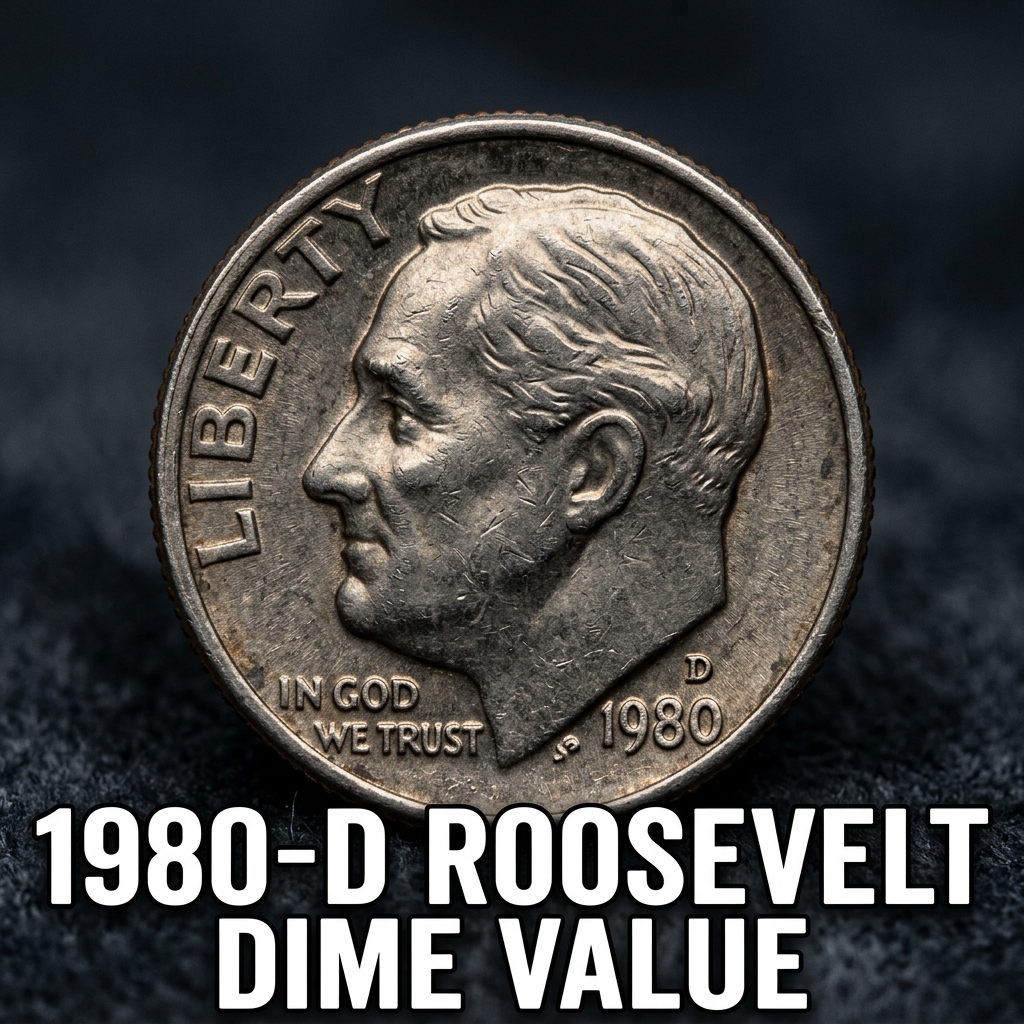
Exploring the 1980 D Roosevelt Dime Value and Rare Features for Collectors
The 1980-D Roosevelt Dime is worth anywhere from its face value of $0.10 in worn condition to over $150 in high-grade mint state. While most of these coins you find in your pockets today are common, certain rare specimens can command a surprising premium among serious collectors and hobbyists.
How Much is a 1980-D Roosevelt Dime Worth Today
If you just pulled a 1980-D dime out of your change, it is likely worth exactly ten cents. Since these coins were minted in massive quantities—over 700 million to be exact—they are very common in the “circulated” grade. However, the story changes when we talk about uncirculated coins. Collectors look for “Mint State” (MS) coins that haven’t been scratched or dulled by handles. If you aren’t sure where your coin falls on the scale, using a free coin identifier app can help you determine the condition instantly.
When using tools like the CoinKnow app, you might discover that your dime has exceptional luster. A 1980-D dime graded at MS65 is generally worth about $2 to $5. However, if you are lucky enough to find a specimen graded at MS67 or higher, the value jumps significantly. These high-grade coins are rare because the quality control at the Denver Mint in the early 80s wasn’t always perfect, making flawless survivors quite desirable.
Identifying the Denver Mint Mark and Material
The “D” on your 1980 dime stands for the Denver Mint. In 1980, the United States Mint placed the mint mark on the obverse (front) of the coin, just above the year. If you look closely at the area near the date, you will see that small “D.” It is important to remember that by 1980, the US had long since stopped using silver for dimes. These coins are made of a “clad” composition: a core of pure copper with an outer layer of 75% copper and 25% nickel.
Because they lack silver content, their value is driven entirely by numismatic rarity rather than melt value. You can find more detailed breakdowns of these 1980 Roosevelt Dime auction prices to see what the highest-quality versions have sold for recently. For a quick reference on standard market rates for various grades, consult the price chart below.
| Condition / Grade | Estimated Value |
|---|---|
| Circulated (Average Wear) | $0.10 |
| About Uncirculated (AU58) | $0.25 – $0.50 |
| Mint State (MS63) | $1.00 – $3.00 |
| Gem Mint State (MS65) | $5.00 – $12.00 |
| Superb Gem (MS67+) | $40.00 – $150.00+ |
Key Errors and Rare Varieties to Look For
While most 1980-D dimes are standard pocket change, error hunters often seek out “mint errors.” These occur when something goes wrong during the striking process. Common errors for this year include “Off-Center Strikes,” where the design isn’t centered on the coin blank, or “Die Cracks,” which appear as raised lines of metal on the coin’s surface. A significant off-center strike on a 1980-D dime can increase its value to $20 or $50 depending on the severity.
Another feature to look for is the “Full Bands” (FB) designation. This refers to the horizontal bands on the torch on the reverse (back) of the coin. If those lines are crisp and fully separated, the coin is worth much more. Checking a comprehensive 1980 dime valuation guide will show you that “Full Band” examples are the holy grail for Roosevelt dime collectors. If you think you have an error or a Full Band coin, the CoinKnow app can be a great way to compare your find with known examples.
Tips for Selling Your 1980-D Dime
Before you rush to a coin dealer, realize that most 1980-D dimes aren’t worth the cost of professional grading. Grading usually costs $20-$50 per coin, so only highly pristine or clearly errored coins should be sent to services like PCGS or NGC. For most Americans, the best way to profit from these coins is by keeping an eye out for high-grade samples in “unopened” mint rolls or finding unique errors that stand out to the naked eye.
Always handle your coins by the edges to avoid getting oils from your skin on the surface, which can degrade the “Mint State” quality. You can use the CoinKnow tool to organize your collection and stay updated on market trends. Whether you are a casual hunter or a serious stacker, understanding the nuances of the 1980-D Roosevelt dime can turn a simple ten-cent piece into a fascinating piece of history.
Q: Is a 1980-D dime made of silver?
A: No, the 1980-D Roosevelt Dime is a copper-nickel clad coin. The US Mint stopped using silver for circulating dimes after 1964.
Q: Where is the mint mark on a 1980-D dime?
A: The mint mark is located on the front of the coin (obverse), just above the date on the right side. The “D” signifies it was minted in Denver.
Q: What is the most expensive 1980-D dime ever sold?
A: High-grade specimens in MS67 or MS68 condition with “Full Bands” have been known to sell for several hundred dollars at major numismatic auctions.
