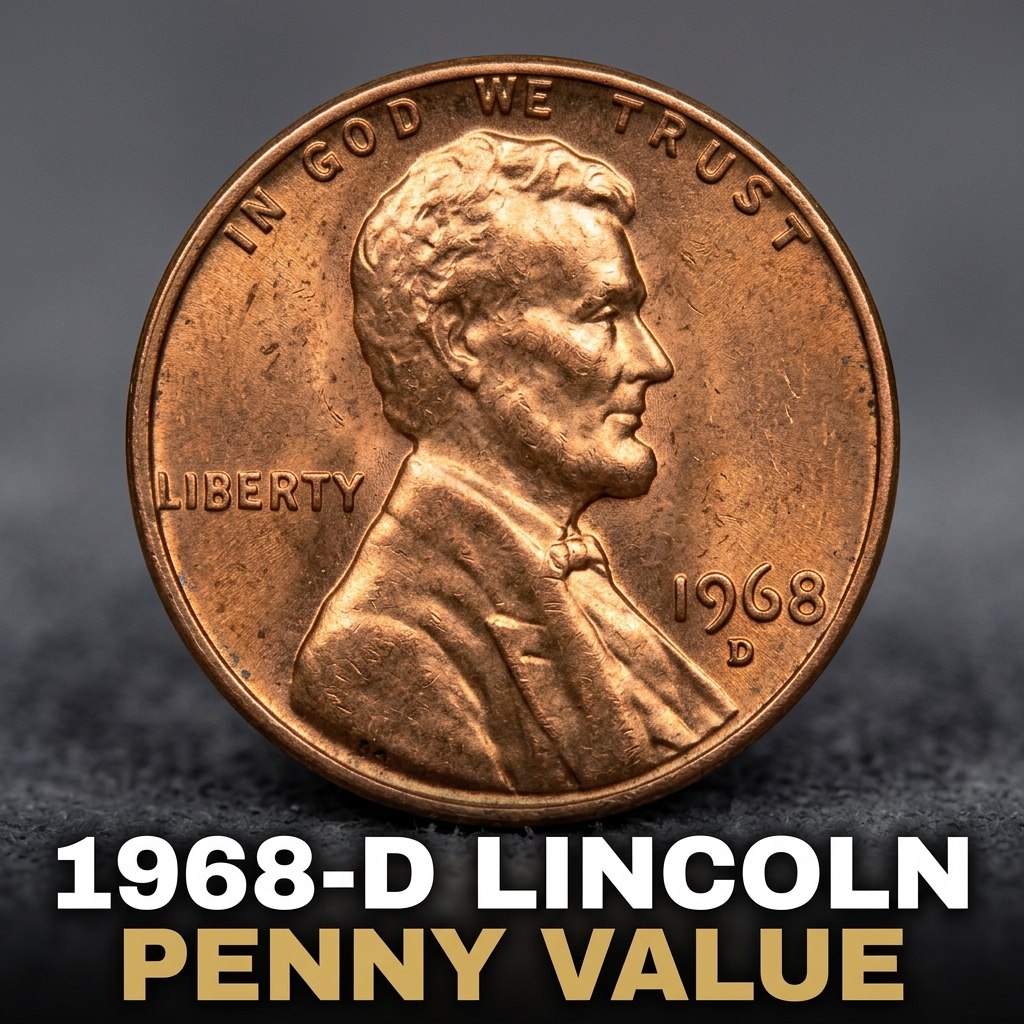
1968 D Lincoln Penny Value and Complete Guide to Rare Varieties
The 1968-D Lincoln Penny is worth anywhere from face value in worn condition to over $1,500 in high-grade mint state. While most of these coins in your pocket change are only worth the copper they are made of, certain high-quality specimens and rare errors can be worth a significant amount of money to the right collector.
Understanding the 1968-D Lincoln Cent and Its Rarity
If you find a 1968 penny with a tiny “D” under the date, it means the coin was struck at the Denver Mint. In that year, Denver produced over 2.8 billion pennies, making it one of the most common issues in the entire Lincoln Memorial series. Because so many were made, a standard circulated coin won’t make you rich overnight. However, the value shifts dramatically when we look at coins that were never spent.
Most people who find an old penny want a quick way to check if it’s a “keeper.” Using a free coin identifier app is often the fastest way to distinguish between a common find and a potential treasure. For everyday Americans, the key is looking for the “Red” (RD) designation. Copper coins oxidize over time, turning brown. A 1968-D penny that still retains its original bright orange-red luster from the mint is much more valuable than one that has turned chocolate brown. To get the most accurate result, you can use CoinKnow to photograph your coin and see where it stands.
How Much is a 1968-D Penny Worth Today?
The value of a 1968-D penny is determined primarily by its grade on the Sheldon Scale, which ranges from 1 to 70. Most circulated pennies you find in jars are “Average Circulated” or “About Uncirculated.” These are worth about 2 to 3 cents, purely for their copper melt value. The real money lies in “Mint State” (MS) grades. Collectors are willing to pay a premium for coins that look like they just came off the press.
For a deeper dive into market trends, looking at historical sales of 1968-D penny auction records shows that coins graded MS67 or higher are the true prizes. While an MS65 might sell for $10 to $20, an MS67 can jump to hundreds or even thousands of dollars. Since grading is difficult for the untrained eye, many collectors use CoinKnow to learn about the subtle differences in surface marks and luster that dictate these price jumps.
| Condition / Grade | Estimated Market Value |
|---|---|
| Circulated (Brown) | $0.02 – $0.05 |
| Uncirculated MS63 (Red) | $1.00 – $3.00 |
| Gem Uncirculated MS65 (Red) | $15 – $25 |
| Superb Gem MS67 (Red) | $250 – $600+ |
| Auction Record (MS67+) | $1,600+ |
Valuable 1968-D Errors to Look For
Error coins are the “wildcards” of the hobby. Even if a 1968-D penny is brown and worn, a significant mint error can make it worth $50, $100, or more. One common error found in late-60s pennies is the “DDR” or Doubled Die Reverse. To spot this, you’ll need a magnifying glass or a high-resolution camera. Look for doubling in the lettering of “E PLURIBUS UNUM” or “UNITED STATES OF AMERICA.”
Other errors include “Repunched Mint Marks” (RPM) or “Clipped Planchets,” where the coin looks like a bite was taken out of it during manufacturing. If you aren’t sure what you’re looking at, consult a 1968 penny value and error guide to see visual comparisons of known mistakes. Using CoinKnow can also help you identify structural anomalies that might indicate a rare error rather than just post-mint damage.
Tips for Preserving Your Lincoln Penny Value
Once you find a coin that looks particularly shiny or has a possible error, handle it with care. Oils from your skin can cause fingerprints that eventually turn into permanent black spots. Always hold coins by their edges. For 1968-D pennies that seem to be in pristine condition, consider placing them in a PVC-free plastic holder or a “flip.”
Remember that “cleaning” a coin is the fastest way to destroy its value. Collectors prefer a coin with natural aging over one that has been scrubbed bright with chemicals. If you suspect your 1968-D penny is a high-grade MS67 candidate, it might be worth sending it to a professional grading service like PCGS or NGC. A certified grade is the only way to realize the maximum potential value of your find in the open market.
Q: Is a 1968-D penny made of real copper?
A: Yes, pennies minted in 1968 are composed of 95% copper and 5% zinc. This makes them significantly heavier and more valuable in metal content than modern zinc pennies made after 1982.
Q: How can I tell if my 1968 penny is from Denver or Philadelphia?
A: Look for the mint mark below the date. A small “D” indicates it was struck in Denver. If there is no letter at all, it was struck in Philadelphia.
Q: What is the most expensive 1968-D penny ever sold?
A: The current record for a 1968-D Lincoln Cent is over $1,600 for a specimen graded MS67+ Red. These are extremely rare because the copper used in that era was prone to spots and scratches.
