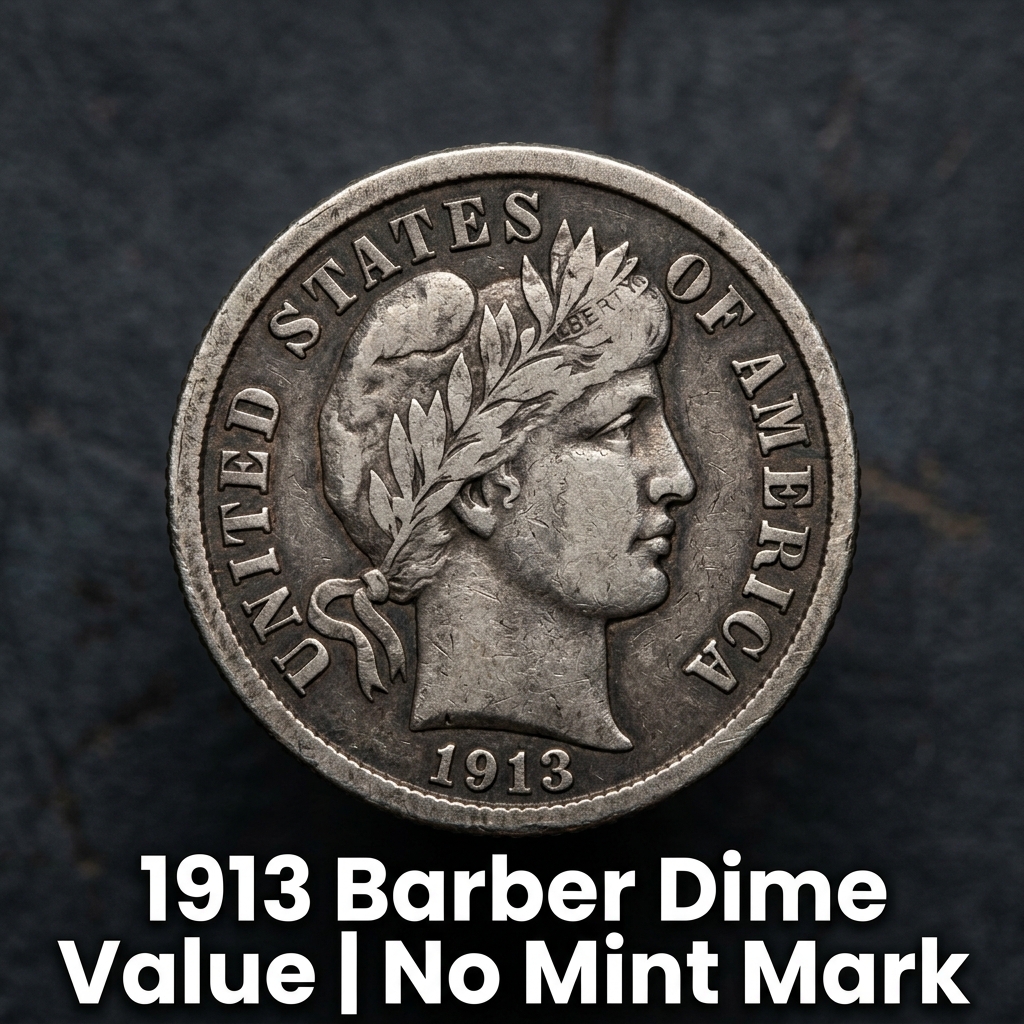
1913 Barber Dime Value and Worth for Coins with No Mint Mark
The 1913 Barber Dime with no mint mark is worth anywhere from $3 in heavily worn condition to over $450 in high-end uncirculated grades. Finding one of these silver treasures in your pocket change or an old jar is an exciting discovery that connects you directly to American history.
Identifying the 1913 Philadelphia Mint Barber Dime
If you have found a dime dated 1913 and you cannot find a small letter “S” or “D” on the back, you have a Philadelphia Mint coin. During the early 20th century, the main U.S. Mint in Philadelphia did not use a mint mark on its coinage. To identify your coin, look closely at the reverse side (the tails side) just below the wreath. If that area is blank, it was struck in Philadelphia.
Before you take your find to a dealer, it is helpful to use a free coin identifier app to confirm the variety and overall condition. Many beginners mistake heavy scratches for rare errors, but tools like the CoinKnow app can help you distinguish between damage and genuine numismatic value.
The 1913 Barber Dime features the head of Liberty wearing a Phrygian cap and a laurel wreath. Because these coins were made of 90% silver, they often carry a “melt value” even if they are in poor shape. However, most collectors are willing to pay a premium above the silver price if the coin still displays clear details in Liberty’s hair or the word “LIBERTY” on her headband.
Grading and 1913 Dime Value Factors
The price a collector will pay for your 1913 dime depends almost entirely on its “grade,” or its state of preservation. Most coins found today are in “Good” or “Very Good” condition, meaning they are quite worn from decades of circulating in people’s pockets. In these lower grades, the 1913 Barber Dime value remains relatively affordable, usually hovering between $3 and $10.
When a coin reaches “Extremely Fine” or “About Uncirculated” grades, the price jumps significantly. You can look for internal details in the corn and wheat ears on the reverse wreath to gauge quality. If the lines are crisp and the fields of the coin still have some original mint luster (shimmer), you could be looking at a coin worth $50 to $100.
Using the CoinKnow app allows you to compare your coin against high-resolution images of graded specimens. This visual comparison is the easiest way for “everyday” collectors to estimate if their 1913 dime is a common filler or a high-value investment piece. Remember, cleaning your coin will almost always lower its value, so keep it in its original state.
1913 Barber Dime Price Guide Table
To help you understand what your coin might be worth at a coin shop or online auction, refer to the pricing chart below. Note that these prices are estimates based on recent market trends for coins minted in Philadelphia (no mint mark).
| Condition / Grade | Estimated Value (USD) |
|---|---|
| Good (G-4) | $3.50 – $5.00 |
| Very Good (VG-8) | $7.00 – $12.00 |
| Fine (F-12) | $15.00 – $22.00 |
| Very Fine (VF-20) | $28.00 – $40.00 |
| Extremely Fine (EF-40) | $65.00 – $85.00 |
| Uncirculated (MS-63) | $220.00 – $275.00 |
| Choice Uncirculated (MS-65) | $450.00+ |
Mintage Scarcity and Collectibility
The Philadelphia Mint produced over 19 million dimes in 1913. While this sounds like a large number, many of these coins were melted down in later years when silver prices spiked, or they were simply lost to heavy wear. Consequently, finding a 1913 dime with “no mint mark” that still has all its letters and designs intact is becoming harder for collectors.
The 1913 Philadelphia issue is considered a “common date” compared to the rare 1913-S (San Francisco), which had a much lower mintage. However, the 1913-P is a staple for anyone trying to complete a Barber Dime folder. Because it is an affordable piece of history, there is always a steady demand from hobbyists.
If you are unsure whether your coin is a 1913 Philadelphia or if a mint mark has simply been worn away, the CoinKnow app can provide a second set of eyes. Technology has made it much easier for the average person to spot the difference between a common coin and a rare find without needing to visit a professional appraiser immediately.
Frequently Asked Questions about the 1913 Dime
Q: Is the 1913 Barber Dime made of real silver?
A: Yes, all Barber Dimes minted in 1913 are composed of 90% silver and 10% copper. This gives them an inherent bullion value regardless of their condition as a collectible.
Q: Where is the mint mark located on a 1913 dime?
A: The mint mark is located on the reverse side of the coin, at the bottom, just below the bow of the wreath. If there is no letter there, it was minted in Philadelphia.
Q: Should I clean my 1913 Barber Dime to make it worth more?
A: No! You should never clean old coins. Collectors prefer the original patina or “toning” that develops over time. Scrubbing a coin creates microscopic scratches that can reduce its market value by 50% or more.
