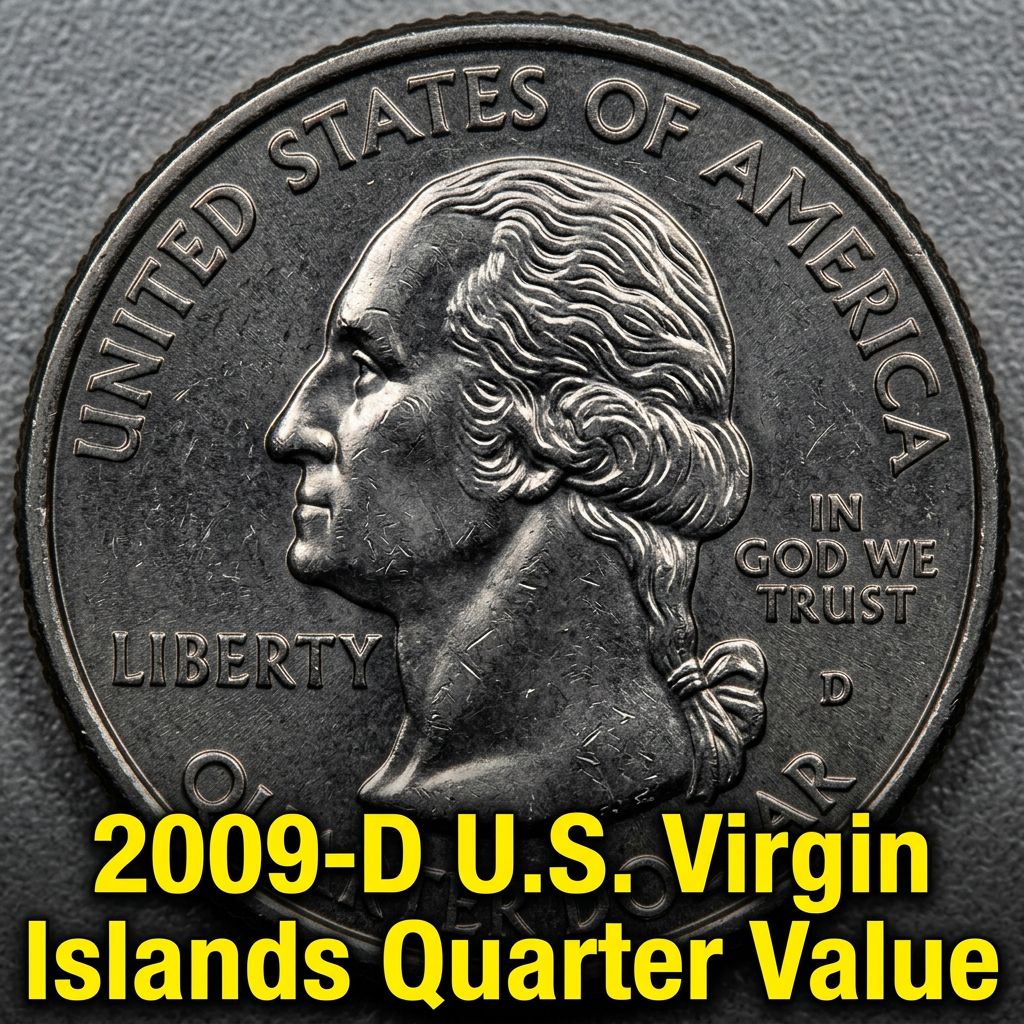
2009 D U.S. Virgin Islands Quarter Value and Price Guide for Collectors
The 2009 D U.S. Virgin Islands Quarter is worth anywhere from its $0.25 face value in worn condition to over $35 in high-grade mint state. While most of these quarters you find in your pocket change today are only worth twenty-five cents, certain specimens with specific characteristics can command a premium among collectors.
What Makes the 2009 D U.S. Virgin Islands Quarter Special
The 2009 D U.S. Virgin Islands Quarter was released as part of the District of Columbia and U.S. Territories Quarters Program. This was a one-year follow-up to the incredibly popular 50 State Quarters Program. The “D” mint mark signifies that the coin was produced at the Denver Mint. Because these coins were minted during a period of economic instability, the mintage numbers were significantly lower than the state quarters produced in the early 2000s.
Whenever you find an unusual quarter, it is a good idea to use a free coin identifier app to confirm its origin and variety. Understanding the background of the 2009 series is crucial because the lower production numbers mean these coins are becoming harder to find in circulation.
The reverse design features an outline of the three major islands—St. Croix, St. Thomas, and St. John—along with a Yellow Breast bird (Bananaquit), a Yellow Cedar flower, and a Tyre Palm tree. To get a quick estimate of your coin’s potential, you can use the CoinKnow app to scan the details of the bird and foliage, which are often the first places to show wear.
Grading and Value Factors for the Denver Mint Issue
When determining the 2009-D US Virgin Islands Quarter value, condition is the most significant factor. Most quarters found in “pocket change” are considered Circulated. These will have scratches, dings, and smoothed-out details on the palm tree branches or the bird’s feathers. These coins are generally only worth their face value of 25 cents.
However, if you happen to find one that looks like it just came from the bank—with a bright, mirror-like luster and no visible scratches—it might be “Uncirculated.” Uncirculated coins are graded on a scale from MS60 to MS70. A 2009-D Virgin Islands Quarter in MS65 grade can sell for around $2 to $5.
If you achieve a grade of MS67 or higher, the price jumps significantly. High-grade specimens are rare because the 2009 quarters were handled roughly during the minting and bagging process. Using CoinKnow can help you compare your coin against high-resolution images of top-tier grades to see if yours is worth sending to a professional grading service.
Current Market Prices for 2009 D Virgin Islands Quarters
To help you understand what your coin might be worth at a local coin shop or on an online auction, we have compiled a price chart based on recent sales data. Remember that professional grading by companies like PCGS or NGC often adds value but also costs money, so only high-grade coins should be submitted.
| Condition / Grade | Estimated Value (USD) |
|---|---|
| Circulated (Good to About Uncirculated) | $0.25 |
| Uncirculated (MS63) | $1.50 – $2.50 |
| Choice Uncirculated (MS65) | $5.00 – $10.00 |
| Gem Uncirculated (MS67) | $35.00 – $55.00 |
| Superb Gem (MS68 or Higher) | $150.00+ |
Identifying 2009 D Virgin Islands Quarter Errors
Error hunters often look at the 2009 D series because the Denver mint occasionally produced coins with interesting flaws. While the U.S. Virgin Islands design doesn’t have a famous “major” error like the Wisconsin extra leaf, “minor” errors such as die cracks or machine doubling can still be found.
Look closely at the lettering of “U.S. VIRGIN ISLANDS” and the date. If you see what looks like a shadow or a second set of letters, you might have a doubling error. Usually, mechanical doubling doesn’t add much value, but a true Doubled Die reverse could be worth $20 to $100 depending on the severity.
Another thing to look for is a “capping” error or a “broadstrike,” where the coin isn’t contained by the collar correctly. If your coin looks off-center or has an unusual rim, it is definitely worth holding onto. If you aren’t sure if what you’re seeing is a valuable error or just damage, the CoinKnow app can provide instant feedback by analyzing your coin’s photos.
How to Start Storing Your Coins
If you find a 2009 D quarter that looks better than average, don’t just throw it back in your change jar. The oils from your fingers can actually damage the coin’s surface over time. Handle the coin by its edges and place it in a cardboard 2×2 flip or a plastic coin capsule. This prevents further scratches and preserves the “mint luster” that collectors crave.
As more people collect the Territorial Quarters, the supply of high-quality 2009-D specimens continues to dwindle. Keeping your coins in a cool, dry place is the best way to ensure that their value remains stable or increases over the next several decades.
Q: How many 2009 D U.S. Virgin Islands Quarters were made?
A: The Denver Mint produced approximately 41,000,000 of these quarters, which is significantly lower than many of the state quarters from previous years.
Q: Where is the mint mark on the 2009 D Quarter?
A: The mint mark “D” is located on the obverse (front) of the coin, just to the right of George Washington’s ponytail.
Q: Is a silver version of the 2009 D Virgin Islands Quarter available?
A: No, the “D” mint mark coins are made of a copper-nickel clad composition. Silver versions were only minted at the San Francisco Mint and carry an “S” mint mark.
