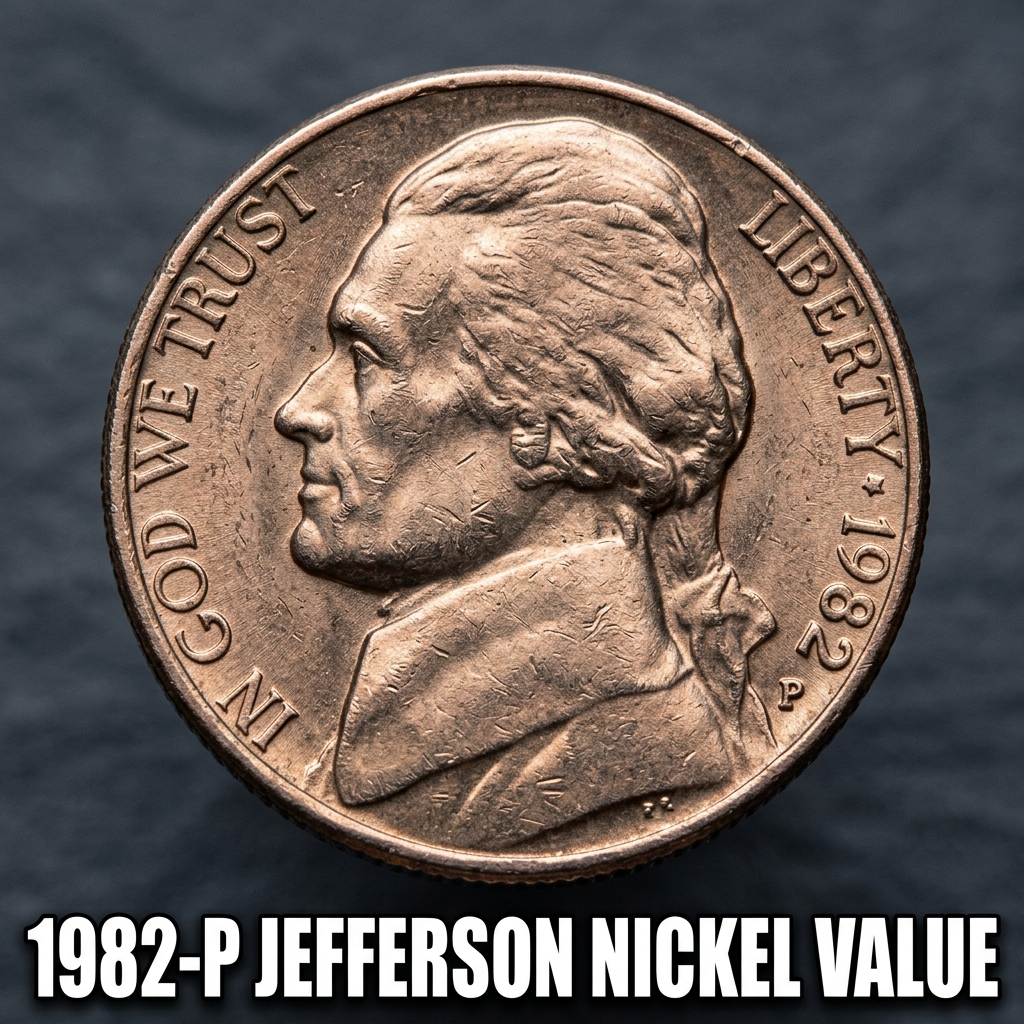
1982 P Jefferson Nickel Value Guide How Much is Your 5 Cent Coin Worth
The 1982-P Jefferson Nickel is worth anywhere from its 5-cent face value in circulated condition to over $1,500 in high-grade mint state with Full Steps. While most of these coins in your pocket change are only worth five cents, certain rare versions are highly sought after by collectors today.
History and General Value of the 1982-P Jefferson Nickel
If you have just found a nickel from 1982 with a small “P” mint mark above the date, you might be holding a small piece of American economic history. During the early 1980s, the United States was dealing with significant economic shifts, and the San Francisco mint stopped producing business-strike nickels, leaving the work to Philadelphia and Denver.
To find out exactly what you have, you can use a free coin identifier app to scan your pocket change instantly. The “P” on your 1982 nickel indicates it was struck at the Philadelphia Mint. Because 1982 was a year where the U.S. Mint did not produce traditional uncirculated mint sets for collectors, finding a 1982-P nickel in pristine, brand-new condition is much harder than finding nickels from other years.
Most people using the CoinKnow app find that their 1982-P nickels have been heavily used in commerce. If the coin looks dull or scratched, it is likely only worth its face value. However, if the coin looks like it just came from the bank and has a sharp “P” mint mark, its value begins to climb into the dollar range quickly.
What Determines the Price of a 1982-P Nickel
The value of a 1982-P Jefferson Nickel is primarily dictated by its “Grade” and the presence of “Full Steps.” Standard coins that have been passed from hand to hand for decades are considered “Circulated.” These are very common and generally do not carry a premium. However, collectors are constantly hunting for “Mint State” (MS) examples that have never been spent.
According to current market data, the 1982-P Jefferson Nickel price in high grades can reach surprisingly high levels because so few were preserved. A coin graded MS65 might sell for $20, while an MS67 can fetch hundreds. The CoinKnow platform helps users distinguish between a common nickel and a potential rarity by highlighting the luster and strike quality.
The “Full Steps” (FS) designation is the holy grail for 1982-P nickel hunters. This refers to the steps on Monticello (the building on the back of the coin). If all five or six steps are clearly visible and not blurred together, the coin is significantly more valuable. Because the 1982 dies were often worn down, a crisp strike is very rare.
1982-P Jefferson Nickel Price Reference Table
For a quick look at what your coin might be worth based on its condition, refer to the table below. Remember that professional grading by services like PCGS or NGC is usually required to hit the highest price points.
| Condition / Grade | Estimated Market Value |
|---|---|
| Circulated (Average Wear) | $0.05 – $0.10 |
| About Uncirculated (AU58) | $0.50 – $2.00 |
| Mint State 63 (MS63) | $5.00 – $12.00 |
| Mint State 65 (MS65) | $25.00 – $45.00 |
| MS66 with Full Steps (FS) | $250.00 – $400.00 |
| MS67 with Full Steps (FS) | $1,200.00+ |
How to Spot Rare 1982-P Nickel Errors
Beyond just the condition, you should also look for minting errors. Errors occur when something goes wrong during the striking process at the Philadelphia Mint. While not as common as standard coins, these anomalies can turn a five-cent piece into a hundred-dollar prize.
Common errors for this era include “Double Dies,” where the letters or numbers appear to have a faint ghost image or doubling. You should also look for “Off-Center” strikes, where the design is not perfectly aligned in the middle of the metal disk. Many collectors use the 1982 Jefferson Nickel value guide to identify specific die cracks and clips that are known to exist for this year.
If you find something odd, like a nickel that feels lighter than usual or has a strange edge, it is worth investigating. Using the CoinKnow app can help you compare your coin with known error specimens to see if you have a genuine rarity or just a damaged coin.
Tips for Selling Your 1982-P Nickel
If you have used a guide and believe your 1982-P nickel is in Mint State condition, your next step is deciding how to sell it. For coins that are only worth a few dollars, local coin shops or online marketplaces like eBay are usually the best bet. However, if your coin has those elusive Full Steps, you should consider having it professionally graded.
Avoid cleaning your coin at all costs. Even a light scrubbing with a cloth can leave microscopic scratches that ruin the “mint luster,” instantly dropping the value back down to five cents. Leave the coin in the condition you found it. Most collectors prefer a coin with a bit of natural toning over a shiny, cleaned coin that has lost its original surface texture.
When listing your coin for sale, take clear, high-resolution photos of both the front (obverse) and the back (reverse). Specifically, take a close-up photo of the steps on Monticello to prove the coin’s quality. This transparency helps you get the best price from buyers who are looking for that specific 1982-P Philadelphia strike to complete their collections.
FAQ
Q: Does a 1982 nickel have any silver in it?
A: No, the 1982-P Jefferson Nickel is made of a cupro-nickel alloy (75% copper and 25% nickel). The US Mint stopped using silver in nickels after the “War Nickels” ended in 1945.
Q: What does the “P” mean on a 1982 nickel?
A: The “P” mint mark stands for the Philadelphia Mint. Interestingly, the Philadelphia Mint didn’t start putting a “P” on nickels until 1980, making the 1982-P part of the early years of this practice.
Q: Why is the 1982-P nickel considered a “key date” for condition hunters?
A: Because the U.S. Mint did not sell official “Mint Sets” to collectors in 1982, very few nickels were saved in perfect condition. Most went straight into circulation, making high-grade examples very rare today.
