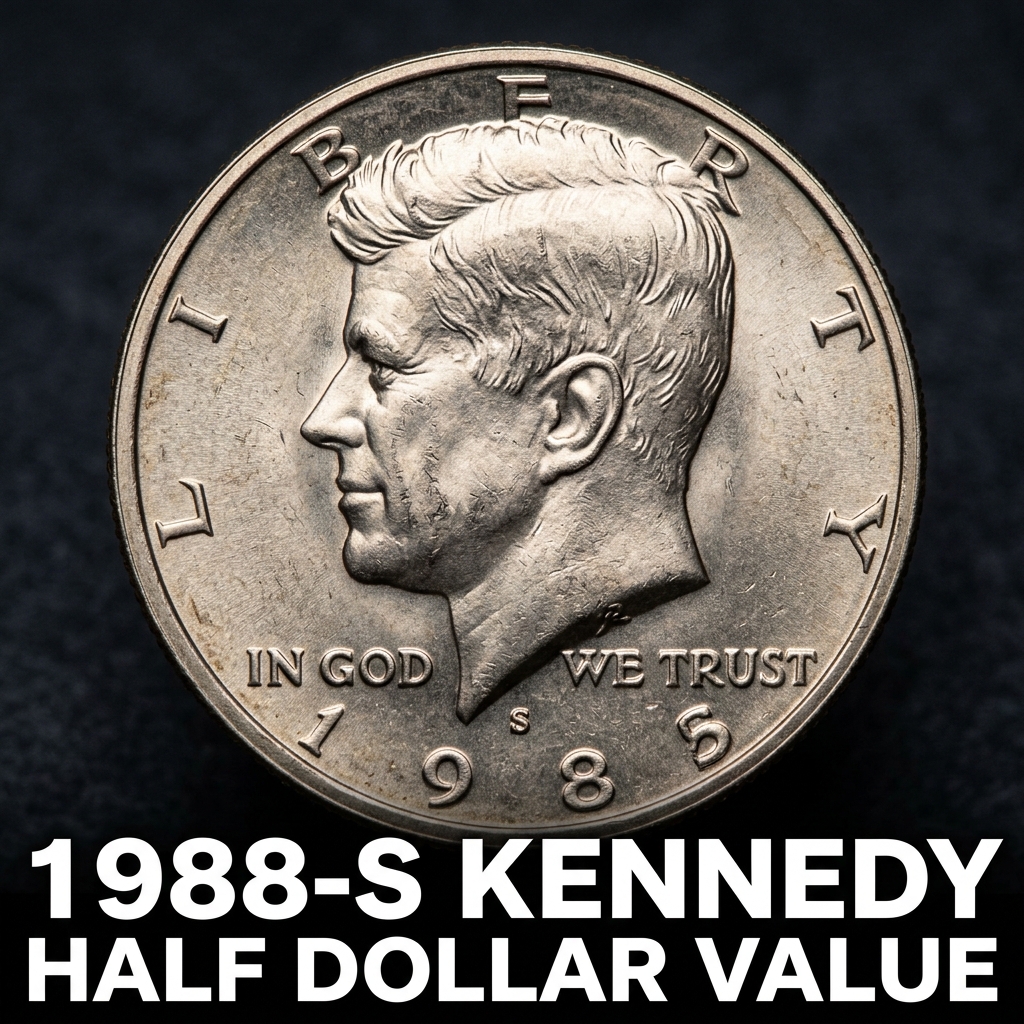
1988 S Kennedy Half Dollar Value and Collector Price Guide
The 1988-S Kennedy Half Dollar is worth anywhere from $3 in typical proof condition to over $40 in pristine deep cameo perfection. While most of these coins found in original packaging won’t make you rich overnight, they represent a beautiful piece of American minting history that remains highly accessible for casual collectors.
Understanding the Unique Status of the 1988 S Proof Half Dollar
Most Americans are used to seeing Kennedy Half Dollars with a “P” or “D” mint mark in their pocket change, but the 1988-S version is fundamentally different. This coin was produced exclusively at the San Francisco Mint for inclusion in special annual proof sets. Unlike coins meant for the grocery store or bank, these were struck twice with specially polished dies to create a mirror-like field and frosted details. If you have found one of these in a plastic case or perhaps loose in a jar, you are looking at a coin that was never intended for circulation. Using a free coin identifier app can help you confirm the mint mark and visual characteristics of your find.
When you look at a 1988-S Kennedy Half Dollar, the contrast is what usually catches your eye. Collectors call this the “Cameo” effect. Because these sets were well-preserved by the U.S. Mint, the supply is relatively high, which keeps the entry-level price affordable. However, the CoinKnow app shows that prices can climb significantly if the coin is certified by a professional grading service as a perfect “Proof 70.” Most examples you find in the wild will be “Proof 67” or “Proof 69,” which are standard for the era.
Grading and Market Prices for 1988 S Kennedy Half Dollars
To determine the exact value of your coin, you need to look at its preservation. Because these were sold to collectors, even a small hairline scratch from improper handling can drop the value. A 1988-S that has been removed from its original plastic lens and spent time in a pocket will likely only be worth its face value or a small premium for the copper-nickel melt. On the other hand, the 1988 Kennedy half dollar market rates for high-grade specimens show that collectors are still willing to pay a premium for “Deep Cameo” coins that look like they were struck yesterday.
The 1988-S is not made of silver. Like other Kennedy halves from 1971 onwards, it is a clad composition of copper and nickel. This is a common misconception among people who find shiny “S” mint coins; they often assume the shine means silver content. While no silver 1988 halves were minted for the public, the historical significance and the low mintage of roughly 3.2 million Proof pieces ensure they stay relevant in the numismatic world. You can check the current 1988 S half dollar valuation to see how recent auction trends are moving.
| Condition / Grade | Estimated Value |
|---|---|
| Circulated / Impaired Proof | $0.50 – $1.00 |
| PR65 (Proof Choice) | $3.00 – $5.00 |
| PR69 DCAM (Near Perfect) | $12.00 – $18.00 |
| PR70 DCAM (Museum Quality) | $40.00 – $85.00+ |
Spotting Rare Varieties and Errors in 1988 Half Dollars
While the 1988-S is the “collector’s version,” the 1988-P and 1988-D versions are also worth mentioning. If you find a 1988 coin without an “S” mint mark, it is likely a standard business strike. However, even these can be valuable if they are in exceptionally high uncirculated condition. Most 1988 halves we carry in our pockets are worn down, loses their luster, and are only worth 50 cents. If you find one that looks exceptionally sharp, use the CoinKnow app to scan the surface for errors like double dies or planchet flaws.
Error coins are the “holy grail” for many hobbyists. In 1988, the minting process was fairly refined, making major errors rare. Look for “Double Die” features where the lettering or the date looks like it was stamped twice. Even a minor error on a 1988-S Proof coin can skyrocket its value from a few dollars to several hundred. Always inspect the “S” mint mark under a magnifying glass; sometimes, RPMs (Re-punched Mint Marks) can be found, though they are less common in modern proof coinage than in vintage sets.
Is a 1988 S Kennedy Half Dollar a Good Investment
For the average person who finds a 1988-S in a drawer, it is a wonderful “gateway” coin into the world of numismatics. It likely won’t fund a retirement, but it is a beautiful object that holds its value better than modern change. If you have the original 1988 Prestige Set or the standard Proof Set, keeping the coins in their original housing is usually the best way to preserve their value. These coins represent a time when the San Francisco Mint was perfecting the “Deep Cameo” finish that we see on modern coins today.
If you are looking to sell, the best place is often a local coin shop or an online auction platform. Before you go, consult with CoinKnow to get a baseline price so you don’t accept an unfair offer. Because the 1988-S is a clad coin, its value is derived entirely from its condition and its appeal to collectors who are trying to complete a “Year Set” or a “Kennedy Half Dollar Registry.” It remains a staple of American coin collecting and a favorite for many due to the iconic design of President John F. Kennedy.
Q: Is the 1988-S Kennedy Half Dollar made of silver?
A: No, the 1988-S is a clad coin made of a copper core with an outer layer of 75% copper and 25% nickel. Silver proof halves were not reintroduced as a regular annual option until 1992.
Q: How can I tell if my 1988 half dollar is a proof?
A: Look for the “S” mint mark located above the date. Additionally, proof coins have a mirror-like, reflective background and very sharp, frosted details, whereas “P” or “D” coins have a duller, satin-like finish.
Q: What is the most valuable 1988 Kennedy Half Dollar ever sold?
A: While standard 1988-S proofs sell for modest amounts, high-grade 1988-P or 1988-D business strikes in MS67 condition can sometimes sell for over $500 at auction because they are much harder to find in perfect condition than the proof versions.
