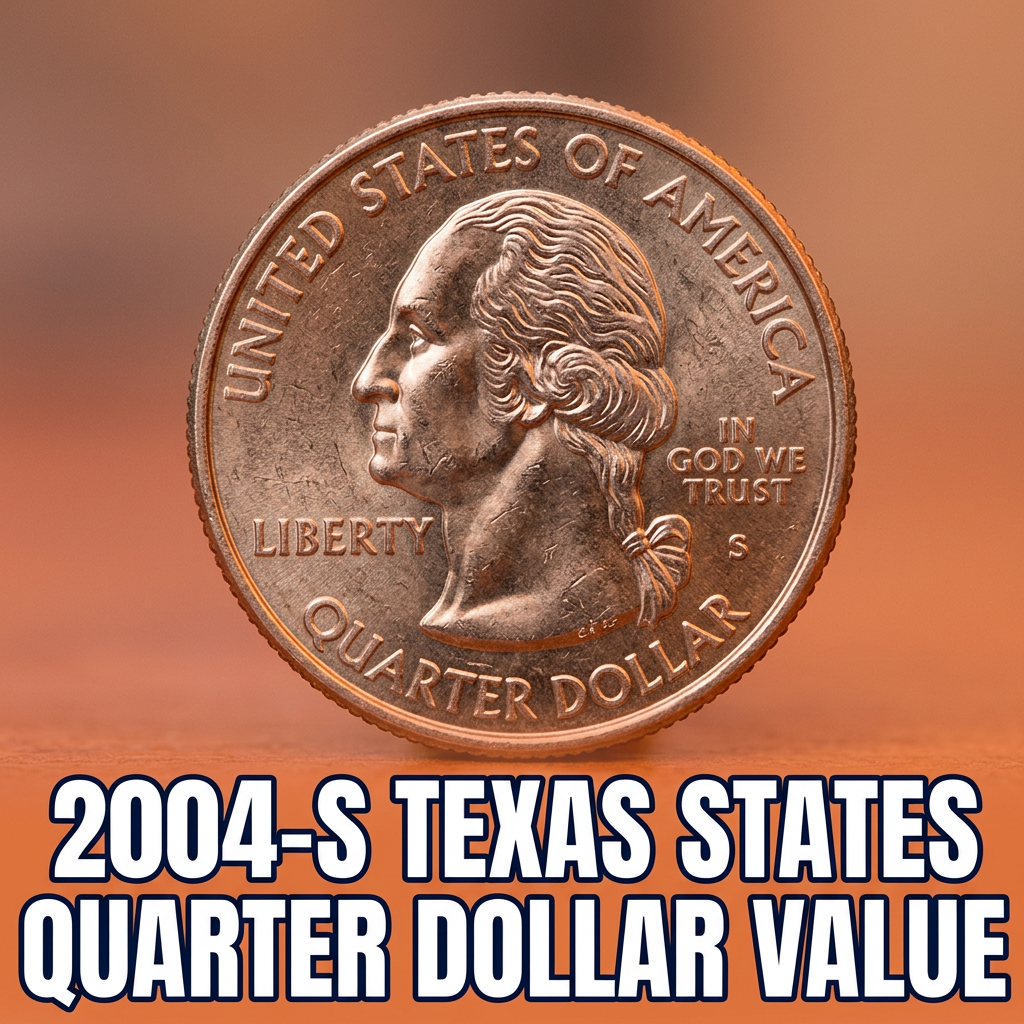
2004 S Texas State Quarter Value and Collecting Guide for Beginners
The 2004-S Texas State Quarter is worth anywhere from $5 in standard proof condition to over $500 for high-grade silver versions. If you have recently discovered one of these “Lone Star” coins in a collection or a mint set, you might be curious if you have found a small fortune.
The Distinct History and Design of the Texas Quarter
The Texas State Quarter was released in 2004 as the 28th coin in the beloved 50 State Quarters Program. This specific design celebrates the “Lone Star State” by featuring a large star superimposed over an outline of the state. A lariat encircles the design, symbolizing the cattle and cowboy history that is so central to Texas identity. While these coins are common in pocket change, the “S” mint mark indicates a special production process specifically for collectors.
Checking your change can be exciting, but identifying specific variations is key to knowing a coin’s true worth. If you are struggling to tell if your coin is a standard strike or a proof, using a free coin identifier app can save you a lot of time and effort. Most 2004 quarters you find in your wallet will have a “P” or “D” mint mark, but the “S” versions were never intended for circulation, making them much more desirable to the average hobbyist.
Before you sell, it is helpful to look at current Texas state quarter auction records to see what buyers are actually paying. Often, the CoinKnow app can help you track these market shifts in real-time. Knowing whether your coin is made of standard copper-nickel or 90% silver is the first step in determining if you have a five-dollar coin or a fifty-dollar coin.
How to Identify the Rare Silver 2004-S Texas Quarter
In 2004, the San Francisco Mint produced two distinct types of “S” mint mark quarters: the Clad Proof and the Silver Proof. The Clad Proof is made of the same copper-nickel composition as your daily change but features a mirror-like finish. The Silver Proof, however, is struck on a planchet of 90% silver and 10% copper. These silver versions are highly sought after because of their precious metal content and lower mintage numbers.
To tell them apart, look at the edge of the coin. If you see a solid silver-colored edge without a copper stripe, you likely have the more valuable silver version. If you see a brown or orange copper stripe, it is a clad proof. Serious collectors often use the CoinKnow app to verify these specialized mintages against historical data. Even a small difference in luster can change the value significantly, especially if the coin is “Deep Cameo,” meaning the frosted design stands out sharply against the shiny background.
Finding a high-grade specimen is the goal for most investors. You can find more detailed 2004 S Texas quarter price data by comparing your coin’s condition to professional grading standards. While most proofs are kept in protective plastic, any scratches or “milky” spots on the surface will lower the value, so handle your Texas quarters with care by the edges only.
2004-S Texas Quarter Price Reference Table
Values for these quarters depend heavily on whether they are clad or silver, and whether they have been professionally graded by a service like PCGS or NGC.
| Coin Type / Grade | Estimated Market Value |
|---|---|
| 2004-S Texas Clad Proof (PR65) | $3.00 – $5.00 |
| 2004-S Texas Clad Proof (PR70 Deep Cameo) | $25.00 – $40.00 |
| 2004-S Texas Silver Proof (PR65) | $12.00 – $18.00 |
| 2004-S Texas Silver Proof (PR70 Deep Cameo) | $45.00 – $90.00 |
| 2004-S Texas Silver Proof (Error or Unique Grade) | $100.00+ |
Are There Any Rare Errors on the 2004-S Texas Quarter?
While the San Francisco Mint is known for high quality control, errors do occasionally slip through. The most common “errors” people look for are doubled dies, where the lettering or the star appears to have a secondary “shadow” image. On the 2004-S Texas Quarter, look closely at the “2004” and the “E Pluribus Unum” text. If the doubling is clear to the naked eye, the value could soar into the hundreds of dollars.
Another rare occurrence is the “off-center” strike or a “clipped planchet,” where the coin is misshapen. However, these are extremely rare for proof coins because they are inspected by humans before being packaged in sets. If you think you’ve spotted something unusual, the CoinKnow app is an excellent resource for comparing your coin to known error catalogs. Remember that most modern quarters found in circulation with “damage” are just worn down, not genuine mint errors.
Collectors also pay a premium for “First Strike” or “Early Release” designations. These are coins that were verified to be among the first batches produced by the mint in 2004. These are almost always found in sealed professional slabs. If you find a loose 2004-S quarter in a “junk bin” at a coin shop, it is still worth a few dollars, which is a 20x return on the face value of 25 cents!
Frequently Asked Questions about Texas Quarters
Q: Does the “S” mean my quarter is made of silver?
A: Not necessarily. The “S” mint mark stands for San Francisco, which produced both copper-nickel (clad) proofs and 90% silver proofs. You must check the weight or the edge of the coin to be sure.
Q: How much is a circulating 2004 Texas quarter worth?
A: If it has a “P” or “D” mint mark and has been used in stores, it is generally only worth its face value of 25 cents. However, if it is in perfect, uncirculated condition, it might be worth $1 to $3.
Q: Where is the best place to sell my 2004-S Texas Quarter?
A: For common clad proofs, local coin shops or eBay are your best bets. For high-grade silver proofs or certified PR70 coins, specialized numismatic auctions will help you get the highest price.
