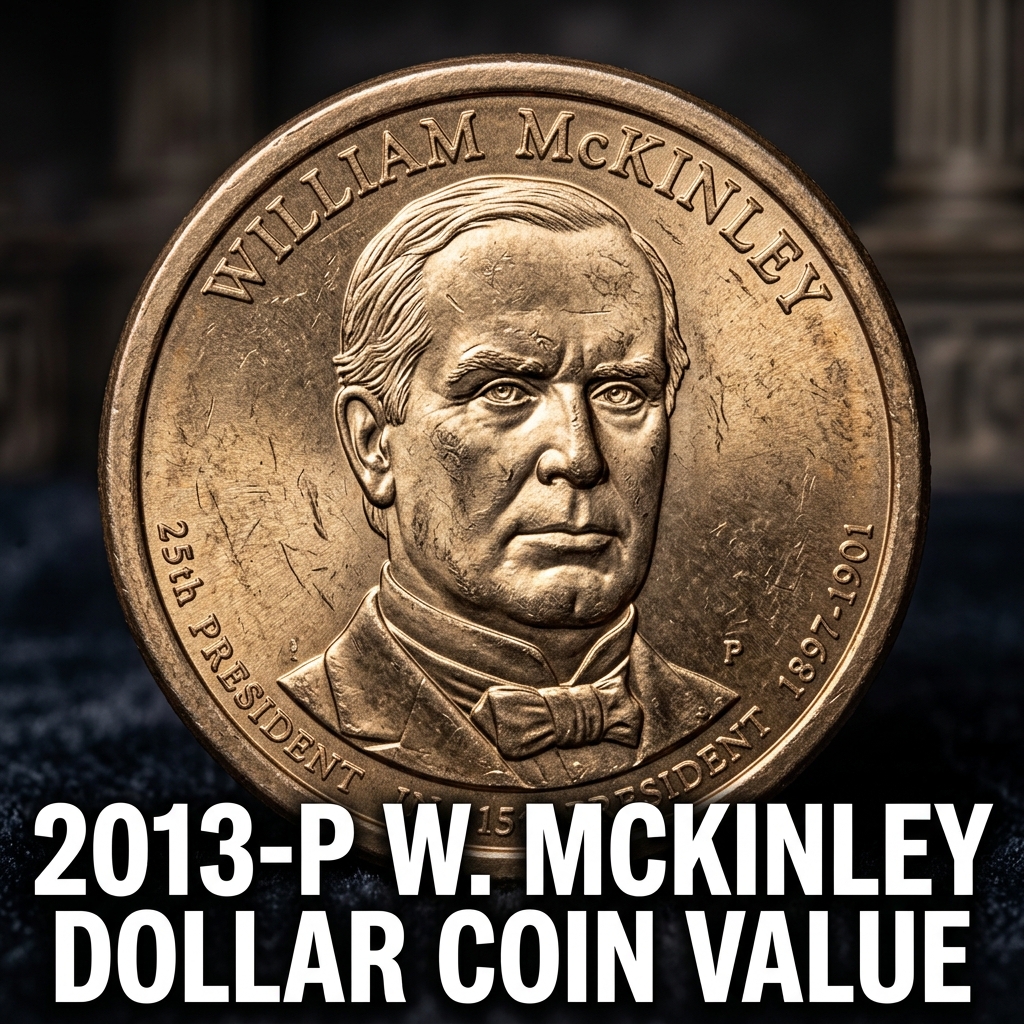
2013 P William McKinley Presidential Dollar Value and Identification Guide
The 2013-P William McKinley Dollar coin is worth anywhere from its face value of $1 in circulated condition to over $50 in high-grade uncirculated condition. If you have found one of these golden-colored coins in your pocket change or a desk drawer, you are likely curious if it is a hidden treasure or just a standard buck.
History of the 2013 P William McKinley Presidential Dollar
William McKinley was the 25th President of the United States, and his legacy was honored as part of the Presidential $1 Coin Program. By the time 2013 arrived, the United States Mint had actually stopped producing these coins for general circulation because of a massive surplus in government vaults. This means that unlike the Quarters or Dimes you use at the store, the 2013-P McKinley Dollar was primarily minted for collectors.
If you want to quickly identify whether your coin has specific mint errors or high-grade characteristics, using a free coin identifier app can save you hours of research. Because these coins were sold in rolls and bags directly to hobbyists rather than released into banks, they are slightly harder to find than the earlier James Madison or George Washington versions.
The “P” mint mark on this coin indicates it was produced at the Philadelphia Mint. While millions were still made, the limited distribution makes them a fun “hunt” for everyday Americans who stumble upon them. If you aren’t sure what you have, the CoinKnow app can help you compare your coin’s luster and strike quality against known examples.
Understanding the Grade and Value of Your McKinley Coin
When determining how much your coin is worth, “condition” is the most important factor. Coin collectors use a 70-point scale to grade coins. Most McKinley dollars found in the wild will be in “About Uncirculated” or “Low Mint State” condition. Because these coins weren’t bounced around in vending machines as much as other denominations, they often retain their “golden” shine quite well.
Professional collectors look for “MS” (Mint State) grades. A 2013-P McKinley dollar in MS65 is a common collector item, but once you reach MS67 or MS68, the price climbs significantly. You can check the current market trends for 2013-P dollar auction results to see how much premium specimens are selling for today.
Common blemishes that lower the value include “bag marks”—small nicks caused by coins hitting each other in the mint bags—and tarnish. If your coin looks brand new with no scratches, it might be worth sending in for professional grading. For a quick estimate on the go, the CoinKnow app is a fantastic resource for checking current price lists and market demand.
| Condition / Grade | Estimated Value (USD) |
|---|---|
| Circulated (Average Wear) | $1.00 |
| Uncirculated (MS63) | $2.00 – $4.00 |
| Choice Uncirculated (MS65) | $5.00 – $12.00 |
| Gem Uncirculated (MS67+) | $45.00+ |
What to Look for on the Edge of the Coin
One of the most unique features of the Presidential Dollar series is the “Edge-Incused Inscriptions.” Instead of the date and mint mark being on the face of the coin, they are stamped into the side (the edge). This is where you will find the year “2013,” the mint mark “P,” and the motto “E Pluribus Unum.”
Some collectors specifically look for “Position A” or “Position B” variations. This simply refers to which way the edge lettering is oriented when the President’s face is up. While this doesn’t usually add massive value, it is a key detail in documenting comprehensive 2013 dollar value data.
The edge is also where error hunters find the most excitement. “Missing edge lettering” is a famous error in this series, where the coin goes through the striking process but misses the lettering machine. If you find a 2013-P McKinley dollar with a completely smooth edge, you could be looking at a coin worth hundreds of dollars. The CoinKnow app can help you identify these rare striking errors with its visual database.
Presidential Series Design and Composition
The obverse (front) of the coin features a dignified portrait of William McKinley, designed by Phebe Hemphill. The reverse features a striking image of the Statue of Liberty, designed by Don Everhart. It is a common misconception that these coins contain real gold. In reality, they are made of a copper core with a manganese-brass cladding, which gives them that distinct yellow hue.
Because the manganese-brass alloy tarnishes easily when exposed to skin oils, the value of your 2013-P McKinley dollar is highly dependent on its “eye appeal.” A coin that has turned a dark, brownish color is generally only worth a dollar. However, if it has maintained its original luster, it remains a pillar of many modern coin collections.
Understanding the “mintage” is also helpful. About 4.48 million McKinley dollars were struck in Philadelphia in 2013. While that sounds like a lot, it is a tiny fraction of the billions of pennies and quarters made every year. This scarcity is what keeps the value of even “common” uncirculated examples slightly above their face value.
Q: Is the 2013-P McKinley Dollar made of gold?
A: No, it contains no gold. It is composed of 88.5% copper, 6% zinc, 3.5% manganese, and 2% nickel.
Q: Where can I find the mint mark on my 2013 dollar?
A: The mint mark “P” is located on the edge of the coin, not on the front or back surfaces.
Q: Can I spend a 2013-P McKinley Dollar at a store?
A: Yes, it is legal tender worth exactly one dollar, though most people prefer to keep them as collectibles since they were not intended for general circulation.
