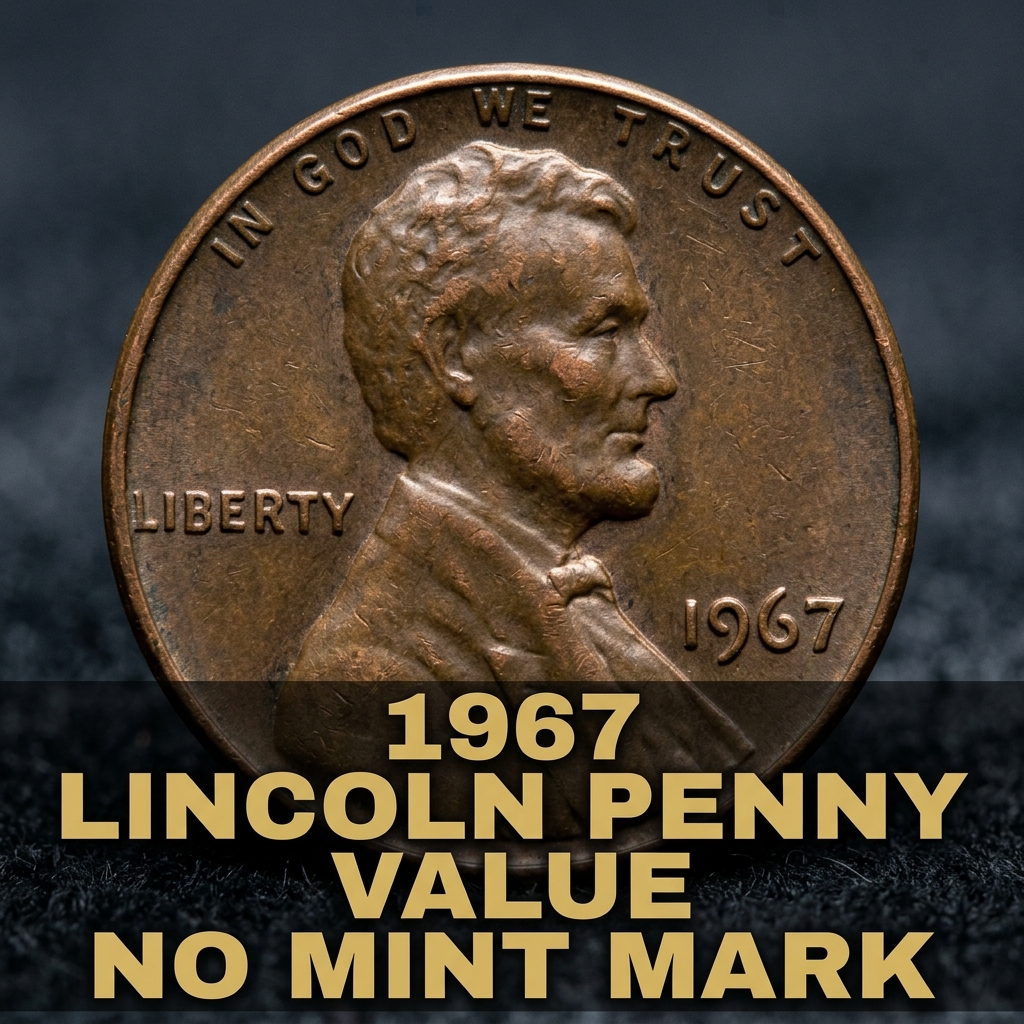
1967 Lincoln Penny Value No Mint Mark and How Much They Are Worth Today
The 1967 Lincoln Penny is worth anywhere from its face value of $0.01 in worn condition to over $1,500 for rare high-grade specimens. If you have found one of these copper coins in your pocket change, don’t spend it just yet—understanding its grade and strike quality is the key to discovering its true market price.
Why There Is No Mint Mark on the 1967 Penny
If you are looking for a small letter “D” or “S” under the date on your coin and can’t find one, don’t worry—your coin isn’t a mint error. During the mid-1960s, the United States was facing a coin shortage. To discourage coin collecting and keep money in circulation, the U.S. Mint decided to remove all mint marks from 1965 to 1967. This means that whether your penny was struck in Philadelphia, Denver, or San Francisco, they all look identical. This unique era in numismatic history makes identifying the value a bit harder for beginners. To get an instant answer on your specific coin’s condition, using a free coin identifier app is a great way to start your journey. Many hobbyists also use the CoinKnow app to keep track of their growing collections and identify subtle variations that the naked eye might miss.
Grading and the 1967 Lincoln Penny Value
The value of a 1967 Lincoln Penny is heavily dependent on its “grade,” which refers to the amount of wear and tear on the surface. Most pennies you find in your spare change jar are “Circulated,” meaning they have been handled by thousands of people and have lost their original orange-red luster. These are generally only worth their weight in copper (about 2 cents). However, “Uncirculated” coins—those that look like they just came from the bank—can be worth significantly more. Collectors look for the “Red” (RD) designation, which indicates the coin still has 95% of its original copper color. You can check the current market trends for a 1967 Lincoln Penny in Mint State Red condition to see how much these pristine examples sell for at auction. Using CoinKnow can help you compare your coin against high-resolution images of graded specimens to see where yours fits on the scale.
| Condition / Grade | Estimated Market Value |
|---|---|
| Circulated (Average Wear) | $0.02 – $0.05 |
| About Uncirculated (AU58) | $0.15 – $0.50 |
| Uncirculated (MS63 Red Brown) | $1.00 – $5.00 |
| Choice Uncirculated (MS65 Red) | $15.00 – $30.00 |
| Superb Gem Uncirculated (MS67 Red) | $150.00 – $450.00+ |
Special Mint Sets and Rare Errors
While no “Proof” sets were made in 1967, the Mint produced “Special Mint Sets” (SMS). These coins were struck with higher pressure on polished blanks, giving them a much sharper detail and a satin-like finish. An SMS 1967 penny can be worth $5 to $50 depending on how “Cameo” (the contrast between the portrait and the background) it appears. Beyond the standard strikes, collectors hunt for error coins. The most common errors for this year include “Doubled Dies,” where the doubling is visible in the lettering or the date, and “Off-Center” strikes, where the image is not centered on the copper planchet. If you think you’ve stumbled upon a rarity, reviewing a comprehensive 1967 penny price guide will help you determine if your error is a valuable find or just common damage.
How to Maximize the Profit of Your 1967 Penny
If you believe you have a high-grade 1967 penny, the most important rule is: do not clean it! Cleaning a coin with chemicals or even a soft cloth can leave microscopic scratches that destroy its numismatic value instantly. Instead, handle the coin by its edges and place it in a protective cardboard flip or a plastic holder. For everyday Americans, the dream is finding that one-in-a-million coin that fetches thousands at an auction house like Heritage Auctions. While most 1967 pennies are common, the high copper content (95% copper, 5% zinc) means they are always worth at least double their face value just for the metal content alone. For a deeper dive into the world of coin hunting, the CoinKnow app provides educational resources to help you spot the difference between a regular penny and a treasure.
Frequently Asked Questions about the 1967 Lincoln Penny
Q: Does a 1967 penny have any silver in it?
A: No, the 1967 Lincoln Penny is composed of 95% copper and 5% zinc. The U.S. Mint did not use silver for pennies; silver was reserved for dimes, quarters, and half dollars (and even then, silver was being phased out of those coins in 1967).
Q: Is a 1967 penny with no mint mark a rare error?
A: No, it is completely normal. The U.S. Mint intentionally omitted mint marks from all pennies struck in 1965, 1966, and 1967 to discourage collectors from hoarding coins during a national coin shortage.
Q: How can I tell if my 1967 penny is an SMS (Special Mint Set) coin?
A: SMS pennies have a much higher quality strike than regular pennies. They feature sharp, crisp details on Lincoln’s hair and the columns of the Lincoln Memorial. They also possess a smooth, satin-like finish rather than the grainy texture found on most pocket change.
