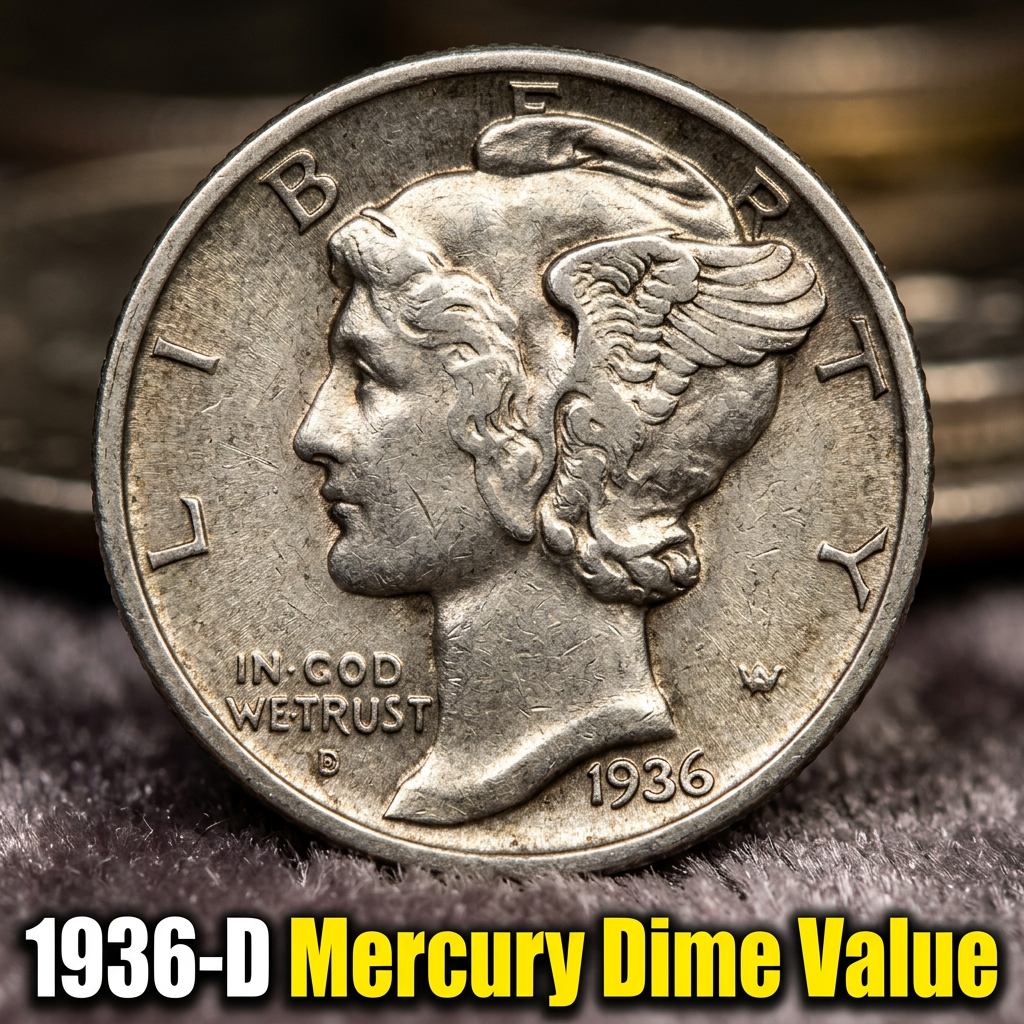
1936 D Mercury Dime Value and Complete Pricing Guide for Collectors
The 1936-D Mercury Dime is worth anywhere from $4 in worn condition to over $600 in high-end mint state grades. These beautiful silver coins, officially known as Winged Liberty Head dimes, are a favorite among hobbyists because they contain 90% pure silver and represent a classic era of American coinage history.
The History and Silver Content of the 1936-D Mercury Dime
If you just discovered a thin silver coin with a winged head in an old jar, you are holding a piece of Art Deco history. Designed by Adolph A. Weinman, the Mercury Dime was minted between 1916 and 1945. Contrary to its popular nickname, the figure on the front is actually Liberty wearing a winged cap to symbolize freedom of thought—not the Roman god Mercury.
The “D” on your 1936 dime signifies that it was struck at the Denver Mint. In 1936, the Denver Mint produced 16,132,000 of these dimes, which is a relatively healthy mintage. However, because these coins were used heavily in daily commerce during the Great Depression, finding one in perfect, uncirculated condition is challenging today.
Before digging into the specific numismatic value, remember that every 1936-D dime has “melt value.” Since they are 90% silver, they are always worth a premium over their 10-cent face value. To get an instant identification of your coin from a photo, you can use a free coin identifier app to check its basic features. For more advanced features, the CoinKnow app can help you organize your collection and track silver spot prices.
How to Determine the Condition and Grade of Your 1936 Dime
The most important factor in determining the price of your 1936-D dime is its physical condition, or “grade.” Professional graders use a 70-point scale. A coin that has been carried in pockets for years will be “Circulated,” while a coin that looks like it just came from the bank is “Uncirculated” or “Mint State.”
When looking at your coin, check the vertical lines on the back (the fasces). In “Good” condition, the lines will be mostly worn away. In “Fine” condition, the horizontal bands holding the sticks together will be visible but flat. If you are lucky enough to find a coin with “Full Bands” (FB), where the horizontal straps are perfectly separated and rounded, the value skyrockets.
Determining the exact grade can be tricky for beginners. Many people find that using the CoinKnow app allows them to compare their coin against high-resolution images to see where it lands on the grading scale. Accurate grading is the key to knowing if you have a common $5 silver coin or a rare treasure worth hundreds. You can check the current 1936-D Mercury Dime auction prices for high-grade specimens to see how much condition impacts the final sale price.
Detailed Price Chart for the 1936-D Mercury Dime
The following table provides an estimate of what collectors are currently paying for 1936-D Mercury Dimes across various grades. Keep in mind that market prices fluctuate based on the price of silver and collector demand.
| Condition Grade | Estimated Market Value |
|---|---|
| Good (G-4) | $3.50 – $4.50 |
| Fine (F-12) | $6.00 – $8.00 |
| Extremely Fine (EF-40) | $15.00 – $22.00 |
| About Uncirculated (AU-50) | $25.00 – $35.00 |
| Mint State (MS-63) | $55.00 – $75.00 |
| Mint State (MS-65 Red/Full Bands) | $150.00 – $600.00+ |
Identifying the 1936-D Mint Mark and Rare Variations
To confirm you have the Denver variety, you need to find the “D” mint mark. Flip your dime to the reverse side (the back). Look at the bottom left, near the rim, just to the left of the base of the fasces (the bundle of sticks). If you see a small “D,” it was made in Denver. If the area is blank, it was made in Philadelphia, and an “S” means San Francisco.
While the 1936-D is not the rarest date in the series, it is highly sought after in “Full Band” condition. This refers to the horizontal lines that hold the bundle of rods together on the back. If these lines are fully separated with no blending, the coin is considered a premium strike. You can find more 1936 Mercury Dime value details and variations by researching specialized pricing guides.
If you are unsure whether your coin has “Full Bands,” the CoinKnow app’s scanning technology can help identify these minute details that the naked eye might miss. Collectors will often pay double or triple the standard price for a 1936-D that exhibits these sharp details.
Final Tips for Storing and Selling Your Old Dimes
Once you’ve identified that your 1936-D Mercury Dime has value, you must handle it with care. Never clean your coins! Even a soft cloth can leave microscopic scratches that professional graders will notice, which can cut the coin’s value by 50% or more. Patina or “tarnish” is often preferred by collectors as it proves the coin’s age.
Store your dimes in PVC-free flips or cardboard holders to prevent environmental damage. When you are ready to sell, check recent sold listings on eBay or visit a local reputable coin shop. Having a digital record of your collection in the CoinKnow app makes it much easier to show potential buyers what you have without constantly handling the physical metal.
Q: Where is the mint mark on a 1936 Mercury Dime?
A: The mint mark is located on the reverse side of the coin, at the bottom left near the rim, positioned to the left of the bundle of sticks (fasces).
Q: Is a 1936-D dime made of real silver?
A: Yes, all Mercury Dimes minted in 1936 are composed of 90% silver and 10% copper. They contain approximately 0.07234 troy ounces of pure silver.
Q: How much is a 1936-D dime worth if it’s very worn?
A: Even in very worn condition, a 1936-D dime is typically worth at least its silver melt value, which usually stays between $2 and $4 depending on current market rates.
