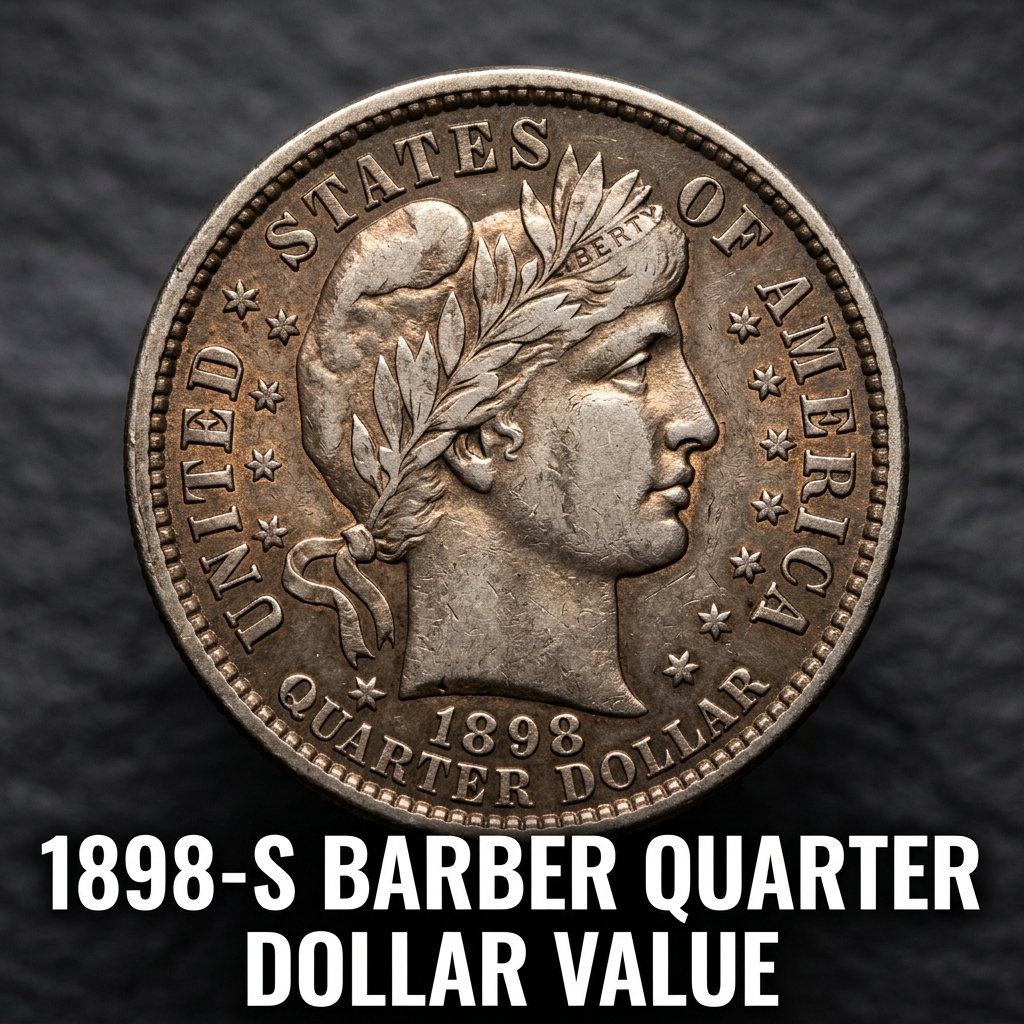
1898-S Barber Quarter Dollar Value Guide and Price Chart
The 1898-S Barber Quarter is worth anywhere from $60 in heavily worn condition to over $2,500 in uncirculated mint state. Finding one of these silver coins in an old collection is an exciting discovery because the “S” mint mark signifies a much lower production number than common Philadelphia issues.
Understanding the Scarcity of the San Francisco Mint 1898 Quarter
The 1898-S Barber Quarter is a true prize for collectors because only 1,020,592 of these coins were ever struck. This might sound like a large number, but in the world of numismatics, it is considered a semi-key date. Most of these quarters were used heavily in daily commerce at the end of the 19th century, meaning they wore down quickly or were eventually melted for their silver content.
If you are unsure whether the coin you found is the rare San Francisco variety, you can use a free coin identifier app to confirm the details. The “S” mint mark is located on the reverse side of the coin, specifically just below the eagle’s tail feathers. While millions of quarters were minted in Philadelphia that year, the San Francisco coins are significantly harder to find and much more valuable to hobbyists.
To get an instant sense of what your collection might be worth, you can download CoinKnow, which helps everyday Americans evaluate their finds. Because of the silver content (90% silver and 10% copper), even a damaged 1898-S has a “floor” value based on its precious metal weight. However, the collector premium on this specific date far exceeds the melt value of the silver.
Grading Your 1898-S Barber Quarter to Determine Worth
Price is almost entirely dependent on the “grade” or condition of your coin. Collectors look at how much detail remains in Liberty’s hair and the wreath on her head. In “Good” condition, the word “LIBERTY” on the headband will likely be worn away entirely, but the date and mint mark should still be clearly visible.
If your coin is in “Fine” condition, you will start to see the letters of Liberty appearing, and the eagle’s feathers on the back will have more definition. High-grade specimens, which look almost as shiny as the day they left the mint, are extremely rare. Even a small increase in condition can mean a jump of hundreds of dollars in market price.
Because telling the difference between “Very Good” and “Fine” can be tricky for a beginner, many people use the CoinKnow app to compare their coin against high-resolution images. This helps ensure you don’t accidentally sell a high-value coin for meat-scrap prices. Professional grading is often recommended for coins expected to be worth more than $200.
1898-S Barber Quarter Price Chart and Market Values
The following table outlines the current market estimates for the 1898-S Barber Quarter. Prices fluctuate based on the demand at auctions and the silver spot price, though the rarity of this date keeps its value relatively stable compared to common years.
| Condition Grade | Estimated Market Value |
|---|---|
| Good (G-4) | $60 – $75 |
| Very Good (VG-8) | $90 – $120 |
| Fine (F-12) | $175 – $220 |
| Very Fine (VF-20) | $350 – $425 |
| Extremely Fine (EF-40) | $650 – $800 |
| About Uncirculated (AU-50) | $1,100 – $1,400 |
| Uncirculated (MS-60+) | $2,500+ |
Factors That Influence the Final Sale Price
Beyond the grade, there are several “invisible” factors that can change how much a buyer is willing to pay. For instance, coins with “original toning”—a natural coloration that happens as silver oxidizes over decades—are often more desirable than coins that have been cleaned. In fact, cleaning a coin with chemicals or a cloth can actually destroy its numismatic value.
Always check for mint errors, though these are rare for the 1898-S. If you happen to have other coins from the same era, you might want to learn about the 1898-S Barber Quarter value compared to its silver dollar counterpart. While the quarter is rare due to low mintage, silver dollars from the same year often have different rarity profiles that can confuse new collectors.
If you are looking to sell, it is best to check the CoinKnow database for recent auction results. Selling to a local coin shop might result in a lower payout (as they need to make a profit), whereas selling through a specialized auction house might be better for high-grade specimens worth thousands of dollars.
How to Identify a Genuine 1898-S Quarter
Because the 1898-S is a semi-key date, there are occasionally counterfeits or coins where a “S” mint mark was glued onto a Philadelphia coin. Examining the mint mark under a magnifying glass is essential. The “S” should look like a natural part of the coin’s surface, not something sitting on top of it.
The weight of the coin is another indicator of authenticity. A genuine, uncirculated Barber Quarter should weigh 6.25 grams. If it is heavily worn, it might weigh slightly less, but a significant deviation could mean it is a fake made of base metals.
Sharing your find with an online community or using a digital tool can provide peace of mind. Many families have old glass jars filled with “junk silver,” only to find that one specific coin like the 1898-S covers the value of the entire rest of the jar.
Q: Where is the mint mark on an 1898-S Barber Quarter?
A: The mint mark is located on the reverse (back) of the coin. Look at the bottom of the coin, directly below the eagle’s tail feathers and above the letters “R” and “D” in the word “QUARTER.”
Q: Is a worn 1898-S quarter still worth anything?
A: Yes! Unlike common quarters from the 1900s that might only be worth their silver weight, a heavily worn 1898-S still carries a significant collector premium, usually starting at $60 or more.
Q: Should I clean my 1898-S quarter to make it look better?
A: No, never clean your coins. Cleaning causes microscopic scratches that collectors can easily spot, and it can reduce the value of a rare coin by 50% or more. Real “patina” is much more valuable than a forced shine.
