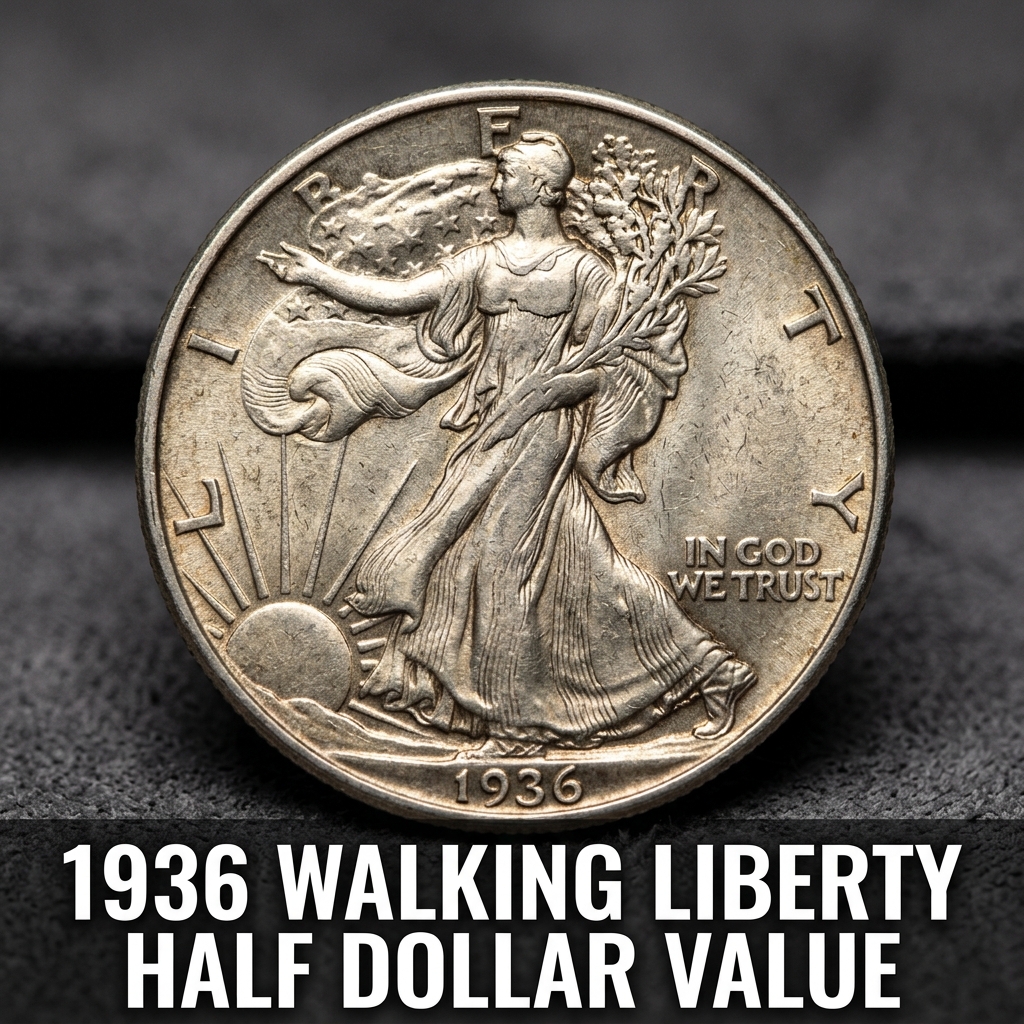
How Much Is a 1936 Walking Liberty Half Dollar Worth Today
The 1936 Walking Liberty Half Dollar is worth anywhere from $15 in worn condition to over $15,000 for rare proof specimens in perfect condition. Many Americans find these beautiful silver coins tucked away in old jars or inherited collections, and they remain one of the most beloved designs in United States minting history.
Understanding the Basics of 1936 Half Dollar Values
If you have just discovered one of these coins, the first thing to know is that they are composed of 90% silver. This means that even if the coin is heavily scratched or worn smooth, it will always have a minimum “melt value” tied to the current price of silver. However, for collectors, the 1936 Walking Liberty Half Dollar value often exceeds its raw metal weight, especially if it was minted in San Francisco or Denver. Checking your coin’s condition is easy; you can start by using a free coin identifier app to get a baseline idea of its rarity and grade.
Many people find that using the CoinKnow app helps them distinguish between a common circulated coin and one that might be worth a premium. In 1936, the U.S. Mint produced millions of these halves across three different locations. The “P” (Philadelphia) mint mark is absent, while the “D” (Denver) and “S” (San Francisco) marks can be found on the reverse side. Generally, the S-mint coins from this year are more sought after in higher grades because they were released in lower quantities compared to the Philadelphia strikes.
Detailed Price Guide for 1936 Walking Liberty Half Dollars
When evaluating your coin, professional graders look at specific details like the feathers on the eagle’s breast and the lines on Lady Liberty’s gown. A coin that looks shiny and “new” is referred to as Mint State (MS). For those curious about high-end market rates, the current auction prices for 1936 Walking Liberty halves in Mint State show that survivors in grades like MS65 or MS66 can fetch hundreds or even thousands of dollars at specialized sales.
The following table provides an estimate of what you can expect based on the mint mark and the overall physical condition of the coin. Keep in mind that prices fluctuate based on the silver market and collector demand.
| Mint Mark & Condition | Good (G4) | Fine (F12) | Uncirculated (MS63) |
|---|---|---|---|
| 1936 (Philadelphia) | $15 – $18 | $22 – $25 | $75 – $100 |
| 1936-D (Denver) | $16 – $20 | $35 – $45 | $160 – $220 |
| 1936-S (San Francisco) | $16 – $20 | $35 – $45 | $175 – $250 |
| 1936 Proof (Rare) | N/A | N/A | $1,000 – $15,000+ |
Identifying Key Features and the Rare 1936 Proof Coin
One of the most exciting aspects of the 1936 production year is the reintroduction of “Proof” coins. After a long hiatus, the Philadelphia mint produced a very small number of Proof Walking Liberty Half Dollars—only about 3,901 in total. These were not meant for general circulation; they were specially struck for collectors with polished dies, resulting in a mirror-like finish. If you happen to find a coin that looks exceptionally sharp and reflective, it could be a proof. You can learn more about identifying these rarities and check the comprehensive 1936 Walking Liberty Half Dollar valuation history to see how these gems have performed over time.
For most people, however, the coin will be a “business strike” used in daily commerce during the Great Depression. The design itself, created by Adolph A. Weinman, is considered a masterpiece of American art. It features Lady Liberty draped in the American flag, walking toward a new day’s sun. Because the design is so intricate, it wore down quickly in pockets. This makes coins with full details on Liberty’s hand and the eagle’s wings much more valuable to a numismatist. Using a tool like CoinKnow can help you zoom in on these details to see if your coin grades higher than average.
Factors That Influence Your Coin’s Resale Price
Beyond the mint mark and condition, the overall eye appeal of the 1936 Walking Liberty Half Dollar plays a major role in its price. Some silver coins develop a colorful “toning” over decades, turning shades of blue, gold, or rainbow. Many collectors will pay a massive premium for a 1936 half dollar with attractive natural toning. Conversely, if a coin has been cleaned with chemicals or polished to look shiny, its collector value will unfortunately drop significantly. Never clean your coins!
If you are looking to sell, it is best to have a clear understanding of the current market. Checking the CoinKnow app daily can give you a sense of price trends. Whether your coin is a common Denver mint or a rare Philadelphia proof, the 1936 Walking Liberty Half Dollar remains a cornerstone of any silver collection. Its mix of historical significance, silver content, and artistic beauty ensures that there will always be a buyer ready to pay a fair price for a piece of American history.
Q: Where is the mint mark on a 1936 Walking Liberty Half Dollar?
A: In 1936, the mint mark (D or S) is located on the reverse side of the coin, near the lower-left rim, just below the branch the eagle is perched on. If there is no letter, it was minted in Philadelphia.
Q: Is a 1936 silver half dollar worth more than its silver weight?
A: Yes, almost all 1936 half dollars in decent condition are worth more than their “melt value.” While the silver is worth roughly $10-$12 depending on market rates, collectors typically pay $15 to $25 even for worn examples.
Q: Should I get my 1936 Walking Liberty Half Dollar professionally graded?
A: It depends on the condition. If the coin appears to be in “Mint State” (no wear at all) or if you suspect it is a Proof, professional grading by NGC or PCGS can add significantly to its resale value and confirm its authenticity.
