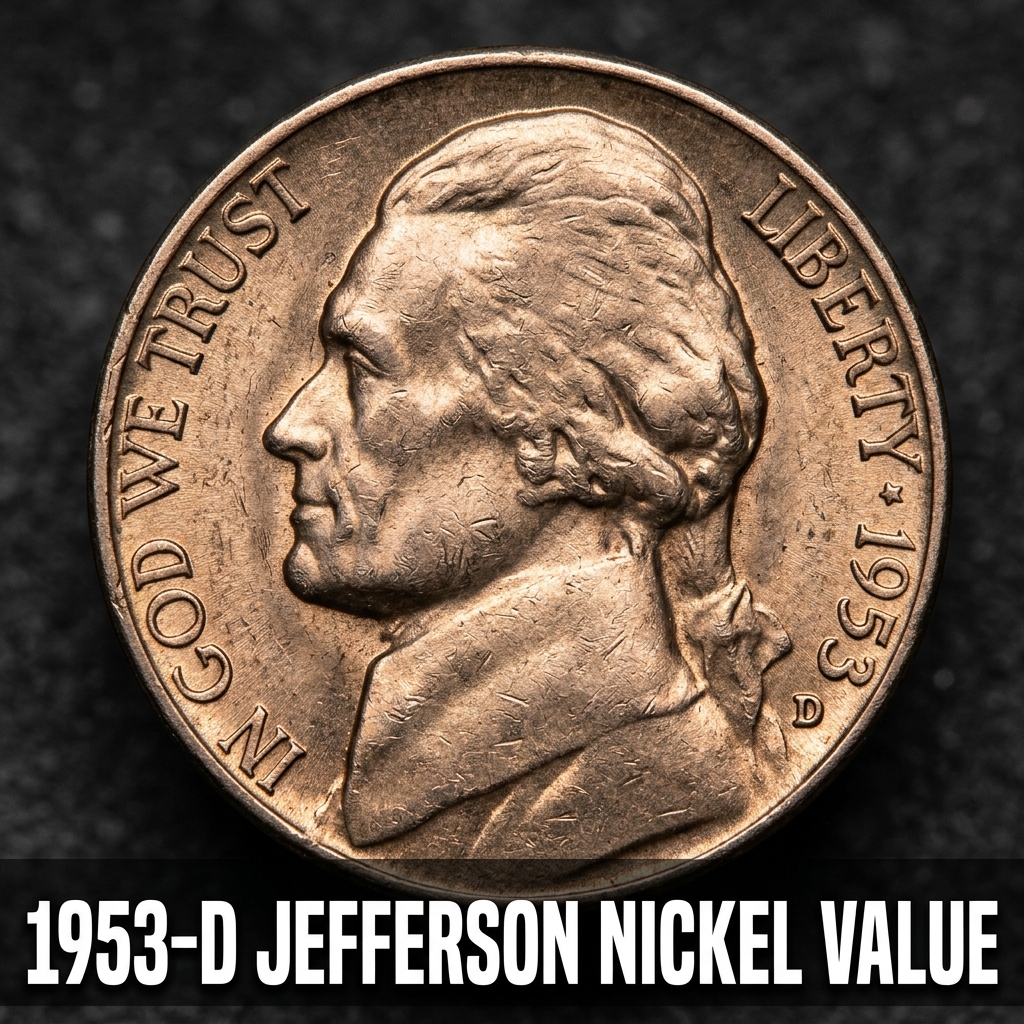
How Much Is Your 1953 D Jefferson Nickel Value Today
The 1953-D Jefferson Nickel is worth anywhere from $0.10 in worn condition to over $150 in high-grade mint state. Most of these coins found in pocket change carry a modest premium, but certain rare “Full Steps” versions can command prices reaching into the thousands of dollars.
Historical Context of the 1953 Deniver Nickel
The year 1953 was a productive one for the Denver Mint, which was responsible for striking nearly 60 million Jefferson Nickels. Marked with a distinct “D” on the reverse side, located to the right of Monticello, these coins were the workhorses of post-war American commerce. While the 1940s saw many silver “war nickels,” the 1953-D is composed of the standard 75% copper and 25% nickel alloy. If you have recently discovered one of these in an old jar, using a free coin identifier app is an excellent way to confirm the date and mint mark before researching its current market worth.
In the early 1950s, the United States was experiencing economic growth, and the demand for small coinage was high. Because of the high mintage numbers, the 1953-D is not considered a rare date by collectors. However, finding one in truly pristine, uncirculated condition is becoming increasingly difficult as more of these coins have been worn down by decades of circulation. You can check the current CoinKnow market trends to see how the demand for early 50s nickels has changed over the last few years.
Detailed 1953-D Jefferson Nickel Value Chart
When determining the price of your nickel, collectors look at the “Grade.” A coin that looks like it just came from the bank will always be worth significantly more than one that is scratched or dull. The following table provides an estimate of what you can expect based on professional grading standards.
| Condition / Grade | Estimated Market Value |
|---|---|
| Good (G-4) to Fine (F-12) | $0.05 – $0.15 |
| Extremely Fine (XF-45) | $0.25 – $0.50 |
| About Uncirculated (AU-50) | $0.75 – $1.50 |
| Mint State (MS-63) | $5.00 – $12.00 |
| Mint State (MS-65 Gem) | $25.00 – $45.00 |
| MS-66 with Full Steps (FS) | $200.00+ |
Identifying the Rare Full Steps Variation
The “holy grail” for Jefferson Nickel hunters is the “Full Steps” (FS) designation. On the reverse of the coin, Thomas Jefferson’s home, Monticello, has a set of steps leading to the entrance. Because the dies used in 1953 were often worn out, these steps are usually blurry or blended together. A coin that shows 5 or 6 clearly defined, horizontal steps is exceptionally rare.
For those looking for high-end investment pieces, the 1953-D Jefferson Nickel MS prices for Full Steps coins can soar into the four-figure range at major auctions. If you think your coin has these sharp details, it is worth getting a high-resolution photo and uploading it to the CoinKnow app to get a second opinion from the community. Even a small amount of wear on those steps will disqualify the coin from the FS premium, so a magnifying glass is your best friend.
Common Errors and What to Look For
Beyond the standard grade, error collectors often seek out specific mistakes made during the minting process. For the 1953 Denver nickel, common errors include “Die Cracks” and “Lamination Errors.” A die crack appears as a thin, raised line of metal where the steel stamp cracked during production. While these don’t always add huge value, they make the coin a unique piece of history.
Another interesting area to explore is the 1953 Jefferson Nickel worth and historical data regarding re-punched mint marks. Occasionally, the “D” would be stamped twice, creating a slight shadow or doubling effect. While the 1953-D isn’t as famous for this as other years, a verified D over D (D/D) mint mark can double or triple the value of an otherwise standard coin. Always keep your eyes peeled for anything that looks “off” about the lettering or the portrait of Jefferson.
Is Your 1953-D Nickel Worth Grading?
Most 1953-D nickels found in circulation are “pocket change” quality. This means they are worth about five to ten cents—mostly as a curiosity for beginners. However, if you find a coin that has orignal mint luster (appears shiny or “white” rather than grey) and has no visible scratches, it might be worth professional preservation.
Generally, it only makes sense to pay for professional grading (from companies like PCGS or NGC) if the coin is expected to be worth more than $100. For the 1953-D, this usually means it must be in MS-66 condition or better. You can use CoinKnow to compare your coin’s appearance to museum-quality specimens to determine if it’s worth the investment. For most folks, placing the coin in a simple cardboard 2×2 holder is plenty of protection for a nice family heirloom.
Q: Where is the mint mark on a 1953-D Jefferson Nickel?
A: The “D” mint mark is located on the reverse side (the back) of the coin, to the right of the building (Monticello), between the building and the rim.
Q: Is the 1953-D nickel made of silver?
A: No, the 1953-D nickel is made of a base metal alloy consisting of 75% copper and 25% nickel. Silver “War Nickels” were only produced from 1942 to 1945.
Q: What is the highest price ever paid for a 1953-D nickel?
A: Highly graded specimens with the Full Steps designation have sold for over $5,000 at specialized numismatic auctions, though these are extremely rare.
