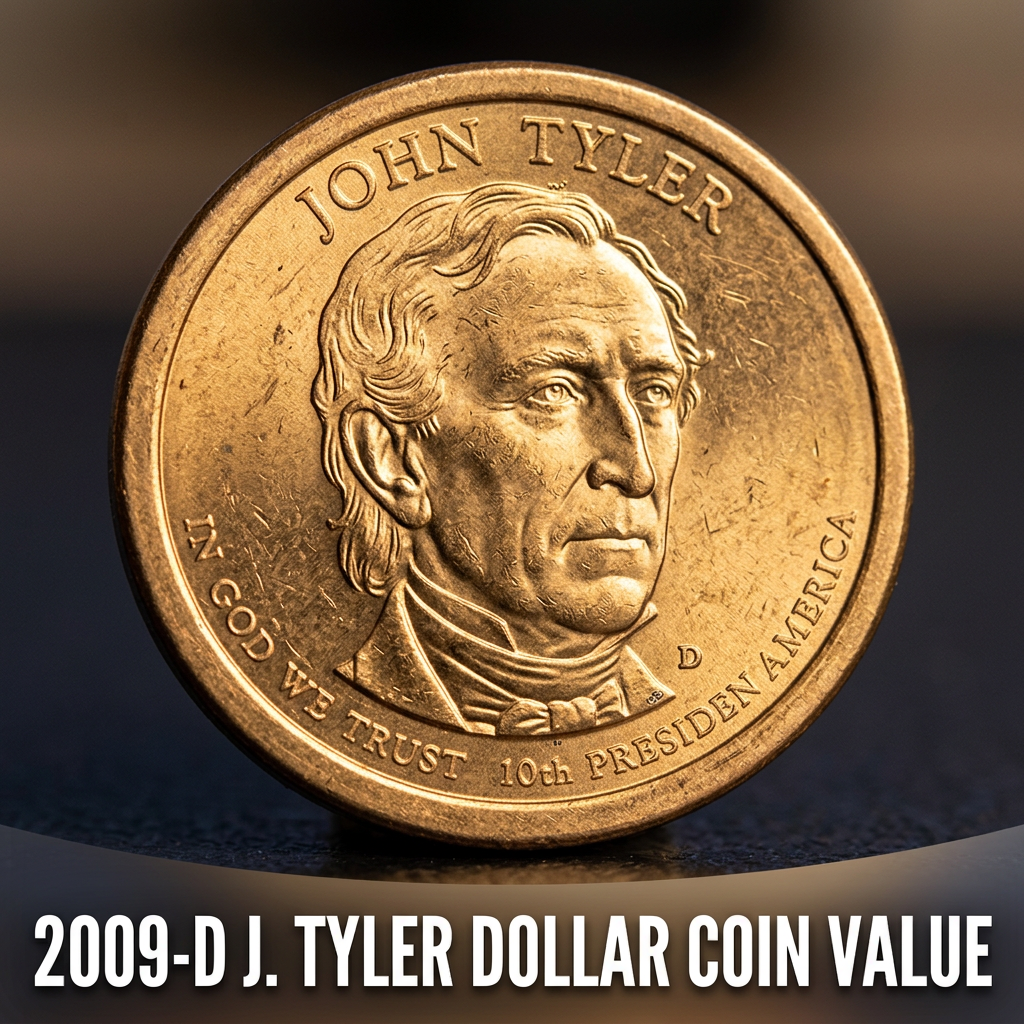
How Much Is Your 2009 D John Tyler Dollar Coin Worth Today
The 2009 D John Tyler Dollar Coin is worth anywhere from $1.05 in circulated condition to over $45 in high-grade uncirculated condition. If you have recently discovered one of these golden-colored coins in your change or an old jar, you are likely wondering if you have found a hidden treasure or just a simple dollar.
History and Design of the 2009 D John Tyler Dollar
The John Tyler dollar was released in 2009 as part of the Presidential $1 Coin Program, which honored each U.S. President in the order they served. Tyler was the 10th President of the United States, and his coin was the second release of the 2009 series. The “D” mint mark indicates that these coins were struck at the Denver Mint. While these coins have a distinct golden luster, they are not made of real gold; instead, they consist of a copper core with a manganese brass cladding.
If you are unsure whether you have a John Tyler dollar or another president, you can use a free coin identifier app to instantly recognize the portrait and minting year. Many Americans find these coins fascinating because they feature “incuse” edge lettering. Unlike most coins where the date and mint mark are on the face, the John Tyler dollar has the date, mint mark, and the motto “E Pluribus Unum” engraved along the thin edge of the coin.
Using the CoinKnow app can help you examine these edge inscriptions more closely. This feature was unique to the Presidential series and sometimes leads to rare “error” coins where the lettering is missing entirely, though such errors are less common for the 2009 Denver issues than for earlier years in the program.
Determining the Value of Your John Tyler Dollar
For most people, a 2009 D John Tyler dollar found in pocket change will only be worth its face value of $1.00. Because the U.S. Mint produced over 43 million of these coins in Denver alone, they are not considered rare in the traditional sense. However, the value climbs significantly when the coin is in “Mint State” (MS), meaning it has never been spent and still carries its original satin-like shine without any scratches or wear.
Collectors often look for coins that have received high grades from professional services like PCGS or NGC. A coin graded MS65 or higher can fetch a premium from enthusiasts looking to complete their sets. You can check current market trends and see how professional grading affects the market value for 2009 dollar coins in top-tier condition. Even a small difference in surface quality can mean the difference between a $2 coin and a $20 coin.
To get a better idea of what your specific coin might be worth before spending money on professional grading, the CoinKnow mobile tool offers a quick way to compare your coin against high-resolution images of known grades. This helps everyday collectors avoid overestimating the value of common “circulated” examples.
Current Price Guide for 2009 D John Tyler Dollars
To help you understand what your coin might sell for on the open market or at a local coin shop, we have compiled a price chart based on recent auction data and collector demand. Note that “Circulated” refers to coins found in daily change, while “Uncirculated” refers to coins kept in rolls or protective holders.
| Condition / Grade | Estimated Market Value |
|---|---|
| Circulated (Average Wear) | $1.00 – $1.25 |
| About Uncirculated (AU) | $1.50 – $2.25 |
| Uncirculated (MS63) | $3.00 – $5.00 |
| Choice Uncirculated (MS65) | $10.00 – $15.00 |
| Gem Uncirculated (MS67+) | $45.00 – $100.00+ |
If you want to explore more details about how these prices compare to other presidents released that same year, you can view the complete 2009 presidential dollar price guide to see if your John Tyler coin is one of the more valuable dates.
What to Look for: Errors and Special Features
While the 2009 D John Tyler dollar is generally a common coin, collectors are always on the hunt for “Planchet Errors” or “Edge Lettering Errors.” In some cases, the machinery that stamps the words into the edge of the coin fails, resulting in a “Plain Edge” dollar. While this was a major story for the 2007 Washington dollars, it is much rarer for 2009 coins. If you find one with a completely smooth edge, it could be worth hundreds of dollars.
Another thing to keep in mind is the “D” mint mark itself. This means it was minted in Denver and is generally valued similarly to the Philadelphia “P” mint mark. However, in some years, one mint produces far fewer coins than the other, creating a “key date.” For John Tyler, the production numbers were relatively balanced, making the condition of the metal much more important than the mint mark itself.
Before you take your coin to a dealer, try using CoinKnow. The app’s advanced recognition features can help you spot minor doubling on the letters or potential strike errors that the naked eye might miss. Identifying these small details is the primary way that a standard $1 coin becomes an expensive collector’s item.
Frequently Asked Questions about the John Tyler Dollar
Q: Is the 2009 D John Tyler dollar made of real gold?
A: No, the coin is composed of 88.5% copper, 6% zinc, 3.5% manganese, and 2% nickel. Its golden color comes from the manganese brass coating, but it contains no actual gold bullion.
Q: Where can I find the date and mint mark on my 2009 John Tyler coin?
A: Unlike most U.S. coins, the date (“2009”) and the mint mark (“D” or “P”) are inscribed on the edge of the coin. You must turn the coin on its side to see this information.
Q: Should I clean my coin to make it worth more?
A: Never clean your coins! Cleaning a coin with chemicals or cloths can create micro-scratches that significantly reduce its value to collectors. It is always better to keep a coin in its natural state, even if it looks a bit dull or dirty.
