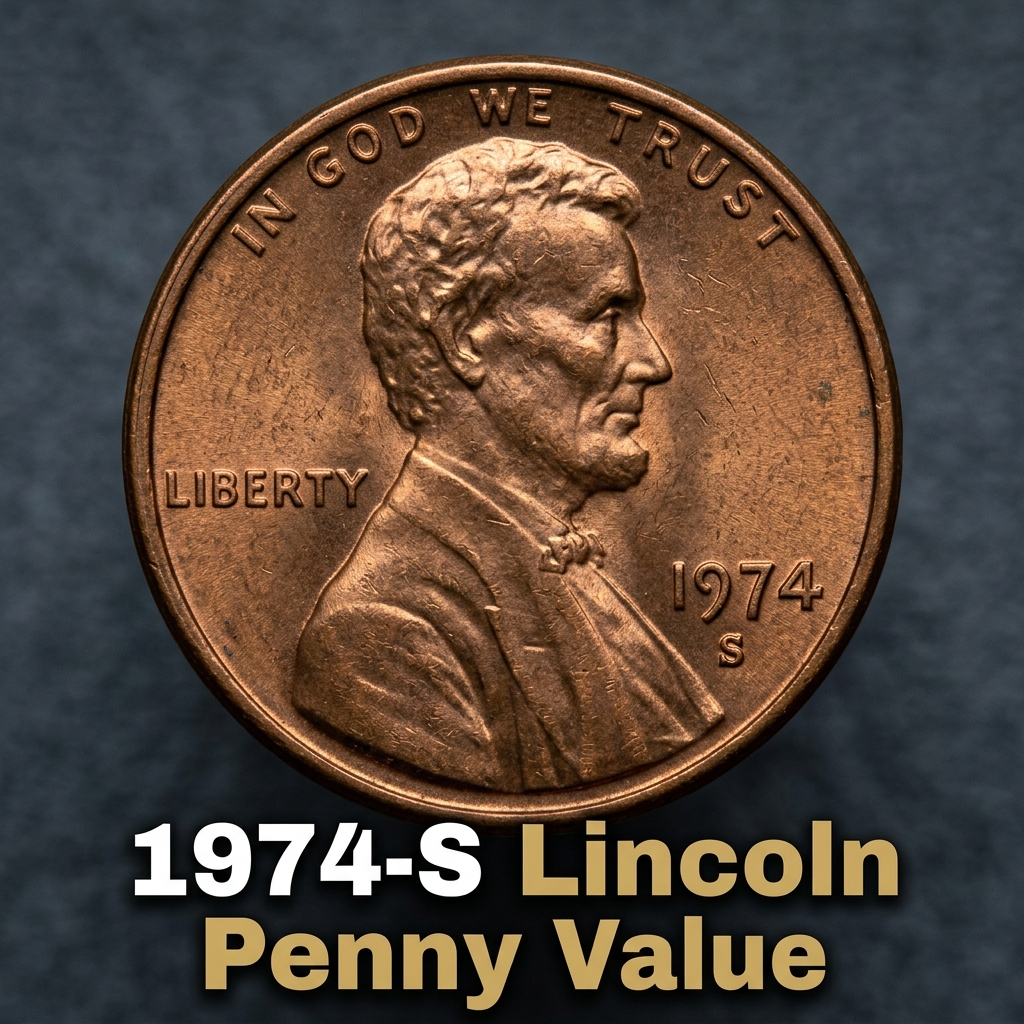
1974 S Lincoln Penny Value Guide and Collector Insights
The 1974-S Lincoln Penny is worth anywhere from its face value of $0.01 in worn condition to over $100 for high-grade proof specimens. While most pennies found in change today are common, those minted in San Francisco often carry a premium that piques the interest of casual collectors and experts alike.
Understanding the San Francisco Mint Mark
If you have looked closely at your 1974 penny and noticed a small “S” below the date, you have found a coin minted in San Francisco. By the mid-1970s, the San Francisco Mint was transitionally producing both circulating coins and special proof sets for collectors. This dual role makes the 1974-S particularly interesting because it was the last year the “S” mint mark appeared on business-strike Lincoln cents intended for regular pocket change.
For a quick and accurate way to identify your finds, you can use a free coin identifier app to check the mint mark and condition instantly. Many people use the CoinKnow app to organize their collections and stay updated on market trends. Knowing whether your coin was intended for circulation or was part of a proof set is the first step in determining if you are holding a common cent or a collector’s item.
Determining the Market Value of 1974 S Pennies
The value of a 1974-S penny depends heavily on its “strike” and “grade.” Business strikes, which were made for general use, are generally worth a few cents unless they are in pristine, uncirculated condition. On the other hand, Proof coins were struck using special polished dies and were sold in sets. These usually have a mirror-like finish and are worth significantly more.
According to current market data, the 1974-S Lincoln Penny price can fluctuate based on the specific color of the copper, with “Red” (RD) versions being the most sought after. If your penny looks like it just came from the mint with a bright orange luster, it is likely a Red variety. You can get a detailed breakdown of the 1974 penny value and history through specialized numismatic databases.
| Condition / Grade | Estimated Value (Business Strike) | Estimated Value (Proof Strike) |
|---|---|---|
| Circulated / Average Wear | $0.01 – $0.05 | N/A |
| Uncirculated (MS-63) | $0.25 – $1.00 | N/A |
| Choice Uncirculated (MS-65 RD) | $2.00 – $10.00 | $3.00 – $12.00 |
| Gem Proof (PR-69 DCAM) | N/A | $25.00 – $150.00+ |
Rare Varieties and High Grade Specimens
While most 1974-S pennies are inexpensive, top-tier specimens set records at auctions. Collectors look for “Deep Cameo” (DCAM) designations on proof coins, where the portrait of Lincoln looks frosted and stands out against a black, mirror-like background. These high-grade proofs are often cataloged in the CoinKnow app by enthusiasts who want to track the appreciation of their investments over time.
Additionally, keep an eye out for “Red” business strikes. Copper coins naturally oxidize and turn brown (BN) or red-brown (RB). A 1974-S penny that has retained its original “Red” color is much rarer in the circulating population. If you find one that looks exceptionally clean, it might be worth having it professionally graded, as high-grade Red examples can sell for dozens or even hundreds of dollars to the right buyer.
Common Errors to Look For
Error hunting is one of the most exciting parts of coin collecting. For the 1974 series, collectors often look for doubled dies, though significant doubled dies for the 1974-S are less common than in other years like 1972 or 1995. However, “repunched mint marks” (RPM) or “off-center strikes” can still be found.
An off-center strike occurs when the coin blank is not properly aligned with the dies. If you find a 1974-S penny where a portion of the design is missing and the blank planchet is visible, you have a valuable error. Using tools like CoinKnow can help you compare your coin against known error types to see if you have discovered something unique that collectors would pay a premium for.
Q: Is a 1974-S penny made of real copper?
A: Yes, all pennies minted in 1974 are composed of 95% copper and 5% zinc/tin. This makes them heavier and more valuable in metal content than pennies made after 1982.
Q: How can I tell if my 1974-S is a proof coin?
A: Proof coins have a much higher level of detail and a shiny, reflective surface. They were not intended for use in vending machines or stores, so they are usually found in plastic protective cases.
Q: Why did the San Francisco Mint stop making pennies for circulation?
A: The mint shifted its focus to producing collector proof sets and supplemental coinage. The 1974-S was the final year that “S” mint mark pennies were widely distributed into general circulation.
