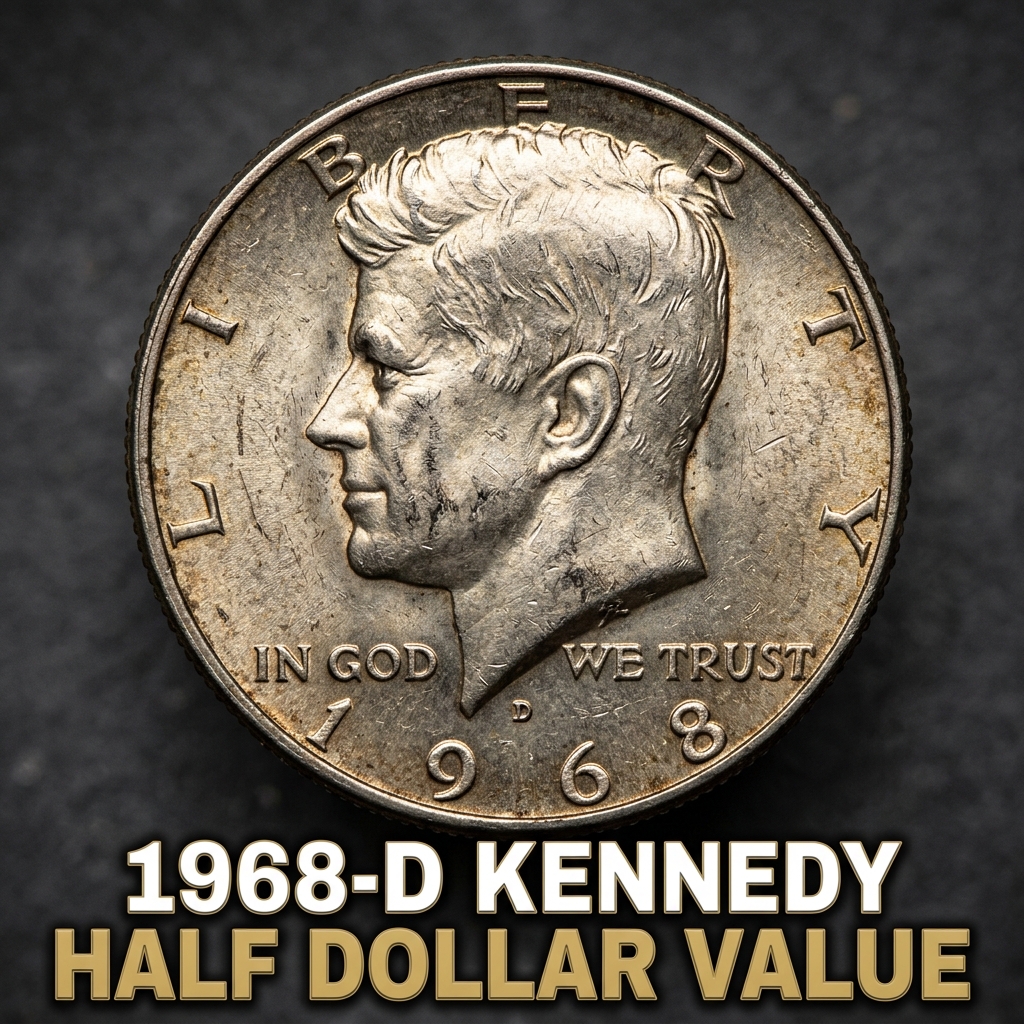
Real Market Value of the 1968-D Kennedy Half Dollar and How to Sell It
The 1968-D Kennedy Half Dollar is worth anywhere from $4 in worn condition to over $1,500 in high-end mint state grades. For most people who find this coin in a jar of change, its value is primarily tied to its 40% silver content rather than extreme rarity.
Understanding the Silver Content and Basic Value
If you just stumbled upon a 1968-D half dollar, the first thing you should know is that it contains real silver. Unlike modern quarters and dimes, half dollars minted between 1965 and 1970 are “silver clad.” This means they have an inner core of 80% copper and 20% silver, with an outer layer of 80% silver. This provides a total silver weight of about 0.1479 troy ounces per coin. Even if the coin is scratched or heavily circulated, it will always be worth its “melt value,” which fluctuates with the precious metals market.
To quickly check the condition of your find, you can use a free coin identifier app to see if your coin has common damage or if it is a high-grade specimen. Most collectors use the CoinKnow app to keep an eye on daily silver prices to know exactly when to sell their silver-clad coins. While millions were minted at the Denver mint, most have been heavily circulated, making clean, shiny examples much more desirable to the average collector.
How to Determine the Grade of Your 1968-D Half Dollar
Grade is the most important factor when moving beyond simple silver value. For the 1968-D, the “D” mint mark is located on the reverse side, just above the “L” in “HALF.” A coin in “About Uncirculated” condition will show slight wear on Kennedy’s cheekbone and the feathers of the eagle’s breast. If the coin looks as though it just came from the bank with no visible wear, it is likely in “Mint State” (MS).
The 1968-D Kennedy Half Dollar MS price guide shows a significant jump in value once a coin reaches MS65 or higher. In these top-tier grades, the strike is sharp and the luster is booming. For everyday hunters, finding a coin in a mint set or an original bank roll is the best way to secure a high-grade piece. If you are unsure about the grade, the CoinKnow app can provide side-by-side comparisons to help you categorize your coin’s condition before you take it to a dealer.
Current Market Price Chart for 1968-D Half Dollars
The following table outlines what you can expect to receive for a 1968-D Kennedy Half Dollar based on its condition. Keep in mind that “Melt Value” is the baseline price when silver is around $25-$30 per ounce.
| Condition / Grade | Estimated Market Value |
|---|---|
| Circulated (Average Wear) | $4.00 – $5.50 (Melt Value) |
| About Uncirculated (AU58) | $7.00 – $10.00 |
| Mint State (MS63) | $12.00 – $18.00 |
| Choice Mint State (MS65) | $35.00 – $55.00 |
| Gem Mint State (MS67+) | $500.00 – $1,500.00+ |
Key Varieties and Errors to Look For
While most 1968-D halves are standard issues, some enthusiasts look for specific minting errors that can skyrocket the price. Look for “doubled die” errors, where the lettering or the dates appear slightly blurred or doubled. Another rare occurrence is a coin struck on the wrong planchet. Since 1964 was the last year of 90% silver coins, there are very rare instances of 1968 coins being accidentally struck on leftover 90% silver blanks.
To verify these details, check the comprehensive 1968 Kennedy half dollar value analysis which details specific auction records for error coins. Using the CoinKnow app allows you to upload high-resolution photos of your coin to identify these subtle “die doubling” marks that are invisible to the naked eye. If you find a verified error, you could be looking at a coin worth hundreds of dollars regardless of the silver content.
Where to Sell Your Kennedy Half Dollars
Once you’ve identified your coin’s value, you have several options for selling. If your coin is in average circulated condition, a local coin shop or a precious metals buyer is your best bet; they will usually pay slightly under the silver melt price. For high-grade or error coins, consider online marketplaces like eBay or professional auction houses like Heritage Auctions to reach collectors willing to pay a premium.
Always remember: never clean your coins. Wiping a 1968-D half dollar with a cloth or using chemicals can strip away the natural “cartwheel” luster and significantly reduce its numismatic value. Store your coins in individual PVC-free flips or capsules to prevent scratches. By preserving the coin’s original state, you ensure that you get the maximum return for your investment when you finally decide to trade or sell.
Q: Is every 1968 half dollar made of silver?
A: Yes, all 1968 Kennedy Half Dollars (both from the Philadelphia and Denver mints) are “silver clad,” containing 40% silver. They do not contain 90% silver like the bits from 1964 and earlier.
Q: Does the “D” on the 1968 half dollar make it more valuable?
A: Not necessarily. The “D” stands for the Denver Mint, which produced over 247 million of these coins. It is very common, so value is driven more by the coin’s physical condition than the mint mark itself.
Q: How can I tell if my 1968-D half dollar is a proof?
A: In 1968, Proof coins were only minted in San Francisco and bear an “S” mint mark. If your coin has a “D,” it is a business strike intended for circulation, even if it looks very shiny.
