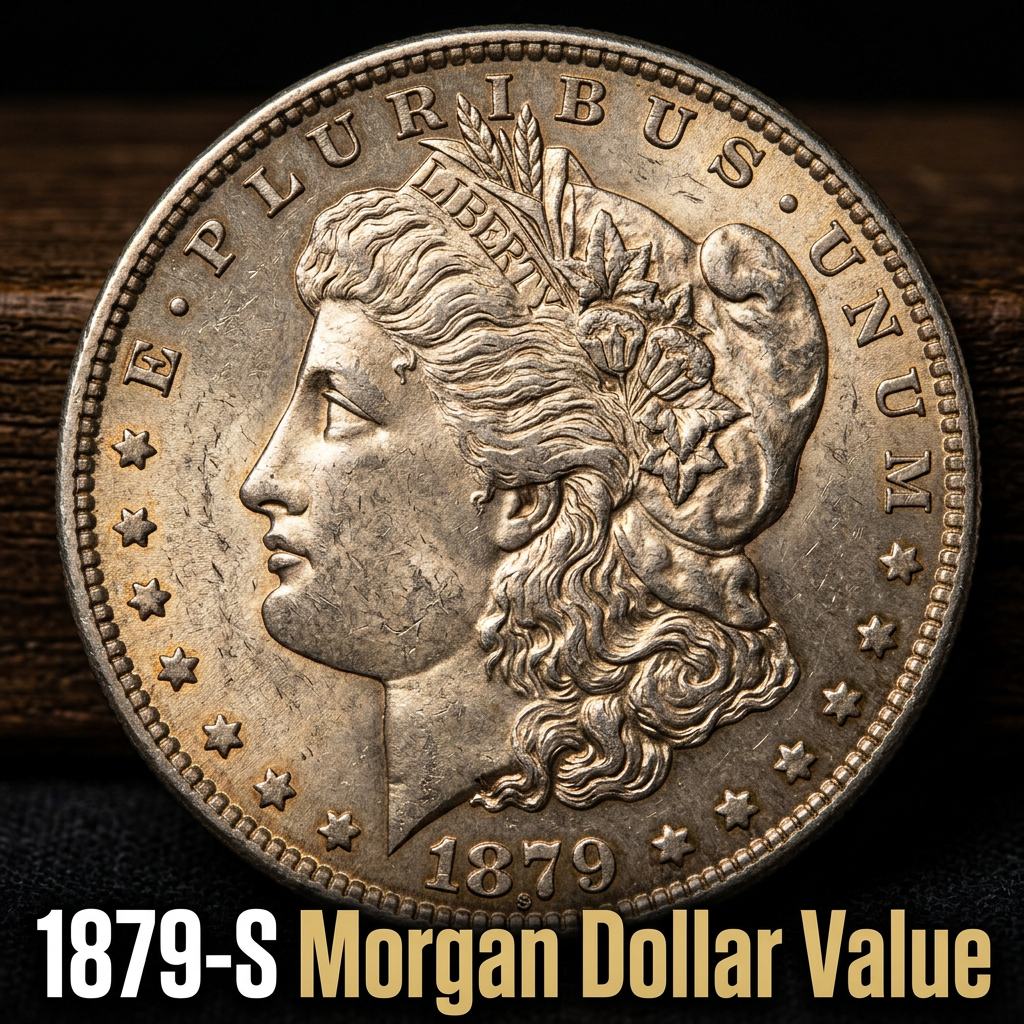
1879 S Morgan Silver Dollar Value and Rarity Guide for Collectors
The 1879-S Morgan Dollar is worth anywhere from $35 in worn condition to over $15,000 for rare high-grade specimens. Finding one of these heavy silver treasures in an old drawer is an exciting moment for any American, as the “S” mint mark represents a piece of San Francisco’s rich mining history.
Current Market Value of the 1879-S Morgan Dollar
If you have just discovered an old silver coin, the first thing you want to know is its market price. Most 1879-S Morgan Dollars found in everyday collections are in “Circulated” condition. This means they were used in daily commerce over a century ago. Even in a heavily worn state, these coins are highly sought after because they contain 90% pure silver. You can use a free coin identifier app to quickly check the grade of your coin from home.
For a more precise estimate of what collectors are paying right now, you should look at the latest 1879-S Morgan Dollar auction prices. While a common circulated coin might sell for $35 to $60, a coin that looks like it just stepped out of the mint can command hundreds or even thousands of dollars. The 1879-S is particularly famous among collectors for its “Proof-Like” qualities, meaning the fields are shiny and mirror-like even though it was intended for circulation. CoinKnow suggests keeping your coin in a protective sleeve to prevent any further scratches which could lower this value.
| Condition / Grade | Estimated Value |
|---|---|
| Good (G-4) to Very Good (VG-8) | $35 – $45 |
| Fine (F-12) to Very Fine (VF-20) | $48 – $55 |
| Extremely Fine (EF-40) | $60 – $75 |
| About Uncirculated (AU-50) | $80 – $95 |
| Mint State (MS-63) | $140 – $180 |
| Gem Mint State (MS-65+) | $350 – $15,000+ |
Identifying the S Mint Mark and Its History
The 1879-S silver dollar was struck at the San Francisco Mint, which was known for its superior craftsmanship during the late 19th century. To find the mint mark, look at the reverse (the “tails” side) of the coin. Right above the letters “D” and “O” in the word “DOLLAR,” you should see a small “S.” If the space is blank, it was minted in Philadelphia.
The San Francisco Mint produced over 9 million of these coins in 1879. While that sounds like a lot, many were melted down over the years for their silver content, making the surviving ones quite valuable. When you research the 1879 silver dollar price trends, you will notice that the “S” mint mark coins are often in better condition than those from other cities. This is because the San Francisco Mint used higher striking pressure, resulting in sharper details on Lady Liberty’s hair and the eagle’s feathers.
Factors That Increase the 1879-S Value
Not all 1879-S dollars are created equal. The most important factor in determining the price is the “grade” or condition. A coin that has no visible wear from being in a pocket will always be worth a premium. Professional collectors look for “luster,” which is the frosty sheen that appears on the surface of a fresh coin. If your coin still has that original glow, it might be worth getting it professionally appraised.
Another factor is the presence of “Proof-Like” (PL) or “Deep Mirror Proof-Like” (DMPL) surfaces. Because the dies used in San Francisco were so well-polished, some early strikes look almost like mirrors. These specific varieties can sell for ten times the price of a standard 1879-S. Using an app like CoinKnow can help you identify these subtle visual markers that the untrained eye might miss. Never try to clean your coin to make it look “shinier,” as this destroys the numismatic value instantly.
Key Varieties and Errors to Watch For
While the standard 1879-S is a beautiful coin, there are also “die varieties” that can make a single dollar worth a fortune. One famous variety is the 1879-S “Reverse of 1878” (also known as the Second Reverse). You can identify this by looking at the eagle’s breast; if it is flat and the top feather on the arrow flight is parallel, you have a rarer variety that collectors crave.
There are also minor errors like doubled dies or “cuds” where the metal didn’t fill the mold correctly. If you notice anything unusual about the lettering or the date, it is worth a closer look. The CoinKnow app features a database of these known errors to help you compare your find with confirmed rare versions. Even a small imperfection from the minting process can transform a $50 coin into a $500 treasure.
Q: How can I tell if my 1879-S Morgan Dollar is real?
A: Genuine Morgan dollars are made of 90% silver and should weigh approximately 26.73 grams. A common test is to use a magnet; silver is not magnetic, so if your coin sticks to a magnet, it is a fake.
Q: Is it worth getting my 1879-S Morgan Dollar graded?
A: It depends on the condition. If the coin looks brand new (uncirculated) with very few scratches, grading by a service like PCGS or NGC can significantly increase its resale value. If it is heavily worn, the grading fees might cost more than the coin is worth.
Q: Where is the best place to sell my 1879-S silver dollar?
A: For common circulated coins, a local reputable coin shop is the easiest option. For high-value or uncirculated coins, online auction houses or specialized coin shows will often get you a better price from serious collectors.
